If you are about to commission software, you will be asked to approve a process you have never personally run: a discovery phase, a set of sprints, a QA cycle, a release plan. Knowing what those words cover is what lets you tell a realistic plan from an expensive one, and a team that has done this before from one that is guessing.
Software development is the process of planning, designing, building, testing, deploying, and maintaining software. It runs as repeating cycles rather than one straight pass, and it involves developers, QA engineers, designers, and a product or project manager. The term stretches from a single mobile app to a multi-year enterprise platform.
This guide covers what that process actually looks like, who does what, the methodologies you will hear named, the main types of software being built, what moves the cost, and the engagement models you can buy it under. Redwerk has run this process on 170+ projects since 2005, across custom software product engineering for clients in North America and Western Europe.
What Is Software Development in Practice?
At its core, software development is a loop with six stages: plan, design, build, test, deploy, maintain.
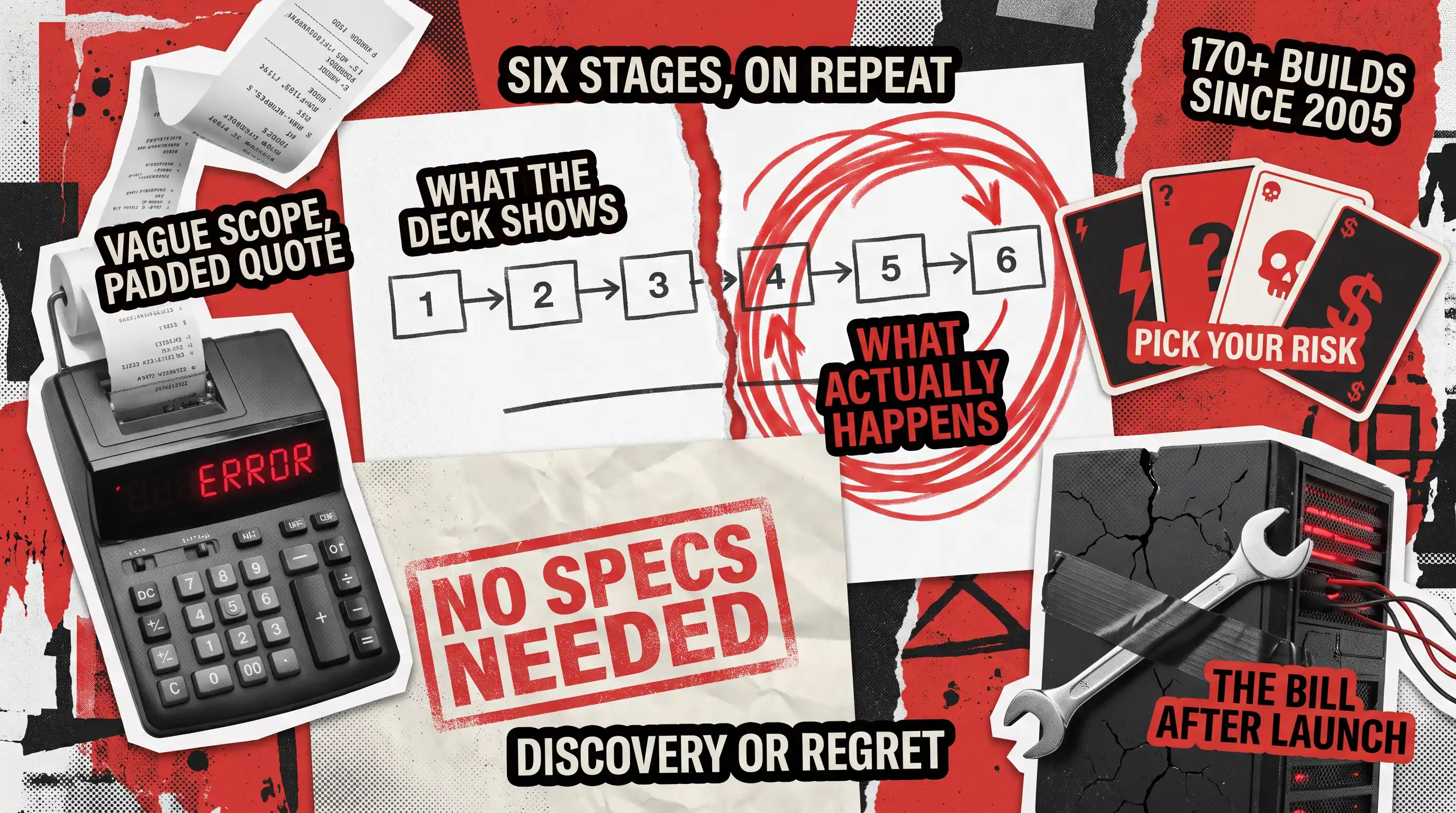
What matters is that it repeats. A team plans a small piece of the product, builds it, learns something that changes the plan, and starts the next round with what they now know.
That is the single most useful thing for a non-technical stakeholder to internalize. When a vendor presents a plan where every phase happens exactly once, in order, with no feedback between them, they are describing a document, not a delivery process.

Who Is Actually Involved
A typical project team has five roles, and you will usually meet all of them:
- Developers write the code. On most projects they split between frontend (what the user sees) and backend (data, logic, integrations).
- QA engineers test the software deliberately and systematically, looking for the ways it breaks before your users find them.
- Designers decide how the product looks and how a user moves through it. On business software this matters more than people expect, because an internal tool nobody can navigate does not get used.
- A product or project manager owns scope, sequence, and the schedule, and is usually your main point of contact.
- A technical account owner, on outsourced work, is the senior person accountable for the engagement overall rather than for one sprint.
The phrase “software developer meaning” gets searched a lot, and the honest answer is that a developer is the person who writes and maintains the code, but shipping working software takes the other four roles too. A team of only developers, with no QA and no one owning scope, is a common and expensive shape of failure.
The Software Development Process, Step by Step
These stages are not evenly weighted. The early ones are cheap to get right and expensive to redo, while the later ones are where visible progress happens and where most of the budget gets spent. How much time a vendor allocates to the first two is a fair signal of how they work.
Discovery and Scoping
This is the step most projects skip and later regret. Discovery is where you establish what the software has to do, who uses it, what it connects to, and what “done” means. It produces a scope you can actually estimate against.
Skipping it does not save money. It moves the cost to a worse place, because the requirements still get discovered, just later, in the middle of the build, when changing direction means throwing away work.
You do not need complete requirements to start. Most clients do not have them. What you need is a structured way to find them, which is what a discovery phase is for, and a written output everyone agrees to, which is what functional specification services produce.
Design and Architecture
Two things happen here. Designers work out the interface and the user flows. Engineers work out the architecture: the stack, the data model, how the system is split into parts, and how it will handle growth.
Architecture decisions are the expensive ones to reverse. Choosing the wrong database shape or coupling two systems that should have stayed separate is a decision you will keep paying for long after launch. A team that has built something similar before already knows where this kind of design tends to break, which is exactly what you are paying them for at this stage.
Build, Test, and Deploy
Modern delivery is iterative. The team builds a working slice of the product, tests it, and puts it somewhere you can click on it, then repeats. You should expect to see something functional within weeks, not at the end.
Testing runs alongside the build rather than after it. QA writes tests as features land, so a bug found on Tuesday costs an hour instead of surfacing three months later, tangled in code that has since been built on top of it.
Deployment is its own discipline. Getting code onto servers reliably, repeatedly, and reversibly is what separates a release you can do on a Thursday afternoon from one that needs a weekend and a rollback plan.
For the phase-by-phase breakdown of the full software development lifecycle, see Redwerk’s guide to SDLC best practices. If you have an existing process and want to know whether it holds up, the SDLC audit checklist is the diagnostic version.
Maintenance and Iteration
Software is not finished when it launches. Dependencies age, security patches land, browsers change, and your business needs things the original scope never imagined. Budgeting for the build and not the maintenance is one of the most reliable ways to end up with an application nobody can safely touch two years later.
Agile, Waterfall, and Hybrid Methodologies Compared
Methodology is how the team organizes the loop. Three shapes cover almost everything you will be offered.
Agile
Short cycles of two to four weeks, each producing working software. Scope adapts as you learn.
Product work where requirements will evolve, and most commercial software
Harder to quote as one fixed number up front, and it needs your input throughout
Waterfall
Phases run in sequence, each signed off before the next begins. Scope is fixed at the start.
Fixed-scope work, regulated environments, projects where the specification is genuinely complete and stable
Change is expensive, and problems surface late because testing comes near the end
Hybrid
Fixed scope and budget at the contract level, agile delivery inside it
Clients who need budget certainty but are building something genuinely new
Requires discipline about what counts as in scope, or it becomes waterfall with sprints
Agile software development is the default for most modern product work, and for good reason. It is not automatically the right answer. If you are building to a regulatory specification that will not change, the ceremony of two-week cycles adds overhead without adding much learning.
The Main Types of Software Development
The word “software” hides a lot of variety, and the type determines the tooling, the team, the timeline, and the constraints.
- Web development builds applications that run in a browser. The most common shape for business software, because there is nothing to install and updates reach everyone at once. Typical stacks include React, Vue.js, Angular, .NET, Django, and PHP.
- Mobile development builds for iOS and Android, either natively (Swift, Kotlin) or cross-platform (Flutter). The constraints are app store review, device fragmentation, and the fact that users will be on a bad connection.
- Desktop development builds software installed on a machine. Still the right answer for heavy local processing, offline work, and deep operating system integration.
- Embedded and IoT development builds software that runs on hardware, where memory is tight, updates are hard to deliver, and a bug can mean a physical device in the field behaving badly.
Custom Software Versus Off the Shelf
Buying an existing product is faster and cheaper, and for a solved problem like payroll or email it is almost always correct. Building custom makes sense when the process you are automating is genuinely specific to how your business works, when the integration burden of stitching several off-the-shelf tools together exceeds the cost of one system that fits, or when the software is the product you sell.
A useful middle path is building the smallest version that proves the idea before committing to the full system. How to build an MVP the right way covers how to scope that so it stays a foundation rather than a throwaway.
What Actually Drives Software Development Costs
Nobody can quote your project from a category name. What they can do is tell you which variables move the number, and these are the ones that matter most:
- Scope clarity. The single biggest factor. A well-specified system gets estimated tightly. A vague one gets padded, because the team is pricing their uncertainty.
- Integrations. Every external system you connect to adds work that is hard to estimate, because you do not control the other end. Three integrations is a different project from zero.
- Compliance and security requirements. Healthcare, finance, and government work carry audit, data-handling, and documentation obligations that are real engineering effort.
- Data migration. Moving years of existing records into a new system, cleanly, is routinely underestimated. Legacy data is messier than anyone remembers.
- Team seniority and composition. Senior engineers cost more per hour and usually less per outcome, because the expensive mistakes are architectural and get made early.
- Design depth. A polished, heavily-used customer-facing interface is a different investment from an internal admin screen used by six people.
- The maintenance tail. Ongoing support, hosting, and updates are a recurring line, not a rounding error on the build.
Want to know where your own project lands? Redwerk gives free estimates. Tell us what you are building, even if the details are still rough, and we will come back with a realistic range and the assumptions behind it.
Engagement Models: How You Buy Software Development
The engagement model decides who carries the risk of things taking longer than expected. That is the whole question, and it is worth understanding before you compare quotes.
Fixed price
One agreed sum for an agreed scope
Well-defined projects with stable requirements and a clear finish line
Every change becomes a negotiation, and the quote carries a risk premium
Time and materials
For hours actually worked
Evolving scope, discovery-heavy work, ongoing product development
Needs trust and real visibility into where the hours go
Dedicated team
A monthly rate for a team working only on your product
Long-running work, filling a capacity or skills gap you cannot hire for
Only pays off over months, not for a short one-off piece of work
Staff augmentation
Per specialist added to your existing team
You have a working team and process and need one specific skill
You still own the management, the architecture, and the outcome
The choice usually follows from how certain your scope is. Fixed price rewards certainty. Time and materials and dedicated teams accommodate the reality that you will learn things during the build.
For a longer treatment of where a dedicated development team fits against the alternatives, see Fractional CTO vs. software development consulting vs. staff augmentation, and for the underlying build-versus-buy-the-team question, in-house vs outsourced software development.
What to Weigh Before Hiring an Outside Team
Outsourcing is not always right, and a vendor who tells you otherwise is selling.
The objection people raise first is knowledge. If an external team builds it, does the understanding leave when the contract ends? That is really a documentation and handover question. A vendor that writes things down, keeps the specification current, and hands over a documented codebase leaves you with more usable institutional knowledge than an in-house team that kept everything in two people’s heads. Ask any vendor what documentation comes with the engagement and who owns it at the end. A vague answer there tells you more than any pitch deck.
Keep it in house when you already have a strong engineering team with spare capacity, since adding an external group creates coordination overhead you do not need.
Think hard before outsourcing if nobody internally can make product decisions. An external team can work without complete requirements, and a good one expects to. What no team can work without is someone on your side empowered to answer questions and make calls. Without that, the project stalls regardless of who is writing the code.
On timelines, AI-assisted development has moved the line. Work that used to take a quarter can land in weeks when the problem is well understood and the code is conventional, and that is now a fair thing to ask a vendor about. What it has not compressed is the time needed to agree what you are building, or to integrate with systems you do not control. For a very short deadline on a common problem, buying an off-the-shelf product and setting it up to fit your process can still be the faster route.
Software Development Terms You Will Hear
Sprint, backlog, technical debt, CI/CD, staging, refactor, API. Vendors use these constantly and rarely stop to define them.
Redwerk maintains a plain-English glossary for exactly this: software development terms, the top 60 worth knowing. It is worth a skim before your first scoping call, because being able to ask “is that in this sprint or the backlog?” changes the conversation.
How Redwerk Runs This Process
Redwerk has been building software since 2005, with 170+ clients across North America and Western Europe. Three things about how we run the process are worth knowing if you are comparing teams.
We start with structured discovery, and we do not require you to arrive with complete requirements. Most clients do not have them. Working out the specification together is part of the job, not a prerequisite for starting it.
We staff for the stack, not just the industry. If your system runs on .NET and Azure, you get engineers who have shipped .NET and Azure systems, which is what makes short onboarding realistic rather than aspirational.
We over-communicate on purpose. The most consistent theme in our client feedback is that they always knew where the project stood. For non-technical stakeholders who depend entirely on the team they hired, that is the difference between a manageable project and an anxious one.
If you are at the beginning of this and want the right scope and approach worked out before anyone writes code, start with software development consulting.
Frequently Asked Questions
What is software development in simple terms?
Software development is the work of planning, building, testing, and maintaining computer programs. It involves a team of developers, testers, designers, and a manager working in repeating cycles, rather than one person writing code from start to finish.
What is the difference between software development and software engineering?
The terms overlap heavily and are often used interchangeably. Software engineering usually implies a stronger emphasis on formal process, architecture, and long-term maintainability, while software development is the broader term covering all the work of creating software.
What are the stages of the software development lifecycle?
The software development lifecycle has six stages: planning, design, development, testing, deployment, and maintenance. In modern practice these repeat in short cycles rather than running once in sequence, so a team revisits planning and design many times across a project.
How long does a software development project take?
It depends mainly on scope and integration complexity. A minimum viable product proving a single core workflow is typically a matter of months, while a full platform with multiple integrations, data migration, and compliance requirements runs considerably longer. A discovery phase is what turns that range into a real schedule.
Do I need complete requirements before hiring a development team?
No. Most clients start without them. A good team runs a structured discovery phase to establish scope collaboratively. What you do need is someone on your side empowered to make product decisions during the build.
Learn how we helped AWE Learning migrate from on-premises to the cloud, and reach users beyond the USA by implementing a scalable SaaS solution