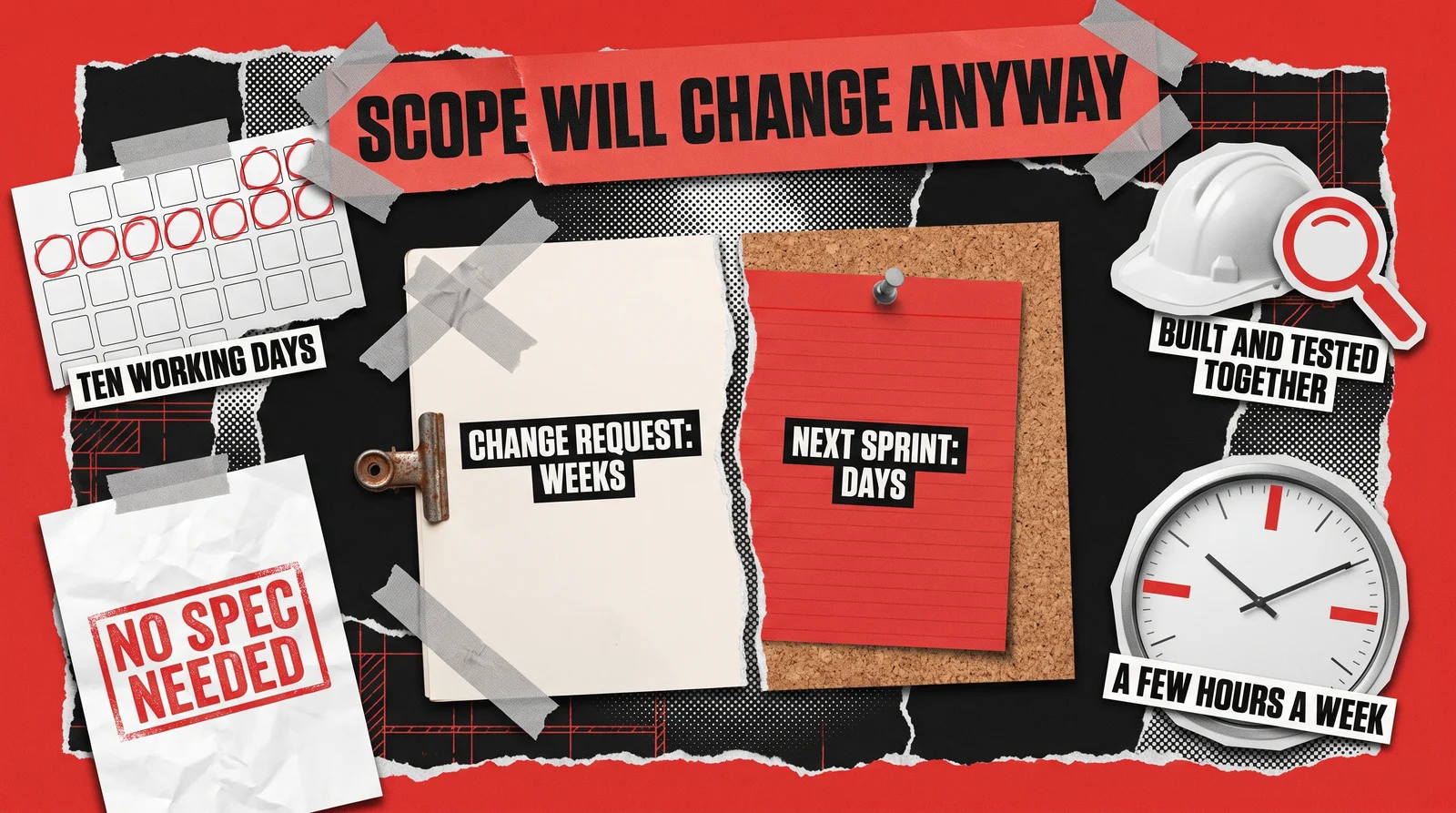
The way your software project runs decides how expensive it is to change your mind later. Agile software development keeps that price low. Under a traditional waterfall plan, a new requirement in month four means a change request and a fresh estimate. In agile, the team adds it to the next two-week block of work. A few meetings and a new sprint plan ensure you get the necessary features or project changes implemented fast, with only minimal disruptions.
Agile software development builds a product in short cycles, usually one to four weeks long. Each cycle ends with something that works and that you can look at, so the plan adapts as you learn. It suits projects whose requirements will move, and it fits badly when scope is locked by contract or regulation from day one.
This guide explains what agile means in plain terms, how it compares with waterfall, and what Scrum and Kanban really are. It also walks through what two weeks of work look like day by day. We build software this way ourselves, usually with a dedicated development team that joins a client’s existing process, so the examples here come from projects we’ve shipped rather than from theory.
What Agile Software Development Actually Means
You’ll find agile methodology explained in dozens of different ways. Underneath the frameworks and the terminology, it comes down to one repeating habit. The team builds a small piece of the product, shows it to the people who will use it, and lets their reaction set what comes next. That loop continues until the software is finished.
Three things hold that habit together:
- Short cycles, so a wrong turn costs two weeks instead of a year
- Something working at the end of each one, rather than a status report
- A plan updated openly, on purpose, with you in the room
One myth is worth killing before we go further. Agile doesn’t remove planning but rather revisits it every few weeks, against what the last cycle taught everyone. Teams that skip that step altogether aren’t agile, they’re simply disorganized, and the difference shows up by the third month.
What agile isn’t:
- A rule that documentation is optional
- Permission to start building before anyone agrees what success looks like
- A promise that deadlines will move whenever that suits the team
Structured scoping still comes first on most of our projects. A discovery phase sets out the goal, the users, the constraints and the rough shape of the work. Agile then decides how that shape gets filled in, and it accepts that some of your early assumptions will turn out to be wrong.
The part clients tend to value most is that we don’t need a finished specification to be productive. Many of the companies that come to us know exactly what outcome they want. The software that delivers it is the open question, so we work that out together as the project moves. Nobody has to invent answers just to fill in a document.
Agile vs Waterfall: When Each One Makes Sense
Waterfall runs a project in one long line. You agree the full scope, then design it, then build it, then test it, then release it. Each stage finishes before the next begins, which is why you usually see working software near the end.
That approach isn’t foolish, and it didn’t die. Fixed-price public tenders, safety certification and hardware launch dates all reward knowing the whole answer in advance. What waterfall handles poorly is discovery. Trouble starts when something you learn late in the build contradicts a choice made at the beginning. Undoing it means more paperwork, a revised price and an awkward conversation.
Scope
Agreed in full before development starts
Agreed at a high level, then detailed cycle by cycle
When you first see working software
Close to the end
Every one to four weeks
Cost of a change in month four
High, usually a formal change request
Normal, it goes into the next cycle
What it needs from you
Detailed requirements up front
A few hours a week, every week
Best fit
Fixed contracts, certified products, hardware deadlines
Products that keep evolving with their market
Biggest risk
Building the wrong thing correctly
Scope drifting when the goal is vague
Choosing between agile software development and waterfall is rarely about which method sounds more modern. It comes down to one question: how much of this product do you genuinely know already? If the honest answer is nearly all of it, waterfall won’t hurt you. If the answer is roughly half, short cycles will save you money.
Being asked for a complete specification before anyone will quote you? Our guide to specifications and project estimation covers what that document can and cannot buy you, and where the numbers inside it come from.
Scrum vs Kanban: The Two Frameworks You Will Hear About
Agile is the idea. Scrum and Kanban are two common ways of putting it into practice, and most of the jargon you’ll run into belongs to one of them.
Scrum organizes work into fixed cycles called sprints, usually two weeks each. The team commits to a set of items at the start, reviews the result at the end, then repeats. It also names a few responsibilities, including someone who owns priorities and someone who keeps the process honest. The official Scrum Guide runs to about a dozen pages, which tells you how light the framework really is underneath the industry built on top of it.
Kanban drops the fixed cycle. Work sits on a visible board, moves left to right as it progresses, and a new item starts only when the team has room for it. The Kanban Guide is shorter still. Its central rule is a cap on how many things may be in progress at once, and that’s the discipline most teams find hardest to keep.
Rhythm
Fixed cycles, usually two weeks long
Continuous, new work starts when capacity frees up
Planning
Committed at the start of each cycle
Reprioritized whenever the next item is picked up
Roles
Defined, including a priority owner and a facilitator
None required, everyone keeps their existing job
Suits
Building a product against a roadmap
Support, maintenance and unpredictable request queues
Main measure
How much the team finishes per cycle
How long one item takes from request to done
Common failure
The meetings survive and the feedback quietly stops
No cap on work in progress, so everything stalls at once
Plenty of teams run a mix of the two, and there’s nothing wrong with that. We tend to use sprints while a product is being built, because a two-week rhythm gives everyone a predictable moment to look, decide and correct. For long-running maintenance work, where tickets arrive when they arrive, a flow-based board fits the reality better.
What a Two-Week Sprint Actually Looks Like
The word sprint sounds like a rush, but it’s not. A sprint is simply a fixed slice of time with an agreed goal, and two weeks is the length most teams settle on. That means 10 working days, and they run like this:
- Day 1 is planning. The team and whoever owns priorities agree what will be delivered by day 10, and write down what done means for each item. Anything too vague to test gets broken up or sent back.
- Days 1 to 10 all open with a short check-in. It runs 15 minutes, and each person answers three questions: what moved yesterday, what I’m on today, what is blocking me. This isn’t a status meeting for managers but a way to surface an obstacle on the day it appears rather than a week later.
- Days 2 to 9 are the work itself. Developers and testers work at the same time instead of in sequence, so nothing counts as done until it has been checked. That single rule prevents the pile of unverified code that turns the final month of a waterfall project into a crisis.
- Day 10 holds two conversations. First the team shows what actually works, on screen, with live data. Then they look back at how the process went and pick one thing to change.
Teams that skip that second conversation keep the meetings but stop getting better, so they end up running agile software development in name only.
What a Sprint Needs From Your Side
Agile is not a way to buy software without paying attention. It needs a few hours a week from someone on your side who can answer questions and make decisions. That person also has to watch each demo. Give a team an absent stakeholder and the cycle keeps turning while the product drifts.

The payoff is that nothing stays hidden for long. You see progress every two weeks, and you can change direction at the start of any cycle. A slipping timeline also announces itself in time to act on. That feedback gets sharper when the work reaches real people, and our piece on involving end users early covers the practical ways to do it.
This rhythm scales further than people expect. On the Justin Alexander project we merged four separate websites into one multibrand platform for a bridal company selling through more than 1,500 authorized retailers. Ten developers, three project managers and four QA engineers worked to that same rhythm on a Python and Django stack. The site now serves over 30,000 visitors a month.
Agile and MVPs: Building the Smallest Version That Teaches You Something
An MVP, or minimum viable product, is the smallest version of your idea that real users can actually do something with. Not a prototype, not a slide deck, but working software with the one job it exists to do. Its purpose is to tell you if your assumptions are true before you commit the rest of the budget.
Agile and an MVP fit together naturally, because both treat your guesses as things to test rather than facts. Build the core, put it in front of users, then let their behavior rank what comes next. Most lists of agile software development benefits start in the same place, with money not spent on features nobody used.
Our MVP development services deliver a launch in 12 weeks, which is short enough to keep the scope honest. Deciding what belongs in that first version is the hard part, and it’s where most of the debate happens. Our guide on how to build an MVP walks through cutting a wish list down to something you can ship and learn from.
Where Agile Struggles, and What to Do About It
Agile doesn’t fit every project, and any vendor who tells you otherwise is selling something. Three situations genuinely make it harder, and each one has a sensible workaround:
- A fixed-price contract locks the scope. Whatever the delivery process gets called, agreeing everything up front is a waterfall deal. You can still work in cycles inside it, but you’ve traded away the freedom to change direction. Where clients want both, we agree the goal and the budget, keep the details open, and review them together every few weeks.
- Regulated work demands an audit trail. A casual process won’t produce one, though that doesn’t rule out short cycles. Government bodies run agile software development at scale, and the GAO Agile Assessment Guide exists to help federal auditors evaluate it. We worked on Current with the Change & Innovation Agency. It’s a web app handling citizens’ requests for state-administered programs, built on Angular, ASP.NET Core and Azure. Current’s business logic kept evolving in cycles while the documentation obligations were met alongside it.
- Nobody on your side can review the work. A team with no one to demo to will make its own calls, and some will be wrong. If your organization can’t free up a decision-maker for a few hours a week, say so before the project starts. The honest answer might be a shorter engagement, a business analyst on our side, or a delay until someone can own it.
How Redwerk Runs Agile Delivery
Our default model is a dedicated team working in two-week sprints, with a demo you attend at the end of each one and direct access to the developers in between. Clients tell us the communication is what they notice first, and that’s deliberate. No weekly summary written by somebody who wasn’t in the code.
The bigger difference is where we’re willing to start. Many of the projects that reach us have no complete specification, and a few arrive as a half-finished codebase somebody else abandoned. Neither stops us, because a first sprint can just as easily produce an assessment of what already exists as a working slice of new software. Our software development consulting work often begins exactly there, with a clear look at the ground before anyone commits to a plan.
Agile works because it assumes you won’t have every answer on day one. Twenty years of building products has taught us to plan for exactly that. A process that improves as you learn beats one that breaks when requirements shift. Short cycles only help if you look at the result and act on what you see. To talk through which way of working fits your next project, tell us what you’re building.
FAQ
What is agile software development?
Agile software development is an approach that delivers software in short cycles, usually one to four weeks, with a working version reviewed at the end of each one. Requirements are expected to change, so the plan gets revisited regularly instead of being fixed at the start. Scrum and Kanban are the two frameworks teams most often use to run it.
Is agile better than waterfall?
Agile is better for products whose requirements will change, which covers most commercial software today. Waterfall still suits fixed-price contracts, certified products and projects tied to hardware dates. The deciding question is how much of the product you genuinely know before you begin. If that’s nearly all of it, waterfall costs you nothing.
Should we use Scrum or Kanban?
Use Scrum when you’re building a product against a roadmap and want a predictable two-week rhythm for planning and review. Use Kanban for support, maintenance and any queue where work arrives unpredictably and priorities shift daily. Many teams run both, with sprints on new development and a flow board for incoming tickets.
What are the benefits of agile software development?
The main agile software development benefits are earlier visibility, cheaper course corrections and less money spent on features nobody uses. You see working software every few weeks rather than at the end, so a wrong assumption costs a cycle instead of a project. Delays also surface early, while you still have room to react.
Can we start without a full specification?
Yes, and most of our clients do. A discovery phase establishes the goal, the users and the constraints, which is enough to begin building without a finished requirements document. The detail gets settled cycle by cycle, as real software replaces guesswork. It does need someone on your side available to answer questions each week.
Learn how we helped AWE Learning migrate from on-premises to the cloud, and reach users beyond the USA by implementing a scalable SaaS solution