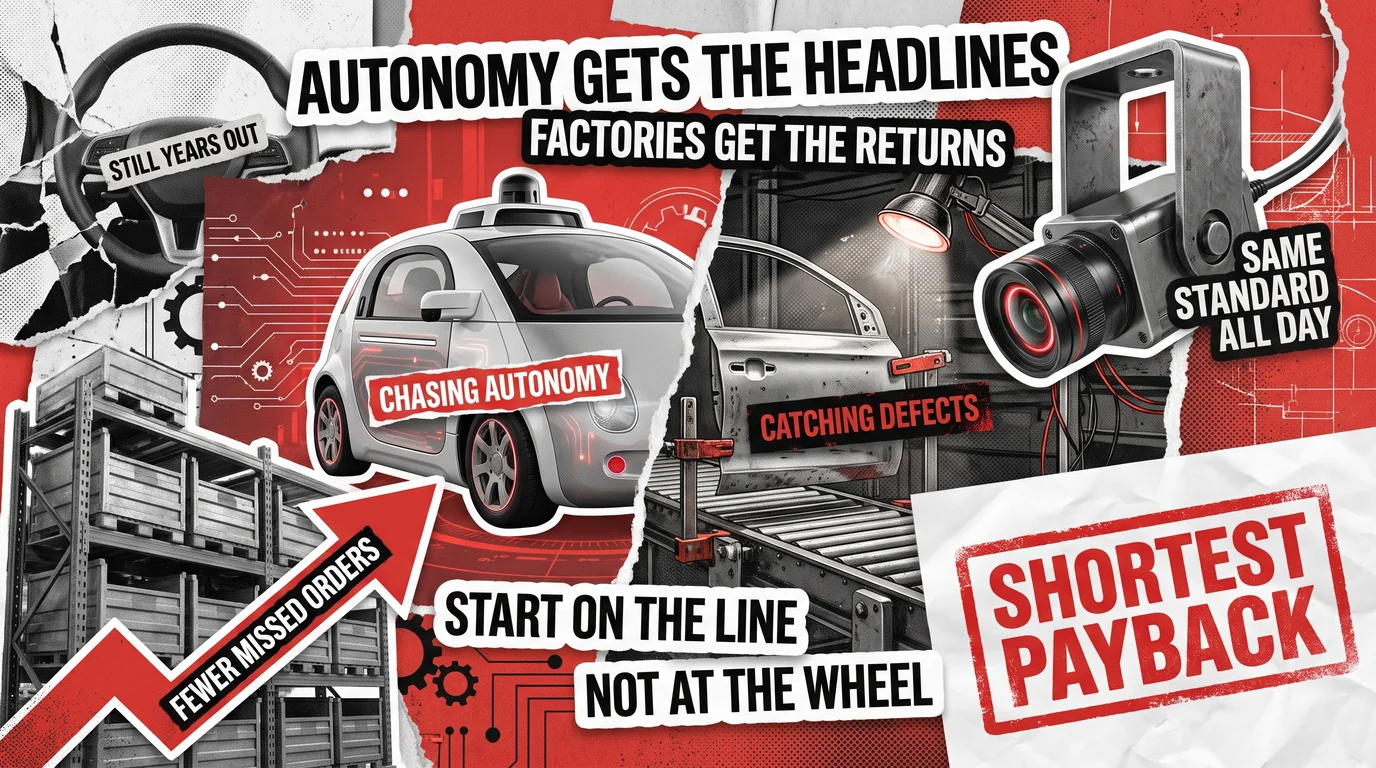
Autonomous vehicles get the headlines. However, the AI actually making money in the car industry today sits somewhere far less glamorous, on the factory floor, in the parts warehouse, and on the service schedule. That gap matters enormously when you are the person signing off the budget.
AI in automotive covers five working areas: spotting defects on the production line, forecasting parts and demand across the supply chain, predicting failures before they happen, running driver assistance and personalization inside the vehicle, and full autonomy. The first two return value soonest. Full autonomy remains the longest and costliest bet.
The sections below take the AI automotive applications that pay off first: what each does, what it needs from you, and where the limits are. Redwerk delivers automotive software development services and AI capabilities behind them, tailored to the client’s needs. The article below is based on the expertise of our engineers and 20+ years of building software at Redwerk.
How Is AI Used in Automotive Manufacturing?
A camera sits above the line and photographs every component that goes by. Software compares each picture against thousands of examples it has already studied, passes the good ones, and pulls anything that deviates for a person to review. That is computer vision, the branch of AI that looks at images and works out what they show.
The appeal of using this technology in automotive manufacturing is consistency rather than raw speed. A person checking door seals at hour seven of a shift is not the same inspector they were at hour one. Software holds the same standard all day, and it logs every decision, which means you can finally trace a recurring flaw back to a shift, a machine, or a batch of raw material.
That reliability is why inspection tends to be the first place AI lands in a factory. Deloitte’s 2026 AI in Manufacturing study surveyed more than 140 manufacturers and found quality furthest ahead on adoption at 62 percent. Production followed at 57, with logistics and supply chain at 49.
What Defect Detection Needs and Returns
Model training is the unglamorous half of this work. Somebody has to gather those example images, label which ones are acceptable, and keep feeding in fresh ones whenever the line changes. Skip that and you get a system that flags everything, so your team learns to ignore it.
We have built this kind of model for Recruit Media. That project meant training a neural network in Azure Machine Learning Studio to read documents and assign keywords automatically, then integrating Cognitive Services so the platform could scan every uploaded image and video without a person opening each file. The underlying discipline transfers directly. A model that checks images against an agreed standard does not much care whether it is looking at a document or a door panel.
Inspection data opens a second use in automotive manufacturing as well. Production optimization models watch how the line genuinely behaves, then suggest adjustments: which machine to load next, when to ease off a station that keeps creating rework further down. Where robots already handle the assembly, the same approach tunes how they are sequenced and how hard each one is pushed. It works well where the floor already records what happens and poorly where it does not.
One honest caveat before you budget for any of it. Defect detection only succeeds when defects are described consistently. If three inspectors write up the same flaw three different ways, your model learns the confusion instead of the flaw.
What Can AI Do for an Automotive Supply Chain?
Ordering parts today usually means last year’s figures, a spreadsheet, and a planner’s instinct about what the market is doing. It works until something moves faster than the numbers do.
A trained model changes the inputs rather than the job. It weighs order history, seasonality, supplier reliability, and shifts in the wider market all at once, then updates itself as conditions move. The planner still makes the call, just against a fresher picture.
The warehouse benefits from the same math. Carry too much stock and cash sits on a shelf. Carry too little and one missing component idles a line. Models trained on your own movement history narrow that gap, though they need clean records of what actually shipped rather than what the system assumed.
We covered this territory properly in our guide to automotive supply chain software, including control towers, supplier portals, traceability, and where custom builds beat off-the-shelf tools. Start there if supply chain is your priority, because it goes deeper than this overview can.
What Does AI Actually Do Inside the Car?
Most people already use AI in the car without calling it that:
- Driver assistance, or ADAS, covers the functions that hold you in your lane, brake when traffic stops abruptly, and warn you about a vehicle in your blind spot. Cameras and sensors feed the car a picture of its surroundings, and models decide what deserves a response.
- Personalization is the quiet one. The vehicle learns a driver’s seat position, climate preferences, and regular routes, then arranges itself accordingly.
- Maintenance alerts reach the driver before a warning light does. The car notices a component drifting out of its normal range and speaks up while there is still time to book a repair.
In-vehicle systems carry the heaviest engineering and regulatory burden of any AI use case in the industry. Our guide to building AI-powered automotive software covers the architecture, the safety standards, and the tech stack in proper depth. If that is your project, read it next.
What Does It Take to Build AI Into Your Automotive Software?
Every application above runs on the same fuel, which is consistent data. That is precisely where most projects stall.
Machines, systems, and departments rarely agree on how to record anything. One line logs downtime in minutes, another in reason codes, a third in somebody’s notebook. We built SystemDataRecorder for that exact problem, a tool that captures performance data consistently across different operating systems and devices so it can be analyzed as one continuous record rather than a heap of incompatible logs.
The second obstacle is the software already running your business. AI rarely arrives on empty ground, so it has to reach into an ERP, a warehouse system, or an application somebody wrote fifteen years ago and never documented. For URS, we rebuilt a desktop application as a real-time cloud tool that several people could use at once, and automated the reporting work staff had been doing by hand.
What these projects show is the engineering underneath: training models, recording data reliably, and connecting new software to old systems. Combined with our artificial intelligence development services and our automotive practice, that is the foundation these use cases stand on.
Two practical notes on getting started. Pick one bounded problem with a cost you can already measure, because a vague brief produces a vague result. Then ask any prospective partner which engineers would work on it and what they have built with that stack before. Teams that already know the technology reach useful output in weeks. Teams learning it on your budget take considerably longer.
Where Should You Start With AI in Automotive?
You will not fund all five at once, so the order matters more than the shortlist. Each row below strips one application down to what it does and when you would notice the difference.
Manufacturing quality control
Cameras and software inspect parts for defects faster and more consistently than a person can
Shortest
Supply chain forecasting
Predicts which components you will need and when, so you hold less stock and miss fewer orders
Short
Predictive maintenance
Watches equipment or vehicles for early warning signs and raises a flag before something breaks
Medium
Driver assistance and personalization
Runs lane keeping, emergency braking, voice control, and settings that adapt to whoever is driving
Long
Full autonomous driving
Handles the whole driving task with nobody at the wheel
Longest
Read that table top to bottom and you have the order most automotive companies should follow. The rows near the top need less data, carry lower risk, and produce a number your finance team can check. Demand forecasting runs on orders you already log, while quality inspection can start from a modest set of labeled images. The rows underneath need enormous datasets and a tolerance for multi-year budgets, which is why they come last, not that they matter least.
Everything in the table above draws on three capabilities we deliver: computer vision, predictive analytics, and process automation. The engineers we put on your project already know the stack rather than learning it at your expense, and we are comfortable starting before every requirement is nailed down, which is usually the real situation.
To work out which use case fits your operation and what it would take to build, book a call with our team.
FAQ
What is AI in automotive?
AI in automotive means software that learns from examples instead of following rules somebody wrote by hand. A traditional program checks a part against a fixed measurement. Trained models learn what a good part looks like from past examples, then flag whatever departs from it. The same approach drives forecasting, maintenance alerts, and driver assistance.
Which AI project should an automotive supplier do first?
Rule out anything that touches vehicle safety for a first project, because the approval burden will swallow your timeline. Then set aside anything whose data sits with a supplier you cannot get records from. What usually survives is inspection on a line you control or forecasting on orders you already log.
How much data do you need to train an AI model?
Less than most people expect, provided it is consistent. A few thousand well-labeled images can train a workable defect detector, while millions of contradictory records teach nothing useful. Volume matters less than agreement, since every example has to be labeled the same way by everyone who touches it. Teams with modest, tidy datasets often move faster than teams sitting on terabytes.
Is AI in automotive manufacturing different from AI inside the car?
Manufacturing AI runs on your own equipment in a controlled setting, where a mistake means a wasted part. In-vehicle AI works on limited hardware inside a moving vehicle, where an error carries safety consequences and strict regulation. The gap shows up in upkeep too: a factory model can be retrained over a weekend, while an in-car one needs formal sign-off first.
How long does an automotive AI project take?
Most of the calendar goes to data rather than modeling. Expect a few months for a focused pilot on one line, with the bulk of that time spent collecting and cleaning records. Rollouts across several sites run longer, and connecting to the systems you already use is usually what sets the pace.
See how Redwerk trained a neural network on 1.5M+ records to power an AI matching platform, later acquired by a US staffing giant