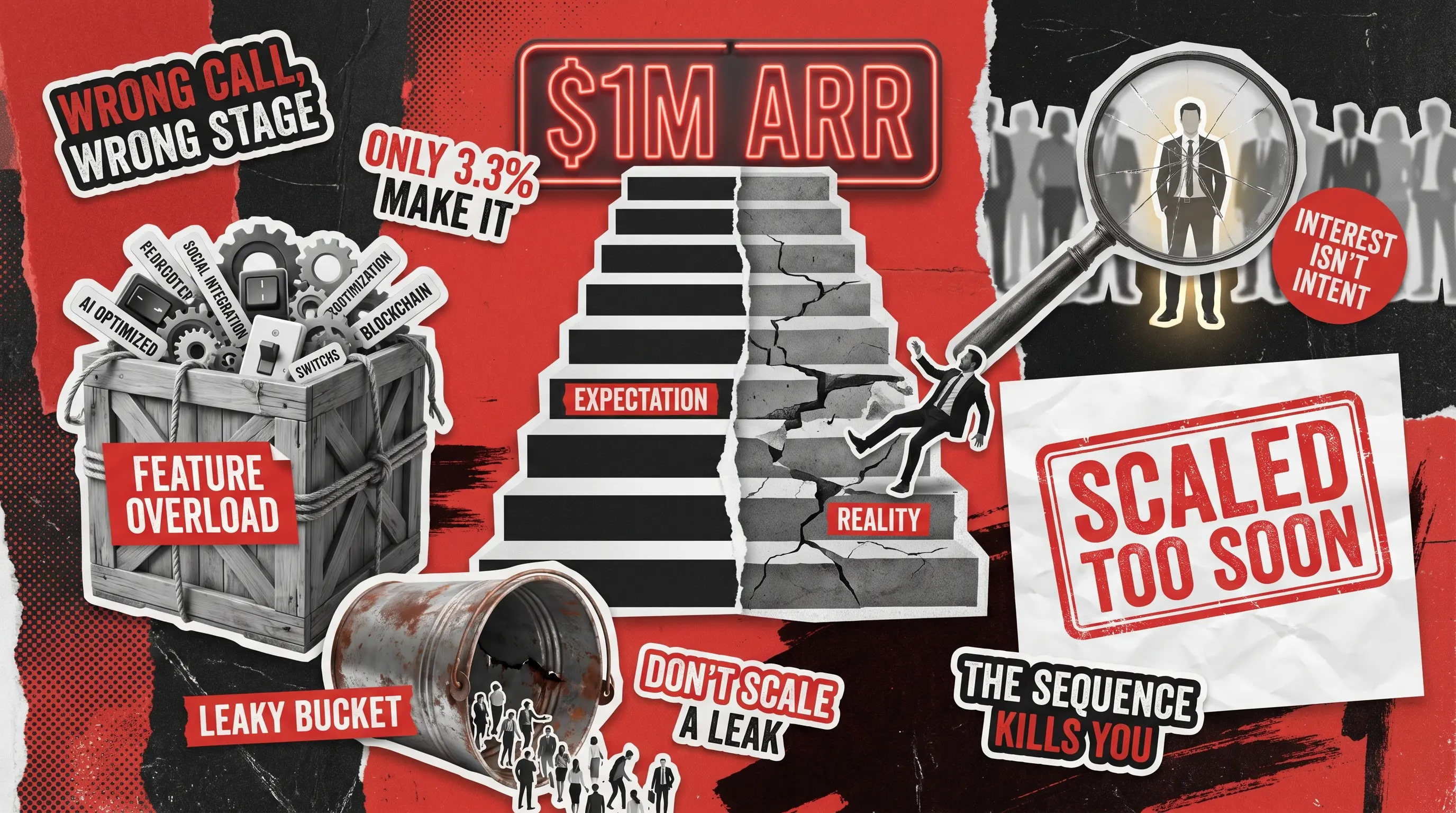
Most SaaS founders fail not because they built the wrong thing technically but because they made the wrong call at the wrong stage. Most often, deadly mistakes come from validating too little before building or building too much before selling. Scaling too early is also a common issue that might become your downfall. So, the product itself often works fine, it’s the stage sequence that doesn’t.
That is the pattern we’ve seen repeat itself across more than 250 projects at Redwerk since 2005. Our SaaS development work spans clients across North America, Europe, Australia, and New Zealand, and the failure modes are remarkably consistent regardless of industry or geography. Certain stages reliably trip up otherwise strong teams, and the reasons are almost always the same.
The opportunity in SaaS products is real and growing. The market is worth $315.68 billion in 2025 and is projected to surpass $1.1 trillion by 2032, according to Fortune Business Insights. However, the path through it is harder than the market size suggests. Judging by ChartMogul’s 2025 SaaS Growth Report, only 3.3% of SaaS startups reach $1 million in Annual Recurring Revenue (ARR) within their first year of monetization. For everyone else, the journey to that milestone takes between two and five years, and a significant portion never gets there at all.
Of course, those stats aren’t a reason to walk away from a SaaS idea but rather to pursue it with a clearer map. That’s exactly what this article offers: a playbook that maps each of the seven stages of SaaS product development to a specific business milestone.
The 7-Stage SaaS Product Development Playbook at a Glance
Each stage below represents a distinct gate in the journey from idea to $1M ARR. Before moving forward, you, as a founder, face one decision that determines whether the next stage will go smoothly or grind to a halt. Knowing where you are in the sequence is the first step to knowing what to do next.
Problem Validation
Confirmed, paying-class problem
Is this worth building a business around?
$0–$5K
Confusing interest with intent
Solution Shape
Value hypothesis with a named buyer
One ICP, one promise, or still hedging?
$5K–$20K
Solving for too many profiles at once
MVP Scope
Buildable, testable product slice
Smallest product someone would pay for and miss?
$30K–$150K
Feature overload before launch
First 10 Customers
First revenue and feedback loop
Genuine use or polite adoption?
$5K–$30K
Chasing acquisition before fixing retention
PMF Signal
Repeatable retention and market pull
Consistent reason customers stay?
Ongoing + $10K–$50K
Early adopter enthusiasm mistaken for fit
Scaling Readiness
Architecture survives 10x load
Ready to grow, or deferring structural debt?
$50K–$200K
Architecture treated as a ‘later’ problem
Revenue-Aware Growth
Modeled path to $1M ARR
Which lever is highest-leverage right now?
$100K–$500K+
MRR growth masking a churn problem
Stage 1: Problem Validation: Confirm the Pain Before You Build Anything
Business milestone: A confirmed, paying-class problem
The thing you must do first, before writing a single line of code or sketching a wireframe, is answer one question: is this problem painful enough that someone will pay to have it solved? Note that the question isn’t about whether it’s “interesting” or “worth exploring”, but whether it’s painful enough to pay for.
This sounds obvious, but CB Insights research consistently identifies lack of product-market fit as the leading cause of startup failure. In practice, poor problem validation at this stage is the root cause of that failure. Teams skip the uncomfortable work of talking to potential customers because they are excited about their solution, and they end up building something no one urgently needs.
Problem validation is not about confirming that a problem exists but about proving that the people who experience it consider it worth solving. It means that the gate you are trying to pass is not “this is a real problem” but rather “this is a real problem for a defined set of people who have both the pain and the budget to use our solution”.
- The decision at this gate: Is there a problem worth building a business around, or just an idea worth exploring further?
- Typical cost band: $0 to $5,000 (customer discovery calls, lightweight surveys, industry research)
- Team composition: Founder + 1–2 domain-expert advisors to pressure-test assumptions
- The most common issue: Teams often confuse interest with intent. When potential users say “that sounds great” in interviews, founders take it as idea validation. You should instead be looking for evidence of active, frustrated effort to solve the problem right now: spreadsheet workarounds, expensive manual processes, and duct-taped software combinations. That is where the paying-class problem lives.
Stage 2: Solution Shape: Define Who Pays, for What, and Why
Business milestone: A value hypothesis with a named buyer and a clear promise
Now that you know the problem is real and urgent, the next step is to shape what a solution would actually look like. You won’t be building yet but rather defining the transaction:
- Who specifically will pay for this product?
- What specific outcome will they pay for?
- What do they need to believe is true to hand over money?
Solution shape is not a wireframe exercise but a strategic one. It’s where you define your Ideal Customer Profile (ICP) with enough precision to build for someone rather than for everyone. It’s also where you make your first real product bet: what is the core promise this product will keep?
To understand why it matters so much, consider this: a recruitment platform for German companies hiring abroad keeps a different promise than a general job board. It’s the same for a market assessment tool for aggregates producers, which is majorly different from a general business intelligence dashboard. The shape of your solution determines the shape of your product, your pricing, your onboarding, and your sales motion.
This is also the stage where a proper discovery phase pays for itself many times over. You can cut down development time by up to 30% by running a structured discovery phase, which involves interviewing stakeholders, mapping workflows, documenting requirements, and prototyping the user journey. It also prevents the expensive rework that comes from building the wrong thing right. If you want to know exactly what goes into this process, check out our piece on discovery phase deliverables.
- The decision at this gate: Do we have a clear ICP, defined promise, and reason to believe in the success of our SaaS product development strategy?
- Typical cost band: $5,000 to $20,000 (discovery phase, stakeholder interviews, journey mapping, lightweight prototypes)
- Team composition: Founder, product strategist or business analyst, UX lead
- The most common issue: Trying to solve for three different customer profiles at once. It feels commercially sensible, since more potential buyers seem like a good thing, but it results in a mediocre product for everyone. The teams that make it to the next stage cleanly have chosen one profile and gone deep on it.
Stage 3: MVP Scope: Build the Smallest Thing That Earns a Real Reaction
Business milestone: A buildable, testable product slice that addresses the core promise
The Minimum Viable Product (MVP) is one of the most misunderstood concepts in SaaS product development. It’s crucial to realize that this is not the smallest product you could technically ship. Instead, it’s the smallest product a real customer in your ICP would pay money for, use regularly, and feel the loss of if it disappeared. That distinction matters enormously for scoping.
The practical test for MVP feature inclusion is the riskiest assumption test. For every feature you are considering, ask: What is the riskiest assumption this feature is meant to validate? If it validates a core assumption (does the user actually want to do this, will they do it this way, will this create the outcome they need), it belongs in the MVP. If it is a nice-to-have or a “we assumed they would want this”, it goes on the backlog.
Founders commonly over-scope their MVPs because they want the first impression to be perfect. The result is a product that takes three times longer to build, costs three times more, and launches with assumptions baked in that real users would have dispelled in week two. Our full guide on how to build an MVP covers the scoping process in detail, including the specific frameworks we use with clients to strip scope back to what actually matters.
- The decision at this gate: What is the smallest version of your SaaS product that a real customer would be willing to pay for (and miss if it were gone)?
- Typical cost band: $30,000 to $150,000 (depending on technical complexity, integrations, and team location)
- Team composition: Product owner, 2–4 developers, one QA engineer, and one designer
- The most common issue: Feature overload turns the MVP into a “Version 1.0” before it even ships. Every stakeholder adds “just one more thing”, so timelines stretch and costs climb. The resulting product arrives in the market nine months after your original plan. By this point, the assumptions it was built on may have aged out.
Stage 4: First 10 Customers: Treat Sales as Research
Business milestone: First revenue and first structured feedback loop
Getting your first 10 paying customers is less of a sales exercise and more of a research operation. These are the people who will provide you with crucial information, including:
- Whether your core promise lands
- Where your onboarding breaks down
- Which features get used and which get ignored
- Whether the problem you validated in Stage 1 is actually the problem your product is solving in practice
That feedback is worth far more than the revenue itself. Therefore, the way to recruit your first 10 customers must be intentional, not at random. You are looking for people who fit your ICP precisely, who have the problem urgently, and who are willing to engage deeply. Early adopters who give you genuine feedback and push you to improve are the foundation of everything that follows.
This stage is also where retention begins. Most founders at this point are focused entirely on acquiring new users, which is a mistake. If you cannot keep the 10 you have, meaning they are not logging in, not getting value, and not talking about the product to peers, acquiring more will just accelerate the rate at which you learn that something is broken.
A case that illustrates the importance of building for a precisely defined ICP: when we built the Muskelhirn platform from scratch, it was not a general recruitment tool, but one built specifically for German companies hiring skilled workers from abroad, targeting a narrow set of roles in electrical and construction trades. That precision is what allowed the platform to cut business operations time in half and create a product the target audience actually needed, rather than a generic solution in a crowded market.
- The decision at this gate: Are customers using the product consistently and expressing genuine value? You should be on alert for polite adoption that will fade once the novelty wears off.
- Typical cost band: $5,000–$30,000 (covers onboarding support, feedback-based iteration, outreach to qualified prospects)
- Team composition: Founder (to handle sales and customer relationships), one customer success specialist, and 1–2 developers available for rapid iteration
- The most common issue: Moving to acquisition before fixing retention. This is the bucket-and-leak problem: you fill the bucket with new users, but it leaks just as fast at the bottom because the product is not yet sticky enough to keep them.

Stage 5: PMF Signal: Look for Patterns, Not Just Enthusiasm
Business milestone: Repeatable retention and consistent, unsolicited pull from the market
Product-Market Fit (PMF) is one of those terms that gets used to describe everything from “a few people like our product” to “we cannot keep up with inbound demand”. For the purposes of SaaS product development strategy, it has a more specific meaning: your product consistently delivers on its core promise, customers stay without being pushed, and the reasons they stay are consistent across the cohort.
The clearest numerical signal of PMF is the “40% rule”, developed by Sean Ellis. It states that if at least 40% of surveyed users say they would be “very disappointed” if they could no longer use your product, you have a strong signal of fit. However, below that threshold, you are pre-PMF, and scaling will be expensive and fragile.
You should also watch out for a related signal: Net Promoter Score (NPS). In SaaS product development, an NPS of 30+ points indicates strong loyalty, and 50+ shows that the product is an exceptional fit. In addition, consider Net Revenue Retention (NRR). If it’s above 100%, it shows that existing customers are spending more over time. Therefore, the product is compounding its value rather than just holding it.
The qualitative version of this test is equally telling. Call your 10 best customers and ask them to describe what your product does. If 70% or more use similar language, meaning the same words, the same framing, the same problem description, you have PMF. If every customer describes your product differently, you either have a market focus problem or a positioning problem. Both are fixable, but you need to identify which one before you scale.
- The decision at this gate: Can you explain why the customers stay? Is that explanation consistent across your entire customer pool? Preferably, that explanation should be in one sentence, as the cause must be clear-cut.
- Typical cost band: Ongoing product support and iteration + $10,000–$50,000 (lightweight growth experiments to validate acquisition channels)
- Team composition: Existing team + a dedicated growth or marketing role and a full-time customer success specialist
- The most common issue: Mistaking the enthusiasm of early adopters for genuine market pull. First users are often forgiving and curious, as they are usually close to the founder personally. Therefore, their NPS will be high regardless of the actual product value. The real PMF signal comes from users who found you through a channel, signed up without a personal introduction, and stayed.
Stage 6: Scaling Readiness: Ensure the Foundation Can Take the Weight
Business milestone: Architecture and team can absorb a 10x increase in users without breaking
Most SaaS product development teams discover their architectural problems at the worst possible moment. It occurs when the traffic spikes due to a successful launch, a press mention, or a partnership announcement. The product slows down or goes offline, the team scrambles, and the business momentum that took months to build evaporates in hours. Scaling readiness is the work you do before such a thing could happen. It entails:
- Reviewing your current infrastructure choices against growth projections based on real-life data
- Addressing architectural shortcuts taken under MVP budget pressure
- Implementing proper multi-tenant architecture (if you haven’t already)
- Ensuring your data layer can handle the volume your growth stage demands
- Establishing compliance and security readiness (non-negotiable once you are selling to businesses of any meaningful size)
Multi-tenant architecture is one of the areas where early decisions have the longest tail. Getting it right means each customer’s data is properly isolated, your operational costs scale predictably with usage, and you can serve hundreds or thousands of customers without rebuilding your infrastructure from scratch. Our piece on multi-tenant SaaS architecture best practices is worth reading before you hit this stage, not after.
We can use the MarketBee project as a useful reference here. We built their market assessment platform from scratch for aggregate producers operating across 12 countries, which meant designing for data handling and visualization at a scale that would not break under real-world commercial use. Getting the architecture right from the beginning is what makes international scale possible without a rebuild.
- The decision at this gate: Are we technically and operationally ready to grow? Did our SaaS product development account for possible surges, or will they cause structural problems?
- Typical cost band: $50,000 to $200,000, depending on the extent of refactoring required, DevOps investment, and security audit scope
- Team composition: Add senior engineers with scaling experience, a DevOps or infrastructure engineer, and a data layer specialist if your product is data-intensive
- The most common issue: Treating architecture as a “later problem” means the technical debt from the MVP phase accumulates interest. Teams that defer this work until they are already under load end up doing it in crisis mode, which is slower, more expensive, and more disruptive than planned infrastructure investment.
Stage 7: Revenue-Aware Growth: Build a Path to $1M ARR, Not a Hope for One
Business milestone: A modeled, evidence-based path to $1 million ARR
The difference between SaaS companies that reach $1M ARR and those that perpetually chase it often comes down to whether your growth is revenue-aware or just activity-aware. Revenue-aware growth means every major investment, whether headcount, marketing spend, or product development, is evaluated against a specific ARR model: if we do this, what does it do to our ARR, our Customer Acquisition Cost (CAC), our churn, and our payback period?
First, let’s understand the math behind $1M ARR:
- If your average contract value is $500 per month, you need roughly 167 paying customers to reach $1M ARR.
- If your monthly churn rate is 5%, you are losing about 8 customers per month at that size. Therefore, you need to acquire 8 new customers just to stay flat.
Now, how does your current acquisition motion perform against that requirement? That question, answered honestly, tells you whether you are on a path to $1M or on a treadmill.
The three levers at this stage are:
- acquiring new customers
- expanding revenue from existing customers
- reducing churn
The teams that reach $1M ARR most efficiently typically work all three simultaneously rather than focusing exclusively on top-of-funnel growth. Expansion revenue, in particular, is underused: when existing customers increase usage or upgrade to higher tiers, you generate ARR without incurring acquisition costs.
According to ChartMogul’s 2025 data, for startups that do reach $1M ARR, it typically takes between two and five years from the start of monetization. The outlier 3.3% who do it in under a year share a common pattern: they were patient in the early stages, doing thorough validation, iterating based on real feedback, and finding genuine PMF before pressing on the accelerator.
- The decision at this gate: What is our specific SaaS product development strategy leading to $1M ARR? Which of the three main levers (new acquisition, expansion, or churn reduction) can produce the highest-leverage investment right now?
- Typical cost band: $100,000 to $500,000 or more in go-to-market investment, depending on your sales model, acquisition channels, and competitive dynamics
- Team composition: A full commercial team is necessary here: dedicated sales, marketing with attribution discipline, and customer success with expansion responsibility. The product organization stabilizes as engineering effort shifts from new features toward reliability and retention-driving improvements.
- The most common issue: Optimizing for Monthly Recurring Revenue (MRR) growth while ignoring churn. Think in these terms: you are adding 20 customers per month and losing 18. Your growth numbers look active, but your ARR trajectory is nearly flat. Churn is the silent tax on every acquisition dollar you spend.
Where Are You in the SaaS Product Development Strategy Playbook?
Most founders who come to us know roughly what stage they are in. What they are less sure about is what specifically broke at that stage and what the right next move is. After 250+ development projects across industries and geographies, we have seen most of the failure patterns in this article play out in real products with real consequences, and we know what it takes to work through them.
It means our engineers can identify exactly what you need after analyzing your current situation. So, if you are ready to fix the issues keeping your SaaS product development project from achieving full success, give us a call.
Find out how AWE Learning could reach users beyond the US by implementing scalable SaaS and cloud migration