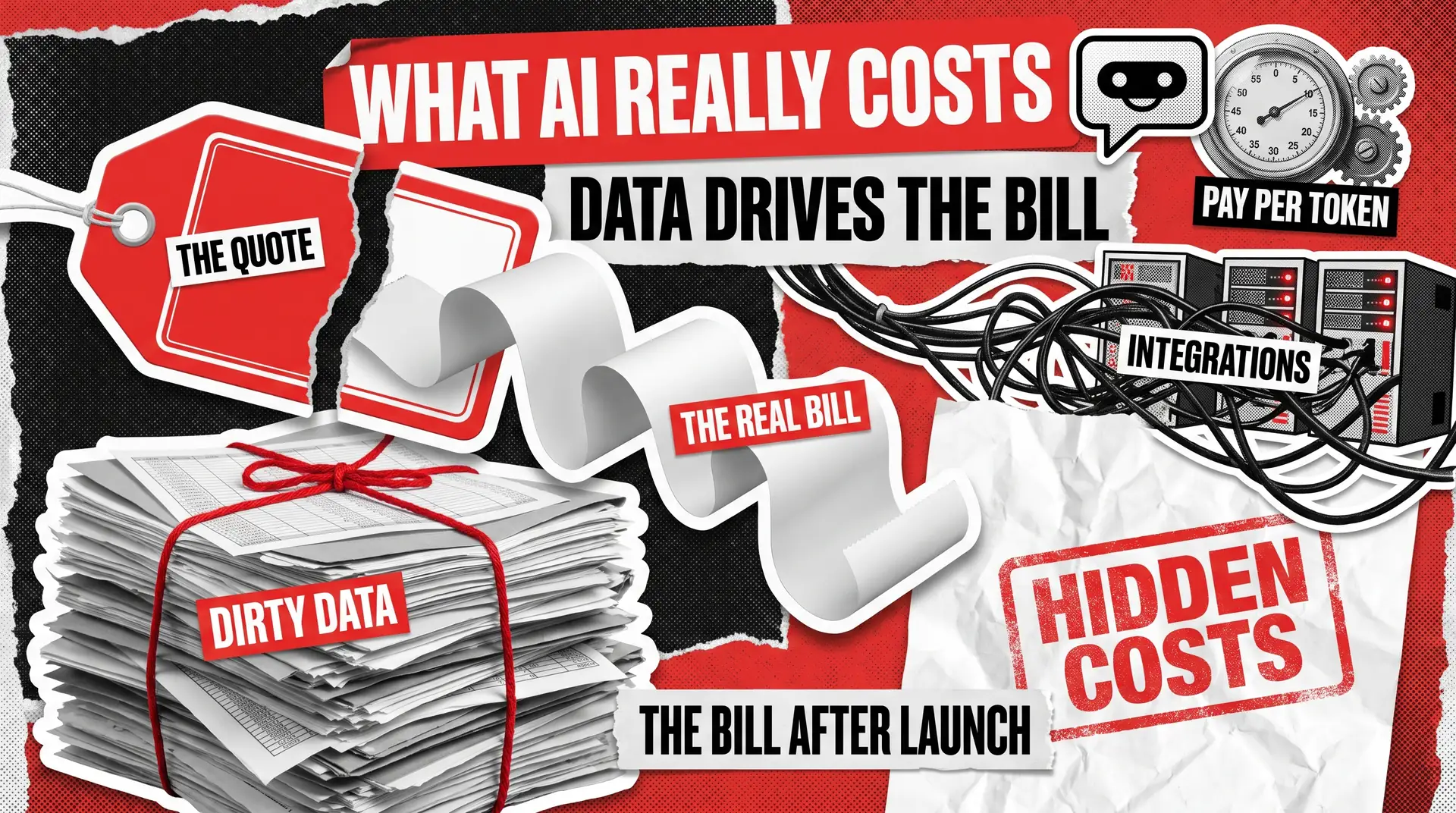
AI development cost is set mainly by how ready your data is and how deeply the system has to integrate with the tools you already run; the model itself is usually a smaller line. Measured as in-house engineering time at US median wages, a production AI chatbot runs roughly $50K to $130K, a custom machine learning model $145K to $385K, an AI agent system $255K to $770K, and a full AI platform $1.15M or more.
Read three pricing guides and you will see estimates anywhere from $5,000 to over $1 million for what sounds like the same project. The spread comes from cost drivers hidden under a single headline number: whether your data is usable, how many systems the AI has to talk to, and what it costs to run once real users arrive. This AI development cost guide breaks the number down by project type, shows the method behind every figure, and covers the running costs that decide whether the project pays back. If you are scoping artificial intelligence development services for a specific workflow, it should also help you read vendor quotes with a sharper eye.
What Actually Drives AI Development Cost
Five factors move the budget. In most mid-market projects, data readiness and integration depth account for the largest share of the engineering hours.
1. Data readiness. Before any model can be useful, the data behind it has to be found, cleaned, deduplicated, labeled where needed, and made accessible with the right permissions. Gartner predicts that through 2026, organizations will abandon 60% of AI projects unsupported by AI-ready data, and the same Gartner research found that 63% of organizations either lack or are unsure they have the right data management practices for AI. When the data sits in five spreadsheets and a legacy database, the data work can take longer than the AI work.
2. Integration depth. Every system the AI reads from or writes to (a customer relationship management platform, an enterprise resource planning system, a ticketing tool, single sign-on) adds authentication, data mapping, error handling, and testing. A chatbot that only answers questions from documentation is a small build. The same chatbot that issues refunds in your billing system is a much larger one, because every action needs permissions, rollback, and an audit trail. We covered the failure side of this in the hidden costs of poor AI integration.
3. Reliability and risk controls. Production AI needs evaluation datasets, guardrails, fallbacks to a human, logging, and monitoring. In regulated domains such as finance, healthcare, or HR, add compliance review and explainability requirements.
4. Inference and infrastructure. Hosted large language model (LLM) application programming interfaces (APIs) bill per token, and self-hosted models bill per graphics processing unit (GPU) hour. This cost scales with usage and is covered under Ongoing Costs Most Guides Skip.
5. Model choice. Calling a hosted model, fine-tuning an open-weight model, or training your own changes the build significantly. For most mid-market business workflows, a hosted model with retrieval over your own data is the sensible starting point, which is why model choice rarely dominates the estimate.
Data readiness
Scattered sources, no labels, unclear ownership, personal data
One clean source of truth, documented schema, existing access controls
Integration depth
Write access to core systems, legacy APIs, many systems
Read-only access, modern REST APIs, one or two systems
Reliability and risk
Regulated domain, customer-facing actions, low error tolerance
Internal users, human review on every output
Inference and infrastructure
High volume, long prompts, frontier models, self-hosting
Moderate volume, smaller models, caching
Model choice
Training or heavy fine-tuning
Hosted model plus retrieval
AI Development Cost by Project Type
Published cost figures rarely show how they were calculated, so here is ours. The US Bureau of Labor Statistics (BLS) puts the median annual wage at $135,980 for software developers and $120,230 for data scientists as of May 2025. Wages make up 70.0% of total employer compensation costs in US private industry, so a fully loaded engineer costs about $16,000 per person-month. The table converts typical team shapes and timelines into that yardstick and sets an approximate outsourced range beside it.
AI chatbot on a hosted model
2 to 3
6 to 12 weeks
3 to 8
$50K to $130K
$43K to $115K
Custom machine learning model
3 to 4
3 to 6 months
9 to 24
$145K to $385K
$130K to $345K
Production AI agent system
4 to 6
4 to 8 months
16 to 48
$255K to $770K
$230K to $690K
Full AI platform
8 to 12
9 to 18 months
72 to 216
$1.15M to $3.5M
$1.04M to $3.1M
Treat both columns as a yardstick for comparing quotes. The outsourced figures are an approximate range: outsourcing rates vary widely by region, seniority, and engagement model, so an individual quote may land below or above them. Outsourcing also takes recruiting time and benefits out of the equation, which matters when the team has to start in weeks. If you plan to staff the build yourself, our guide on how to hire AI developers covers the skills to screen for; if you would rather bring in a complete team, here is what to know before you hire a dedicated development team. The cost to build an AI solution moves up or down a tier based on the drivers described under What Actually Drives AI Development Cost: a chatbot with deep write access to three core systems prices like an agent system.
AI Chatbot Development Cost
A chatbot built on a hosted large language model (LLM) usually includes retrieval-augmented generation (RAG) over your documentation, one or two channels (website, Slack, or Microsoft Teams), handoff to a human, and basic analytics. AI chatbot development cost rises quickly once the bot has to take actions in other systems, answer in several languages, or meet strict accuracy targets on customer-facing answers. Before commissioning a build, check whether an off-the-shelf product covers the job; our AI chatbot comparison for business walks through when to buy, extend, or build. When a custom build is justified, our AI chatbot development services team starts from your real support data.
Custom Machine Learning Model
Forecasting, scoring, matching, and classification models trained on your own data sit in this tier. Most of the timeline goes to data preparation and feature engineering, with training itself a fraction of it. On an HR platform connecting recruiters and candidates, Redwerk trained models in Azure Machine Learning Studio, and that work followed the same pattern: data preparation first, model iterations after. When the model at the center of the build is a language model, our large language model development team follows the same data-first sequence.
Production AI Agent System
Agents plan multi-step work, call tools, and act inside business systems, which puts integration depth and risk controls at the center of the budget. Orchestration can run on workflow platforms such as n8n or be written in code, and the choice affects both build time and how easily your team can maintain it. Gartner predicts over 40% of agentic AI projects will be canceled by the end of 2027, citing escalating costs, unclear business value, and inadequate risk controls. For a concrete build, see inside the architecture of an AI customer support agent built with n8n.
Full AI Platform
A platform serves several AI use cases on a shared data layer, with its own model management, evaluation, governance, and machine learning operations (MLOps). At the far end, Gartner estimates that generative AI deployments aimed at transforming a business model carry costs ranging from $5 million to $20 million. Most mid-market companies reach this tier by growing from one proven use case, which spreads the risk across several smaller budgets.
Ongoing Costs Most Guides Skip
Running the system is a monthly cost on top of the one-time build, and it belongs in the business case from day one.

Inference and API usage. Hosted models bill per token, so monthly spend is roughly conversations per month multiplied by tokens per conversation multiplied by the model’s price per token. A support bot handling 50,000 conversations a month at 4,000 tokens each processes 200 million tokens a month, and the model tier you pick sets the bill for that volume. Prices for a given capability level are falling fast: the Stanford AI Index found the inference cost of a system performing at GPT-3.5 level dropped over 280-fold between November 2022 and October 2024. Total spend can still climb, because newer use cases consume far more tokens. Gartner predicts that by 2030, cost per resolution for generative AI in customer service will exceed $3, higher than many business-to-consumer offshore human agents. Caching, routing simple requests to smaller models, and trimming prompts all cut this line; our guide to LLM inference optimization techniques covers them in depth.
Monitoring and retraining. Models degrade as the data they see drifts away from the data they were trained on. Custom models need scheduled retraining, and systems built on large language models (LLMs) need their evaluation sets rerun whenever the provider updates the model or your content changes. When prompt changes and retrieval updates stop closing the accuracy gap, a round of LLM fine-tuning on fresh examples from your domain brings the model back in line, and each round belongs in the running budget.
Machine learning operations overhead. Someone has to own the data pipelines, model versioning, evaluation dashboards, alerting, and incident response. On a small system this is a fraction of one engineer’s time; on a platform it is a team.
Plan for these three lines before the build starts, and ask any vendor to estimate them alongside the development quote.
When a Custom AI Build Is the Wrong Call
A custom build is the wrong investment in three common situations:
- An existing product already covers most of the workflow. Licensing a mature tool and extending it at the edges is usually cheaper and faster.
- The data is not ready. Spend the first budget on consolidating and cleaning data. The AI project that follows will be smaller and more likely to reach production.
- The volume is too low. If the process runs a few dozen times a month, the build and running costs may never pay back against the manual effort they replace.
How to Get an Accurate AI Development Cost Estimate
A short discovery phase gives a more reliable number than any generic cost calculator, because it prices your data and your integrations. In the same July 2024 release cited under Full AI Platform, Gartner predicted that at least 30% of generative AI projects would be abandoned after proof of concept by the end of 2025, and discovery is the cheapest point at which to find out whether yours is one of them.
Redwerk’s discovery phase services usually run 2 to 6 weeks, depending on product complexity, integrations, and the level of validation required. You come out with:
- A prioritized scope
- An architecture outline
- Integration notes for every system the AI touches
- A roadmap
- Effort ranges you can take to your budget owner
You do not need complete requirements to start. Most AI projects begin with a process that works badly and a rough idea of what better looks like, and discovery is where that gets turned into a scope. To make the estimate sharper, bring:
- A sample of the real data, even a messy one
- A list of the systems the AI would read from or write to
- A current volume figure (tickets, documents, transactions per month)
- The one metric that would prove the project worked
How Redwerk Approaches AI Projects
Redwerk has delivered AI agents, custom machine learning training in Azure Machine Learning Studio, and workflow automation on n8n, OpenClaw, and Claude Code. Every engagement starts from the cost drivers above: we assess the data and map the integrations before quoting the build, staff the project with engineers who already know the stack you need, and keep you updated on scope, spend, and risk at every stage, so the estimate stays tied to what is actually being built.
If you have a workflow in mind and want a number you can defend to your budget owner, get a scoped AI cost estimate.
FAQ
How much does it cost to build an AI solution?
Measured in in-house engineering time at US median wages, a production AI chatbot costs roughly $50K to $130K, a custom machine learning model $145K to $385K, an AI agent system $255K to $770K, and a full AI platform $1.15M or more. Outsourced builds of the same scope typically land somewhat lower, though vendor rates vary widely. Data readiness and integration depth move a project up or down these tiers.
How much does AI chatbot development cost?
A chatbot on a hosted large language model with retrieval over your documentation typically takes a team of 2 to 3 people 6 to 12 weeks, about $50K to $130K in in-house-equivalent engineering cost, or roughly $43K to $115K outsourced. Chatbots that take actions in other systems, such as issuing refunds or updating orders, cost more.
Why do AI development cost estimates vary so much?
Most estimates quote a single number without stating the data work, integrations, and risk controls behind it. Two projects with the same description can differ several-fold once you account for data quality, the number of systems involved, and how much error the use case can tolerate.
What are the ongoing costs of an AI system?
The three recurring lines are inference or API usage, monitoring and retraining, and machine learning operations overhead. Inference scales with volume and model choice, while monitoring and operations scale with how many models and integrations you run.
How long does it take to get an accurate AI cost estimate?
A discovery phase usually takes 2 to 6 weeks and produces a prioritized scope, an architecture outline, integration notes, a roadmap, and effort ranges. It prices your actual data and systems, which is why it is more reliable than a generic calculator.
See how Redwerk trained a neural network on 1.5M+ records to power an AI matching platform, later acquired by a US staffing giant