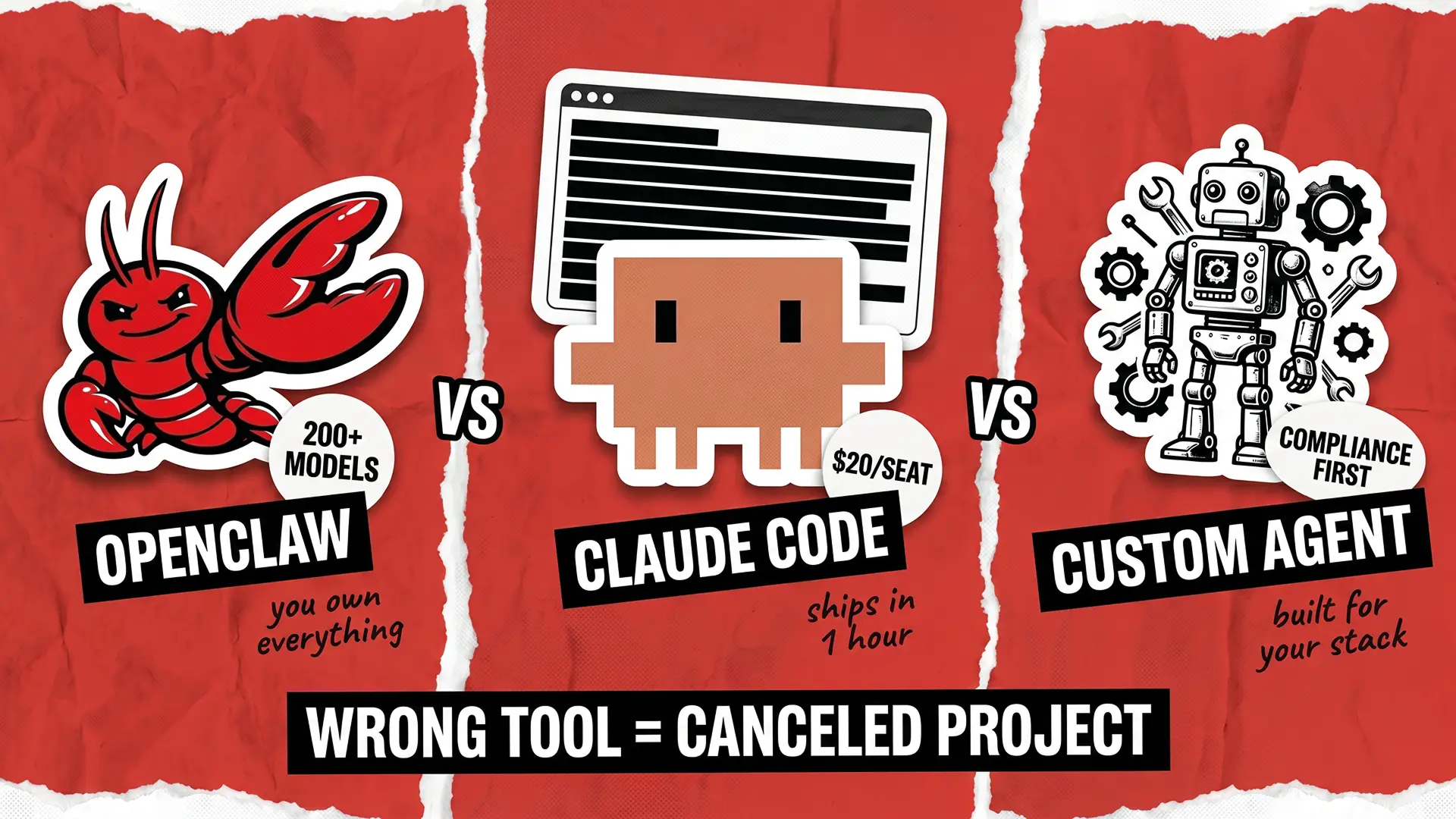
Is your team wondering what the best AI automation approach is? Right now, the choice boils down to OpenClaw vs Claude Code vs custom AI agent development. You’re the one who has to make the choice that will literally define your success. And we are here to break down every option and explain that it’s usually not ‘one or the other’ because each automation strategy serves different goals. Therefore, the choice must be based on what exactly you need to accomplish.
The biggest problem with automation today is that, according to Gartner, 40% of enterprise AI agent projects will be canceled by 2027 due to unclear value and poor governance. The tools aren’t the risk; it’s picking the wrong one for your team that is. Every article out there helps developers compare configs. This one helps you make the call from a business continuity perspective.
OpenClaw vs Claude Code vs Custom AI Agents: What Each Option Actually Is
Let’s start by defining the main characteristics and differences of OpenClaw vs Claude Code vs custom AI agent development. These three are not interchangeable for the most part. Therefore, Redwerk’s AI engineers, each with over a decade of experience, will explain which of these technologies best fits various business scenarios.
OpenClaw: Maximum Control, Minimum Hand-Holding
OpenClaw is an open-source AI agent, not a chatbot you ping for answers. It’s a persistent runtime that stays on, runs scheduled tasks, watches for external triggers, and coordinates multiple specialized sub-agents simultaneously. It went from zero to 150,000 GitHub stars in days, which tells you how much demand there was for something like it.
Its sharpest business advantage is model freedom. OpenClaw connects to 200+ AI models, including Claude, GPT-4o, Gemini, Llama, DeepSeek, and local models you run on your own hardware. You route heavy reasoning tasks to the best model for the job and lighter tasks to a cheaper one. When a vendor raises prices or changes terms, you switch without rebuilding anything. No single provider controls your costs or your roadmap.
The trade-off is real: you own the operations, so setup takes a competent DevOps engineer 15–20 hours. Security hardening, patching, and uptime are your team’s responsibility. The annual cost for 15 seats ranges from $2,000 to $3,500, depending on hosting and model usage.
- Persistent execution loop: runs 24/7, acts on triggers without being prompted
- 200+ AI model integrations, including local and open-source options
- ClawHub marketplace with thousands of community-built skills
- Multi-agent orchestration: specialized agents working in parallel
- Connects to Slack, Discord, Telegram, WhatsApp, email, GitHub, and databases
- Full data sovereignty: your data never leaves your infrastructure
- Annual cost for 15 seats: ~$2,000–$3,500, depending on hosting and model usage
One risk to be aware of before you deploy is that over 30,000 OpenClaw instances are currently exposed to the open internet. A security review of nearly 4,000 community-built skills found that 7.1% contained critical vulnerabilities. We’ve mapped every major attack vector in our OpenClaw security best practices guide.
Claude Code: Fast, Polished, and Locked to One Ecosystem
Claude Code is Anthropic’s official AI agent for software development. It’s the best tool in this comparison for one specific job: helping your engineering team ship faster. Give it access to your codebase, and it works like a senior developer who has already read every file. It can trace calls across your architecture, catch how a change in one module breaks another, and rewrite accordingly.
Claude Code reads your full git history, understands your dependency graph, and carries context across your entire project. Ask it to refactor an authentication module, and it updates every file that touches auth, not just the one you mentioned. Add a CLAUDE.md file to your project root, and it automatically reads your team’s conventions and architecture decisions into every session. Hooks let you fire custom scripts before or after specific agent actions, enforce linting standards, trigger a CI pipeline, or block a commit pattern without ever having to remind a developer again.
The setup takes under an hour, and there is no infrastructure to manage. At $20/month per seat, a 10-person engineering team spends $2,400/year, which is less than two days of senior developer time, so the value compounds fast.
- Reads your full codebase, git history, and dependency graph in context
- Writes and refactors code across multiple files simultaneously
- CLAUDE.md for persistent project instructions carried into every session
- Hooks system: custom scripts triggered by specific agent actions
- Sub-agent orchestration for parallel workstreams on large tasks
- Available in terminal, VS Code, JeThe main constraint is that Claude Code runs only on Claude models, and your code passes through Anthropic’s infrastructure. For most product teams, that’s a reasonable trade-off for the speed it delivers. However, in regulated industries or teams where IP sensitivity is non-negotiable, it isn’t. See our analysis of the Claude Code source code leak for what managed-tool risk actually looks like in practice.tBrains, and a desktop app
- $20/month per seat: $3,600/year for 15 people, zero DevOps overhead
Custom AI Agent Development: Built for Your Stack, Your Data, Your Rules
A custom AI agent is not a product you buy but a piece of software you commission. It’s built from scratch around your business logic, integrated with your actual systems, and designed to meet your compliance requirements before a single workflow goes live.
The practical difference of custom AI agent development is in what it can connect to. OpenClaw and Claude Code integrate with popular tools. However, a custom agent can integrate with whatever you have, such as a 15-year-old ERP system, an internal API your SaaS vendors have never heard of, or a proprietary database that holds the competitive advantage you’ve spent years building. It speaks your data’s language because it was built to do so.
For regulated industries, this is the only option that handles compliance without compromise. HIPAA, SOC 2, GDPR, and FedRAMP requirements are designed into the architecture from the first decision, not retrofitted after the fact. Your data never leaves your infrastructure, so the audit trail is complete and entirely yours.
It’s true that the investment is front-loaded as building a custom agent takes weeks to months and requires real AI engineering expertise. The ROI compounds: every improvement makes the agent more valuable, and the system you’re improving belongs to you, not a vendor that could reprice, pivot, or shut down.
- Integrates with any system: legacy ERP, proprietary databases, internal APIs, data warehouses
- Compliance by design: HIPAA, SOC 2, GDPR, FedRAMP built into the architecture from day one
- Full data sovereignty: runs entirely on your infrastructure
- Complete model flexibility: use any LLM as the AI landscape evolves
- Zero vendor lock-in: you own the codebase, the integrations, and the IP
- Learns and improves over time as it absorbs your data and business processes
- Requires an experienced AI development partner to architect and build correctly
Custom AI agent development might not be the right path for every team. However, if your business handles sensitive data, operates in a regulated industry, or competes on proprietary workflows, a custom agent is the only option that doesn’t introduce structural risk. See how we approach AI solution development at Redwerk.
OpenClaw vs Claude Code vs Custom AI Agents: Side-by-Side Comparison
The majority of feature lists only tell half the story because the dimensions that matter to a CTO or founder aren’t setup steps, they are:
- Data sovereignty
- Vendor lock-in
- Compliance fit
- What the real annual bill looks like once you factor in DevOps, maintenance, and per-seat costs
This table maps all three options across the eight criteria that actually drive the build-versus-buy decision.
Setup time
15–20 hours (DevOps)
Under 1 hour
Weeks to months
Data sovereignty
Full — your infra
Anthropic cloud
Full — your infra
Model choice
200+ models
Claude only
Any model
Vendor lock-in
Low
High
None
Maintenance burden
You own it
Zero
You own it (or outsource)
Compliance fit
Medium
Low–medium
High
Cost: 15 seats/yr
~$2,000–$3,500
~$3,600
Custom (one-time dev investment)
Best for
Cost-sensitive teams, multi-platform automation
Solo devs, small teams moving fast
Regulated industries, proprietary data, unique workflows
Three Things Every Comparison Gets Wrong
Before we delve deeper into the openClaw vs Claude Code vs custom AI agent development debate, we would like to highlight that most similar materials focus on the technical aspects and capabilities of these solutions. However, for you as a business owner, those technicalities matter little compared to factors that have an immediate business impact. Therefore, be sure to look over the three most important misconceptions about AI agent development identified by our team.
- “Open-Source” Doesn’t Mean No Cost
OpenClaw is free to download, but running it at production scale is not. Factor in DevOps consulting and engineering time (15–20 hours of setup), ongoing patching, security hardening, and hosting. For a 15-person team, the total cost of ownership lands around $2,000–$3,500 annually. It’s cheaper than Claude Code’s $3,600, but only if you have the DevOps capacity to manage it. If you don’t, you’re borrowing against future reliability. - Vendor Lock-In Is a Real Business Risk
Claude Code ties your team’s workflows to Anthropic’s pricing decisions, model updates, and service availability. McKinsey’s 2025 State of AI survey, covering 1,993 organizations across 105 countries, found that 88% of enterprises now deploy AI in at least one function. The ones scaling fastest maintained model portability. When Claude Opus 5 ships and pricing changes, every team locked into Claude Code adapts on Anthropic’s timeline, not their own. - Regulated Industries Need a Different Conversation
Healthcare, fintech, legal, and government teams face a binary question: Does your data leave your infrastructure, or not? Claude Code routes everything through Anthropic’s cloud. Enterprise agreements can address some concerns, but not all. OpenClaw on your own infrastructure solves data residency. A custom AI agent with your security architecture solves it completely. According to Gartner, 40% of enterprise applications will include task-specific AI agents by the end of 2026. For regulated industries, the infrastructure decisions you make now determine whether you ride that wave or get buried by it. More on agentic AI frameworks in our LangChain vs LangGraph guide.

Which Option Is Right for Your Team? A Scenario Guide
Let’s take a look at how to choose OpenClaw vs Claude Code vs custom AI agent development on real-life samples:
- Solo developer or small team (1–5 people), non-regulated: Claude Code
Fast setup, zero maintenance, pays for itself in hours saved. Don’t overthink it. - Product team (10–30 people), cost-sensitive, no strict compliance requirements: OpenClaw on managed hosting
At 15 seats, you save ~$1,600/year compared to Claude Code, as long as you budget for DevOps maintenance. The total cost of ownership math works when the infrastructure is stable. - Enterprise team in a regulated industry (healthcare, fintech, legal, government): Custom AI agent
If data sovereignty isn’t a preference but a requirement, a properly architected custom AI agent is essential for handling compliance by design, integrating with your existing systems, and avoiding third-party risk in your audit trail. - Team with proprietary data or unique competitive workflows: Custom AI agent
Your advantage lies in your data and processes, so an agent trained on your internal knowledge compounds over time. A general-purpose tool pointed at your repo does not. - Team evaluating before committing: Start with Claude Code
Three months of validation costs $60/seat. Identify where you hit the ceiling, then decide: OpenClaw for cost and flexibility, or a custom AI agent for compliance and ownership.
When to Bring in a Custom AI Agent Development Partner
Building a custom AI agent in-house sounds straightforward until you’re three sprints in and the architecture doesn’t scale, the integrations are brittle, and security is an afterthought. The OpenClaw security incidents with 30,000+ exposed instances and hundreds of malicious community plugins didn’t happen because teams were careless. They happened because deploying autonomous agents with system-level access requires a different security posture than most teams have built for.
Redwerk has been building custom AI solutions for businesses across North America, Europe, Australia, and New Zealand since 2005. Custom AI agent development for us means:
- Architecture scoped to your actual workflows
- Compliance-first design
- Security hardening from day one
- Integration with your existing systems, not a copy-paste of someone else’s framework
Whether you choose to build a custom AI agent or one powered by OpenClaw or Claude Code, we are here to help guide you through every stage from planning to deployment and maintenance. Are you ready to automate? Let’s scope it together.
See how we built
an AI-powered recruitment app
bought by a US staffing giant