You want your AI in financial applications to outpace your competitors, but not your regulators. Non-compliance with the EU AI Act (Regulation 2024/1689) alone can cost up to 7% of global annual turnover or €35 million. As soon as your model decides who gets credit, which transactions are blocked, or what advice clients see, you step into the world of AI in regulatory compliance. And with 88% of organisations already using AI in at least one business function (per McKinsey’s latest survey), the question isn’t whether you’ll face scrutiny — it’s when.
This guide will help you make AI in finance compliant across the EU, US, and MiCA rules, so every release doesn’t turn into a regulatory headache.
What “Compliant AI in Finance” Actually Means
Today, there isn’t a single rulebook or simple checklist for AI compliance in financial applications. Instead, you have to manage three overlapping areas: sector rules for banking, securities, and lending; data privacy frameworks; and specific AI and regulatory compliance requirements under the EU AI Act and new US guidance.
Regulators are less interested in your claims that a product “uses AI in financial services” and more focused on how your model actually works. They set higher standards for high-impact uses like credit scoring, robo-advice, fraud detection, and algorithmic trading than for basic UX suggestions or internal tools.

Core Pillars of Compliant AI in Financial Applications
Most teams already have at least one AI model in use. Usually, a quick pilot leads to wider adoption, and only later does someone ask how it fits into AI governance for finance. Before AI, decisions were slower but easier to track. Now, with constant model updates, changing data, and shifting regulations, you need a consistent system instead of quick fixes.
- Clear Use-Case Classification: distinguish high‑risk scenarios, such as loan approvals or automated KYC decisions, from medium‑risk fraud scoring and low‑risk personalisation features.
- Data Governance & Privacy: define lawful basis, minimisation logic, retention limits, and cross‑border transfers in line with GDPR, CCPA, and banking secrecy obligations.
- Model Risk Management: treat models as assets with validation, testing, drift monitoring, and explicit boundaries for each algorithmic component.
- Explainability & Accountability: prepare to explain outcomes to customers and supervisors, and keep human override options for critical financial decisions.
- Security & Operational Resilience: ensure security controls, incident handling, and continuity measures comply with frameworks such as DORA for EU entities.
If you can’t answer three basic questions: what the model is used for, when it changed, and who can stop it, your system isn’t ready for production in a regulated financial environment.

The Regulatory Map: EU vs US vs MiCA
You don’t need a hundred-page memo to launch compliant AI in finance, but you do need to understand the main challenges. The same AI code can face very different rules depending on whether you serve EU clients, US clients, or offer digital asset services under MiCA.
By 2026, the pattern is clearer: the EU wants a unified, risk-based AI framework; the US depends on sector agencies and state rules; and MiCA adds a special layer for crypto activities and cross-border digital assets, often using AI-driven monitoring.
A note on timing: The European Commission’s Digital Omnibus proposal (November 2025) could push Annex III high-risk AI obligations to as late as December 2027. However, this is still under legislative review and is far from guaranteed. Prudent teams are treating August 2, 2026 as the binding deadline for high-risk AI systems in finance and planning accordingly.
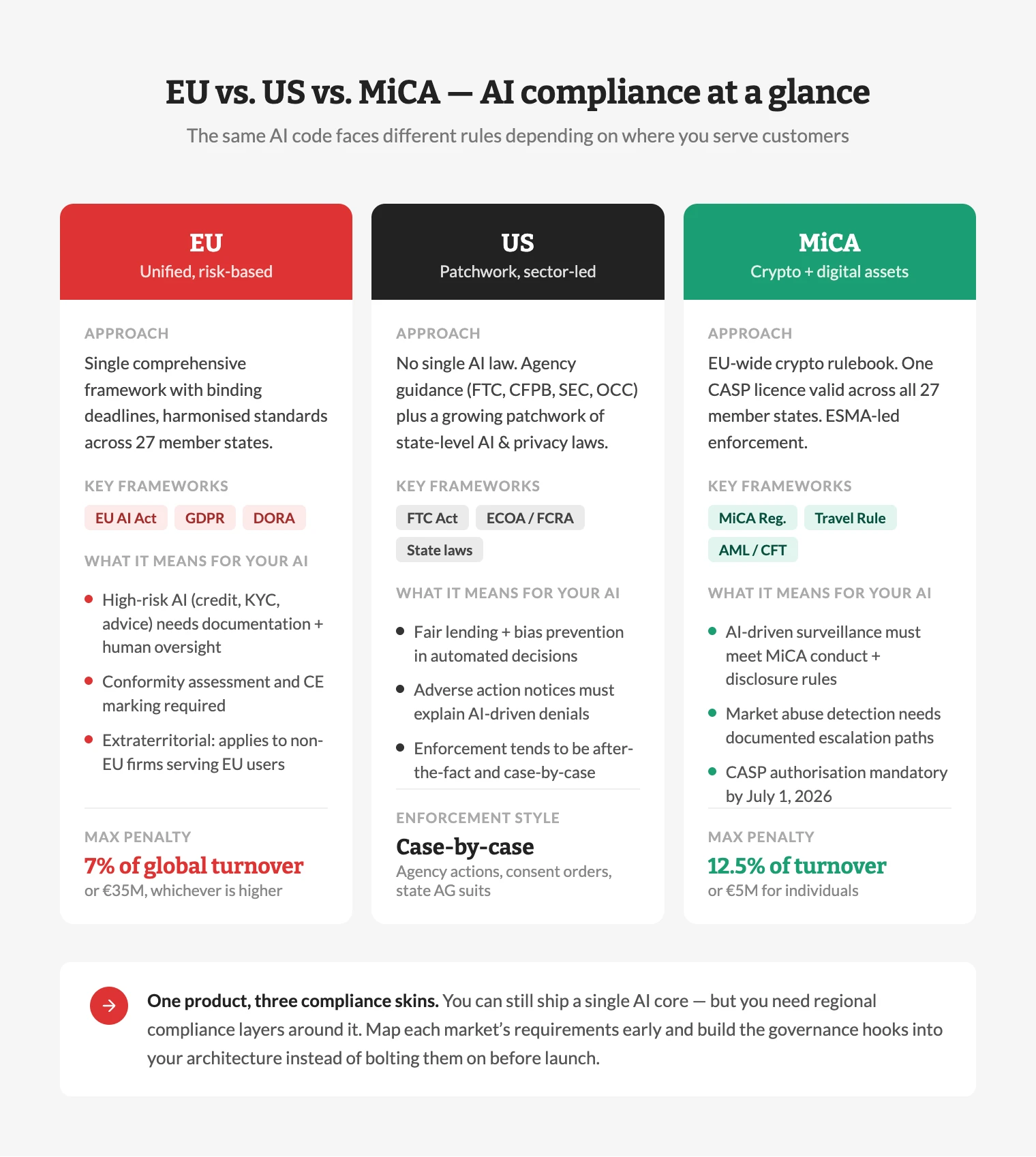
If you’re a fintech founder, that table is your mental model. You can still ship one product; you just need regional “compliance skins” around the same AI core. For a deeper dive into how AI in financial services shapes product strategy, check our take on banking digitalization.
Where AI in Financial Apps Goes Off the Rails (And How Regulators React)
Regulatory cases rarely begin with a clearly malicious implementation. More often, a “quick win” proof of concept turns into part of the production decision chain without matching AI governance for finance or formal approval. At some point, a pattern emerges in customer complaints or audit findings, and authorities begin to ask for evidence.
Regulators are already signalling what they worry about in the future: over‑reliance on generative AI for customer‑facing advice, opaque credit models, and AI‑driven compliance tools that themselves aren’t validated. For you, that translates into very specific risk hotspots to control early.
Typical Failure Modes of AI in Financial Applications
To make this concrete, think about your own stack for a moment. Which decision, if you had to present it tomorrow to a supervisor, would you struggle to explain? That question often points directly to the riskiest part of your system. The issues below recur frequently in discussions on AI in financial services and on financial AI compliance.
- Unexplained bias in credit or underwriting models that disadvantage protected groups without a clear, defensible rationale or mitigation plan.
- Hallucinated or outdated advice from generative AI agents that contradicts official disclosures, product documentation, or your stated risk profile.
- “Shadow models” created or fine‑tuned by teams outside formal approval, never added to your model inventory or validation pipeline.
- Model drift occurs when behaviour and fraud patterns change, yet no monitoring, retraining schedule, or thresholds for intervention exist.
- Compliance functions that use AI for transaction monitoring or KYC quality checks but rarely measure precision, recall, or false positives, causing gaps that regulators will eventually probe.
In a 2025 industry review, firms highlighting AI‑powered compliance also reported higher investments in model risk management and cross‑functional oversight, which is exactly what supervisors expect. Strengthening this capability often starts with a structured approach to artificial intelligence development services that covers data pipelines, model lifecycle management, and integration with existing risk and compliance systems in one coherent architecture.
A 7‑Step Compliance Blueprint for AI in Financial Services
You don’t need a 50‑step framework. You need something your product, data, and compliance leads can actually follow together. Think of this as a practical operating model across financial applications that keeps both engineers and regulators reasonably happy.
We’ll keep the language simple and the steps numbered. If you’re already live, treat this as a gap‑analysis checklist. If you’re pre‑MVP, use it to design your AI governance for finance into the architecture instead of bolting it on later.
Step 1: Map Your AI Use Cases and Risk Levels
You can’t manage what you haven’t mapped. Start by listing every current and planned use of AI in financial services across the customer journey and internal operations, including vendor models and embedded tools.
Then apply a simple risk‑based view inspired by the EU AI Act: high‑risk uses such as credit scoring or KYC decisions, medium‑risk areas like fraud scoring with human review, and lower‑risk UX features. That classification should influence documentation depth, validation requirements, and the level of human monitoring you build into each use case.
Step 2: Fix Your Data Governance Before Training Anything
Many financial AI compliance issues trace back to the data layer. Supervisors closely examine the data you collect, why you collect it, and how it flows through your systems. A model built on poorly governed data is difficult to defend, no matter how sophisticated the architecture.
Clarify the lawful basis and obtain explicit consent where required, control retention and deletion, and review cross-border data flows, especially when EU data is processed or stored in the US or other third countries. Document these decisions in a way that connects your data story to your AI in finance compliance narrative.
Step 3: Build a Model Risk Management Framework That Fits AI
Traditional model risk management often centres on static scorecards and infrequent updates. Modern AI in finance is different: models learn from new data, connect to outside APIs, and support more decisions. Your risk framework should match this reality.
For high‑risk systems, ensure independent review and clear approval criteria so AI governance for finance is a shared responsibility across risk, compliance, and technology teams.
Step 4: Design Explainability and Human Monitoring from Day One
Explainability is not only a technical issue but is also about communication and process. For high-risk AI in finance, like automated lending or investment profiling, supervisors expect clear explanations for users and an easy way for them to appeal to a human. Thoughtful UI/UX design plays a bigger role here than most teams realise: if your explanation screens are confusing, the explainability effort is wasted.
You can combine model‑agnostic explanation tools with simpler, interpretable models in areas where legal obligations leave little room for opacity. At the same time, decide which roles can override the model, under which conditions, and how each override is logged for subsequent audits. This ties directly into your AI governance for finance framework.
Step 5: Treat Generative AI as Regulated Advice, not a Toy
The rise of generative and agentic AI in financial services compliance has created new opportunities in client communication and internal support, as well as new regulatory questions. Supervisory bodies and industry associations warn that using generative tools in financial advice, planning, or suitability assessments introduces risks around hallucinated content, biased outputs, and weak audit trails.
The guardrails include domain‑constrained retrieval, clear topic boundaries, red‑team exercises, and explicit signalling of what the system can and cannot do. Log prompts and responses in line with your broader AI compliance in financial applications and record‑keeping, and ensure all flows remain consistent with your suitability, disclosure, and documentation obligations.
Step 6: Align AI Controls with MiCA Compliance if You Touch Digital Assets
If your AI in financial applications covers digital asset trading, custody, or analytics for EU users, MiCA compliance is central to your roadmap. Under MiCA, crypto‑asset service providers and related platforms face detailed requirements on governance, whitepapers, reserve management, and market conduct, with enforcement led by ESMA and national regulators. The final transitional deadline for CASPs falls on July 1, 2026 — after which providers without authorisation must stop offering regulated crypto-asset services in the EU.
AI‑based surveillance, risk scoring, and customer profiling must therefore be consistent with your MiCA obligations on transparency, incident reporting, and abuse prevention. This includes documenting how your AI detects market abuse, how you test underlying models, and how you escalate suspicious cases to human review. Companies building or upgrading MiCA‑ready fintech or CASP platforms often address these requirements through dedicated MiCA regulation compliance programmes that combine technical implementation, governance design, and ongoing monitoring.
Step 7: Close the Loop with AI Compliance Monitoring in Finance and Regular Audits
AI for compliance monitoring in finance isn’t a one-time task. Models change, data shifts, and rules in the EU and US keep evolving. Supervisors now expect ongoing controls, especially in key areas such as AML, fraud detection, and lending.
Define performance and equity thresholds, implement alerts for drift or unexplained behaviour, and schedule periodic independent software development audits that match each model’s risk level. In some cases, AI can support this work, for example, by helping to summarise complex logs or track regulation updates, provided that these oversight tools themselves follow your financial AI compliance standards.
Practical Examples: Making AI in Financial Services “Audit‑Story Ready”
When supervisors check your use of AI in finance, they want more than just policies. They look for clear explanations that link your business goals, data choices, model design, testing, and monitoring. The examples below show what this looks like in two common cases.
Example 1: Credit Scoring Model for EU and US Customers
Imagine a fintech offering near‑instant credit decisions to customers in both the EU and the US. The scoring model uses account history, income data, and behavioural patterns. To stay compliant, you:
- Classify the model as high‑risk under the EU AI Act and subject it to enhanced validation and documentation.
- Limit inputs to data allowed under fair lending rules and explain in plain language why each feature matters.
- Provide adverse action notices in the US with clear reasons, and GDPR‑compatible explanations, plus a human appeal channel in the EU.
Example 2: MiCA‑Ready Crypto Trading App with AI Fraud Analytics
Consider a crypto trading platform serving EU clients, where AI helps monitor transactions and detect suspicious patterns. This is a typical mix of AI in financial services, digital asset flows, and MiCA compliance. Under MiCA and EU AML rules, you:
- Obtain CASP authorisation and publish required crypto‑asset whitepapers with transparent risk descriptions.
- Use AI in financial applications to detect market abuse and suspicious transactions, but back it with human compliance analysts and documented escalation paths.
- Align your incident reporting process, business continuity plans, and security controls with DORA‑style operational resilience requirements.
If you’re building in the digital-asset space and privacy is core to your product, the compliance stakes are even higher. For example, when we developed Tingl, a blockchain-based anonymous messenger, security and regulatory alignment had to be baked into the architecture from day one, not patched in later. The same principle applies to any fintech shipping AI-powered features: get the compliance foundations right early, and the product scales with fewer roadblocks.
How to Document AI Decisions So Regulators Don’t Come Knocking
When supervisors review your AI documentation, they’re looking for precision, not polish. Vague statements like “our model is fair and transparent” actually raise more questions than they answer. Here’s what works: name the specific regulation or guidance your control addresses, describe exactly what the model does and what data it uses, state the validation method and frequency, and identify who has override authority.
If you can back up a claim with concrete numbers, such as test results, drift thresholds, retraining timelines, and false-positive rates, do it. This level of specificity signals competence to regulators and, as a bonus, tends to perform well in search rankings for AI and regulatory compliance topics.
Keep sentences short and direct. Reference actual regulation numbers (e.g., Article 10 of the EU AI Act on data governance, or MiCA Article 68 on market abuse detection) rather than making broad claims about “best practices.” Link to a few authoritative sources, be it official EU texts, ESMA guidelines, or agency guidance, rather than a dozen blog posts. Supervisors notice the difference.
Takeaways
Cross‑border AI compliance in financial applications hinges on how the US and EU regulate high‑risk AI in financial services such as credit underwriting and automated advice. The US relies on agency guidance and state rules, with rising expectations for bias and transparency, while the EU is shifting to a harmonised, risk‑based EU AI Act regime with strict duties on algorithmic clarity, human control, and alignment with the GDPR.
For financial institutions and fintechs active in several regions, these differences create both constraints and room to differentiate. Investing in regulatory compliance AI tools, building AI governance around local licensing, explainability, and early compliance controls helps scale AI for regulatory compliance in finance with fewer redesigns and smoother supervision. The compliance in the financial services industry only grows more complex, so the earlier you embed these practices, the better positioned you’ll be.
Need help building compliance into your AI-powered fintech product from day one? Whether you’re scoping an MVP, upgrading an existing platform for MiCA readiness, or need a compliance-focused software audit of your AI stack, our team at Redwerk can help. Talk to us about AI development services tailored to regulated industries.
FAQ: AI Compliance in Financial Services
What counts as high-risk AI under the EU AI Act?
Under Annex III of Regulation (EU) 2024/1689, AI systems used for creditworthiness assessment, credit scoring, insurance risk and pricing, and certain other financial decisions that affect access to essential services are classified as high-risk. These systems face the strictest obligations: risk management, human oversight, transparency, data governance, and technical documentation. Obligations for these systems become enforceable on August 2, 2026.
When does MiCA compliance become mandatory?
MiCA entered into force in June 2023, with rules for stablecoins (asset-referenced and e-money tokens) applying in June 2024. For crypto-asset service providers (CASPs), the final transitional deadline is July 1, 2026. After that date, all CASPs must hold MiCA authorisation to operate in the EU. Several member states have already ended their grace periods early, so check your specific jurisdiction.
Do US fintechs need to comply with EU AI rules?
Yes, if your AI system is used within the EU or produces outputs that affect EU residents. Like the GDPR, the EU AI Act has extraterritorial reach: it applies regardless of where your company is incorporated. A US-based fintech using AI for loan approvals or risk scoring that serves EU customers falls within scope and must comply with the relevant high-risk requirements.
What’s the difference between the EU AI Act and DORA for financial services?
DORA (Digital Operational Resilience Act, in effect since January 2025) focuses on ICT risk management, incident reporting, and third-party provider oversight for financial entities. The EU AI Act addresses the specific risks of AI systems, such as bias, opacity, and lack of human oversight. They complement each other: DORA covers your operational resilience and IT infrastructure, while the AI Act governs how your AI models are built, documented, tested, and monitored. Financial institutions using AI need to comply with both.
See how we developed
an anonymous web3 messenger
with exclusive chat privacy