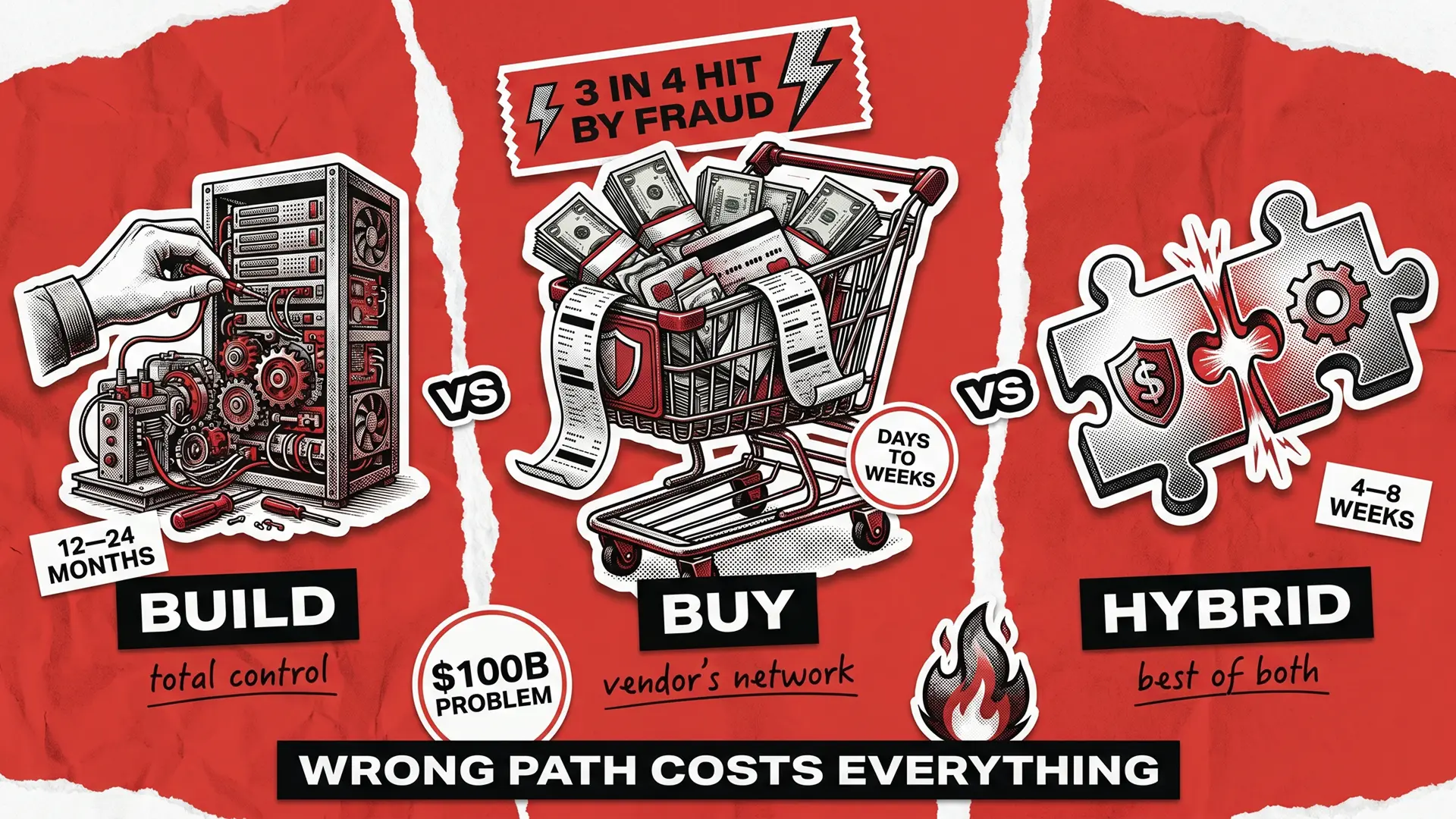
Three out of four U.S. organizations got hit by payments fraud in 2025, according to the 2026 AFP Payments Fraud and Control Survey. Global digital payment fraud losses are on track to climb from $40 billion in 2024 to over $100 billion by 2029, per a recent industry forecast. The pressure isn’t going away, and at banks it stacks on top of broader digital transformation work. So the real question is what you do about it.
The honest question isn’t whether you build or buy. Once fraud lands on your roadmap, the choice is between buying an off-the-shelf platform, building a custom system, or running a hybrid of both. Each path solves the same problem in a very different way. The right one depends on your stage, your engineering capacity, and whether payment fraud prevention is a product differentiator or just table stakes for your business.
Three Real Paths to Payment Fraud Prevention: Build, Buy, or Hybrid
The choice gets framed as binary far too often. There are three viable paths, and the right one depends on your data, your team, and your appetite for ownership.
Time to first protection
12–24 months
Days to weeks
4–8 weeks
Control over logic
Total
Limited
High
Data network effect
None
Strong
Strong + custom
Headcount required
High
Low
Medium
Adaptability to new patterns
High if maintained
Vendor-paced
High
The hybrid path is the one that gets glossed over most often, mostly because it isn’t a clean upsell for vendors. It’s also where most successful fintechs land. We’ll get to that in a moment, but first let’s look at the cases where each pure approach is the right call.
When Buying Off-the-Shelf Is the Right Call
Established SaaS providers run on networks trained on trillions of dollars in annual transactions. Across those networks, a meaningful share of any incoming card has typically been seen, scored, or already linked to known fraud rings. This is the single best argument for buying SaaS instead of building.
A new in-house build starts with zero network data. Even with great engineers, you can’t manufacture that scale on day one. So buying isn’t a compromise. For most companies, it’s the smarter path because the network effect on day one outweighs anything you could build in your first 18 months.

Five Scenarios Where SaaS Wins
You should buy off-the-shelf if at least three of these apply to you right now:
- You’re pre-Series-B with no spare engineers to spin up an ML team.
- Your checkout is standard, with no unique fraud signals coming off it.
- Fraud is table stakes for you, not a product differentiator.
- You need PCI compliance fast, in months and not years.
- Your transaction volume sits below the break-even point for a custom build, around 50 million transactions per year.
The decision gets cleaner as more of these stack up. If you’re a Series A fintech with 8 engineers and 200K monthly transactions, payment processing fraud prevention isn’t where you should be spending engineering cycles right now.
When Building Your Own Fraud Detection System Makes Sense
Building makes sense when off-the-shelf can’t meet your specific requirements. The catch is that most teams overestimate how unique their requirements actually are. A clean test is to ask whether two or more of the triggers below genuinely apply to you. If only one does, hybrid is probably your real answer instead.
Five Triggers That Justify a Custom Build
These are the situations where building your own fraud detection system is the right call:
- Payments are your core product. You’re a PSP, an acquirer, or a payments platform, not just a company that uses one.
- You have proprietary fraud signals competitors can’t see, like merchant behavior data, gameplay patterns, or lending repayment histories.
- Data residency or regulatory rules limit where your data can sit, including EU sovereignty requirements or central bank licensing constraints.
- Your transaction volume is high enough that vendor per-transaction fees outweigh in-house engineering effort.
- You need real-time decisions in under 50 milliseconds and the off-the-shelf API can’t deliver that consistently.
Building well also depends on partnering with the right team. We help fintechs and payment companies stand up custom payment fraud detection capabilities through our enterprise software development and AI development services teams.
Online Payment Fraud Detection: The CNP Case
Card-not-present (CNP) flows are where custom builds often outperform off-the-shelf models. Per the Federal Reserve Bank of Kansas City, CNP fraud rates have continued to climb across both single- and dual-message networks since 2015, even as card-present fraud has dropped.
Custom feature engineering, tuned to your specific funnel, often catches what generic models miss. Subscription billing, marketplace payouts, and B2B invoicing all have flow-specific patterns that off-the-shelf scoring doesn’t see. That’s where online payment fraud detection built from your own signals starts to pay back the investment.
The Hybrid Pattern Most Successful Fintechs Actually Use
Hybrid sits between build and buy, and it’s how a lot of payment platforms run their fraud stack today. You inherit the SaaS network effect on day one and keep full control over the rules and signals that actually move your fraud rate. You also keep the option to replace components incrementally as your needs change, without the big-rewrite trap that often kills full-build projects after year two.
The architecture has four layers, each with a clear owner.
The Four-Layer Stack
A practical hybrid setup looks like this, stacked from bottom to top:
- Baseline scoring (SaaS). An established provider handles the first scoring pass on every transaction.
- Custom rules engine. This sits on top of the baseline. Your business logic, edge cases, and velocity rules live here.
- Proprietary feature pipeline. Feeds your unique signals into the SaaS API or, where the fit is right, a parallel in-house model.
- In-house adjudication. Manual review, chargeback ops, and model performance monitoring stay with your team.
Underneath, the technical building blocks will be familiar to anyone who’s done data engineering work at scale. Streaming runs on Kafka or Kinesis. Real-time decisioning uses Flink or Spark Streaming. Feature stores like Tecton or Feast keep your signals clean and versioned, and a case management UI sits on top for the fraud ops team. This is the pattern that lets you compete on fraud detection and prevention without rebuilding the whole stack from scratch.
What You Trade Off in Each Path
Picking a path means picking the trade-offs you can live with. Pure build gives you total control and total responsibility. Pure buy gives you speed and a vendor’s roadmap. Hybrid splits the difference, with all the coordination overhead that implies.
Time, Talent, and Operational Ownership
Three trade-offs matter more than the rest. The first is time to value, which runs from days for buy, to weeks for hybrid, to twelve months or more for build. The full-build timeline includes data collection, model training, integration work, and shadow-mode testing before anything ships to production.
Talent is the part most teams underestimate. Building needs scarce ML and fraud expertise on staff, and that talent is expensive and hard to retain. Buying needs strong ops people who know the vendor’s tooling. Hybrid needs both, but lighter on each side.
Operational ownership comes down to one practical question: who handles a model misfire at 3 AM? With buy, the SaaS provider does. With build, you do. With hybrid, it depends on which layer broke, so your incident playbooks need to spell that out clearly.
Compliance Adding Weight, Especially in Banking
All three paths share the same operational rhythm, including model retraining cycles, third-party data subscriptions for device fingerprinting and KYC, manual review queues, and audit overhead.
Fraud detection in banking carries an extra layer most fintechs don’t face. Banks have to deal with Regulation E, OCC oversight, and SR 11-7 model risk management requirements. That guidance keeps tightening as ML moves deeper into financial decisioning, which raises the bar for AI compliance in any fraud system. Plan on 20 to 30 percent more documentation, validation, and audit cycles regardless of which path you pick. Issues like debit card fraud also bring specific regulatory scrutiny under Regulation E that doesn’t get relaxed because you bought your scoring engine off the shelf. Neobanks face a softer version once they cross charter thresholds, especially when fraud work runs alongside legacy banking modernization on the same roadmap.
Your 6-Question Decision Framework
Here’s the framework we use with clients sizing up the build, buy, or hybrid call. Run through these honestly with your team. Self-deception here costs you 18 months later.
- Is payments fraud prevention a core product differentiator for you, or just table stakes?
- Do you have 12 or more months of clean, labeled transaction data?
- Can you commit two senior engineers and a data scientist to this for 18+ months?
- Will your fraud model need signals no off-the-shelf provider has access to?
- Are you regulated in a way that limits where your data can sit?
- Is your transaction volume high enough that per-transaction fees outweigh in-house effort?
Score yourself on yes-or-no answers and read across:
- 0–1 yes: buy off-the-shelf.
- 2–3 yes: go hybrid.
- 4 or more yes: build with a partner who’s done this before.
The framework isn’t a magic answer. It’s a way to slow the decision down enough to spot the assumptions hiding underneath it.
Cut to the Chase
There’s no single right answer here, and anyone selling you one is selling you something. Your call depends on what your data shows, what your team can sustain, and whether catching fraud at the payment layer is core to your product or just a feature that has to work.
Run the six-question framework with your team. Be honest about the answers, especially on the talent and timeline questions. Then pick the path that fits your reality, not the one that fits a vendor’s pitch. Working through this decision and want a second pair of eyes? Contact us for a review. We’ll tell you which path fits your case, even if it’s not us doing the work.
FAQ
How long does it take to build a custom fraud detection system?
Twelve to twenty-four months for a production-ready system. That timeline includes data collection, model training, integration work, and shadow-mode testing before anything goes live. Cutting corners on shadow mode is one of the fastest ways to break customer trust at launch, so the time investment is genuine.
What's the minimum dataset to train a fraud detection model?
Realistically, six to twelve months of labeled transaction data with at least a few thousand confirmed fraud cases. With less than that, your model overfits on noise and misses the patterns it should catch. Until you hit that minimum, you’re better off riding off-the-shelf models and collecting data in parallel.
How does PSD2 SCA affect fraud prevention design?
Strong Customer Authentication exemptions hinge on transaction risk analysis. That means your fraud model directly affects checkout friction and approval rates. The smart move is designing SCA exemption logic into the system from day one, not retrofitting it after the first regulatory audit.
See how we extended a screen-watermarking platform that now protects 50+ major fintech and telecom enterprises from data exfiltration and insider fraud.