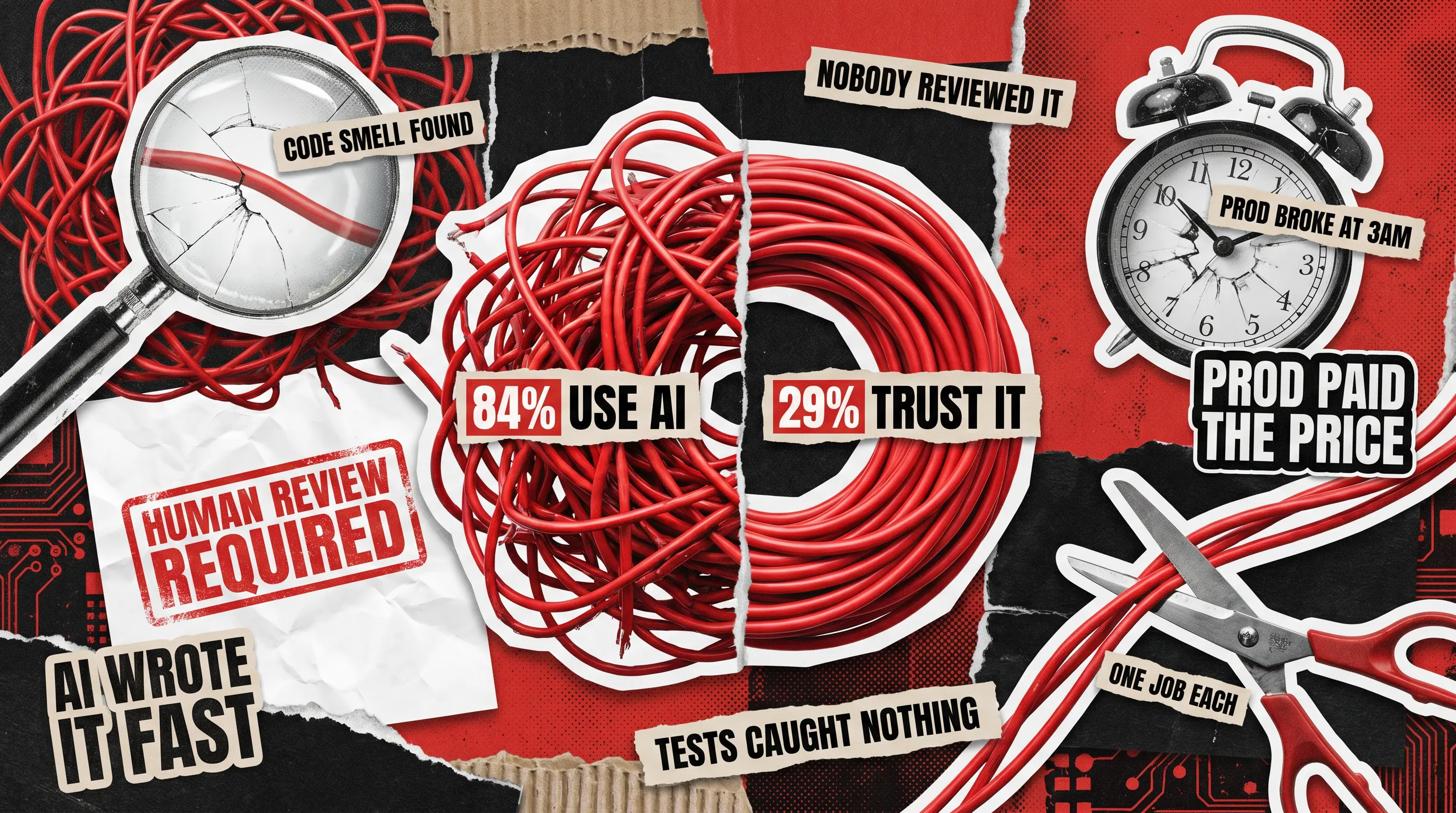
Technical debt has been the top workplace frustration for developers for three years running, and 2025 added a new twist. The Stack Overflow 2025 Developer Survey, based on 49,000 responses, found that 84% of developers now use or plan to use AI tools, yet only 29% trust the accuracy of the output. The biggest single frustration, cited by 66% of respondents, is AI solutions that are “almost right, but not quite,” and 45% report losing meaningful time debugging AI-generated code.
Founders and engineering leaders sit in the middle of that gap. They know refactoring is overdue and that reaching for an LLM without a plan turns cleanup into a regression report. This guide walks through six code refactoring techniques worth using in 2026, when to reach for each, and where AI genuinely helps. When the cleanup looks bigger than one sprint, a structured code review is the fastest way to scope it.
What Refactoring Actually Changes
Refactoring restructures existing code without changing what it does from the outside. Tests pass before; tests pass after. The function signature stays. The API contract stays. What changes is the shape of the code inside: shorter methods, clearer names, fewer duplicates, a design that survives the next six months of feature work.
That definition matters because the word gets misused in three ways. Fixing a bug is debugging. Making code faster is optimization. Replacing the system is a rewrite. Refactoring is the quiet middle ground, where most software engineering teams win or lose their margins for the year ahead.

The Six Code Refactoring Techniques Worth Knowing in 2026
The techniques below cover roughly 90% of the cleanup work a mid-sized product team faces in a year. Each one pairs with a specific code smell, a language where it shines, and a verdict on whether an LLM should be trusted with the change.
Mechanical Refactors: Extract Method and Rename
These two belong together. They are the fastest, safest, and most common starting points, and modern IDEs automate most of the work. Extract Method takes a long function doing three jobs and gives each job its own name. Rename replaces data, tmp, or x with something a reader can parse in one second.
Here is a Python example. Before:
def process_order(order):
    subtotal = sum(item.price * item.qty for item in order.items)
    tax = subtotal * 0.2
    total = subtotal + tax - order.discount
    send_email(order.customer, total)
    return total
After:
def process_order(order):
    subtotal = calculate_subtotal(order.items)
    total = apply_tax_and_discount(subtotal, order.discount)
    notify_customer(order.customer, total)
    return total
Each helper reads like a sentence. The main function reads like an outline. This kind of change is where AI assistants perform reliably and where you should let them.
Refactoring by Abstraction
Two React components share 80% of the same logic with tiny differences. Three microservices each parse the same webhook payload their own way. Abstraction lifts the shared logic into one place: a base class, a shared hook, a utility module.
The payoff is real. When the payload format changes, you edit a single file, and that edit propagates. The risk is real, too. Abstract too early, and you invent a hierarchy that fits nothing. A useful rule from decades of practice: wait until three concrete duplicates exist before abstracting. Two might be a coincidence. Three is a pattern.
This is one of the techniques where an LLM will confidently produce an abstraction that looks clean and quietly fails on the edge case that matters. Human review is required.
Replace Conditional with Polymorphism
The switch statement that grows every quarter is the classic smell. A getShippingCost method with fifteen if branches for fifteen product types. Java example:
// Before
double getShippingCost(Product p) {
    if (p.type == BOOK) return p.weight * 0.5;
    if (p.type == FRAGILE) return p.weight * 2.0 + 5;
    if (p.type == DIGITAL) return 0;
    // ...
}
After that, each product type owns its own shipping calculation as a subclass or strategy, and the giant conditional disappears. New product types slot in through the type hierarchy, leaving the old code untouched. This technique is why the Open-Closed Principle sits at the center of most Java code refactoring techniques references.
Red-Green-Refactor
This one is the discipline that makes every other technique safe. Write a failing test. Make it pass with the simplest code. Then improve the code while the test stays green. It comes straight from test-driven development, and it is the reason mature teams can refactor code aggressively without breaking production.
The reason to name it here: most teams that fail at refactoring skip this step. They restructure without a safety net, ship, discover a regression later, and blame the refactor. McKinsey‘s survey found that top-quintile AI-enabled software teams achieve 16xE2x80x9330% improvements in productivity and 31xE2x80x9345% gains in software quality, and the common thread across those top performers is disciplined testing around every change. The safety net is what makes the difference measurable.
Preparatory Refactoring
Kent Beck’s line: make the change easy, then make the easy change. If a new feature requires touching a tangled module, the honest move is to clean the module first, then add the feature. Two commits. Two reviews. Two rollback points. This is one of those best practices for code refactoring that sounds obvious in a blog post and gets skipped in real sprints under deadline pressure.
The mistake most teams make is bundling the two together. The refactor and the feature ship in a single giant pull request; nobody can tell which change broke production, and the team swears off refactoring for another year. Split the commits and the payoff compounds. On live products, holding this discipline across quarters is the core of any serious software maintenance engagement.
Strangler Fig for Legacy Code
Some codebases sit past the point where in-place refactoring makes sense. A twelve-year-old monolith with 400,000 lines and no tests resists any cleanup effort you throw at it. The strangler fig pattern wraps the legacy system with a new interface, redirects traffic function by function to modern replacements, and lets the old code die piece by piece.
This is the technique that pays for itself on legacy modernization projects. It preserves revenue while the team ships incremental improvements. Older monoliths often need dedicated legacy code modernization rather than in-place refactoring, and our field notes on legacy modernization best practices cover the sequencing choices that decide whether the migration ships in months or drags on for years.
AI-Assisted Refactoring
AI changed the economics of refactoring in the last eighteen months. It also changed the failure mode. An AI-assisted rename looks perfect in the diff, ships to production, and breaks a reflection-based call site that the model never saw.
Where LLMs earn their keep on refactoring:
- Boilerplate renames across a file or module.
- Extract Method suggestions on functions that the model can read end-to-end.
- Characterization test scaffolding for legacy code with no coverage.
- Deprecated API replacements at the call-site level.
- Docstring and inline-comment generation.
Where they hurt:
- Cross-file abstractions that require understanding business rules the model has never seen.
- Seam identification for strangler-fig migrations.
- Any change to code that lacks a passing test suite.
The pragmatic setup used by teams that ship value from AI refactoring: pair every LLM-assisted change with a green test suite and a human diff review. This is one of the code refactoring best practices that separates teams shipping cleaner code from teams shipping faster regressions. The same McKinsey survey found that over 90% of software teams now use AI for refactoring, modernization, and testing, saving an average of six hours per developer per week. Deployed with review discipline, teams get faster diffs and cleaner releases. Building that review layer into a continuous software product engineering workflow is what stops AI speedups from becoming faster regressions.
Language-Specific Idioms That Don't Fit the Universal Six
The six techniques above are language-agnostic. Every mainstream language also has idioms that only make sense inside that ecosystem, and skipping them leaves obvious cleanup on the table.
Python
Python code refactoring techniques worth keeping in muscle memory: replace explicit for loops with comprehensions when the intent is a transformation or a filter, move hard-coded values into configuration or environment variables, and lean on dataclasses instead of dictionaries when the shape stabilizes. The Python community’s shift toward type hints in 2024–2025 also created a low-effort refactor path: annotate function signatures, run mypy, and let the type checker surface the drift that has accumulated since the last cleanup. This is a reliable path to improve the readability of a mature codebase without touching business logic.
Java
The Stream API and lambda expressions are still the biggest source of Java-specific cleanup gains. Loops that filter, map, and aggregate can be compressed into a single expression that states intent rather than mechanics. On top of that, records (finalized in Java 16 and now widely adopted) replace verbose data-carrier classes with three-line declarations. Applying the Single Responsibility Principle to bloated service classes remains the most impactful structural change on the backlog of most Java teams.
JavaScript / React
React code ages badly when components grow past a few hundred lines. Two moves recover most of the readability lost. First, extract custom hooks for any logic that touches state or effects and could be reused. Second, replace prop drilling with context or a state library once the same prop crosses three component boundaries. On the JavaScript side, the shift from callback chains to async/await remains one of the highest-leverage rewrites in older software development codebases, and modern linters surface every candidate automatically.
When Refactoring Is the Wrong Call
Refactoring is a tool. Every tool has a wrong situation. Three cases where a rewrite or a wrap beats a refactor:
The target platform is being retired. If the framework is end-of-life or the runtime hits a vendor sunset date, refactoring inside it postpones the real work. Plan the migration.
The code has zero test coverage and is actively in production traffic. Refactoring blind is the fastest way to ship a regression to paying customers. Write characterization tests first that lock the current behavior, then refactor safely with the net in place. If the codebase resists even that, wrap it with a strangler fig instead.
The cost of learning the code exceeds the cost of rewriting it. This is the honest call on some inherited codebases. If nobody on the team can explain what a critical module does within a week, and the module is 500 lines, a clean code rewrite with the right tests may be cheaper than the archaeology. This decision needs data, and a structured code review surfaces the numbers you need to make it.
Make the Next Feature Easy
Every one of these techniques is an investment in the next feature. Extracting the method makes it easier for the next reader. Abstraction makes the next duplicate cheaper. The strangler fig enables the next migration. Kent Beck’s line still holds twenty years on: make the change easy, then make the easy change.
Two anchors matter more than any specific technique. Keep a passing test suite in front of every refactor. Keep the refactor commit separate from the feature commit. Teams that do both compound gains. If your team is planning a major cleanup and wants a second set of eyes on the sequencing, contact us, and we’ll walk through the plan.
FAQ
What is code refactoring?
Code refactoring is the process of restructuring existing source code to improve readability, maintainability, and structure without changing what the software does externally. Tests that passed before the change should pass after it. The goal is a codebase that is cheaper to extend, easier to debug, and safer to hand off.
What are the most common code refactoring techniques?
The most widely used techniques are Extract Method, Rename, Refactoring by Abstraction, Replace Conditional with Polymorphism, Red-Green-Refactor, Preparatory Refactoring, and the Strangler Fig pattern for legacy systems. Each one addresses a specific code smell and fits some languages better than others.
Is it safe to refactor code with AI?
Safe for mechanical changes such as renames and single-file method extraction, provided the test suite passes. Risky for cross-file abstractions, business-rule-heavy logic, and any code change that lacks test coverage. The reliable pattern used by teams that succeed with AI refactoring is a green test suite plus a human diff review on every LLM-generated change.
What's the difference between refactoring and rewriting?
Refactoring preserves external behavior and evolves the internal structure of code in small, reversible steps. Rewriting replaces the code, often changing behavior, architecture, or platform in the process. Refactoring is the safer default. Rewriting wins when the target platform is being retired or when the existing code costs more to learn than to replace.
How often should teams refactor?
Continuously, in small commits alongside feature work, rather than as isolated multi-week projects. Teams that reserve time for refactoring inside every sprint keep technical debt manageable. Teams that defer it to a dedicated cleanup quarter usually discover the debt has compounded beyond what that quarter can handle.
See how a Redwerk code review of a Python backend uncovered 40 critical issues and drove an 80% increase in maintainability for Project Science