
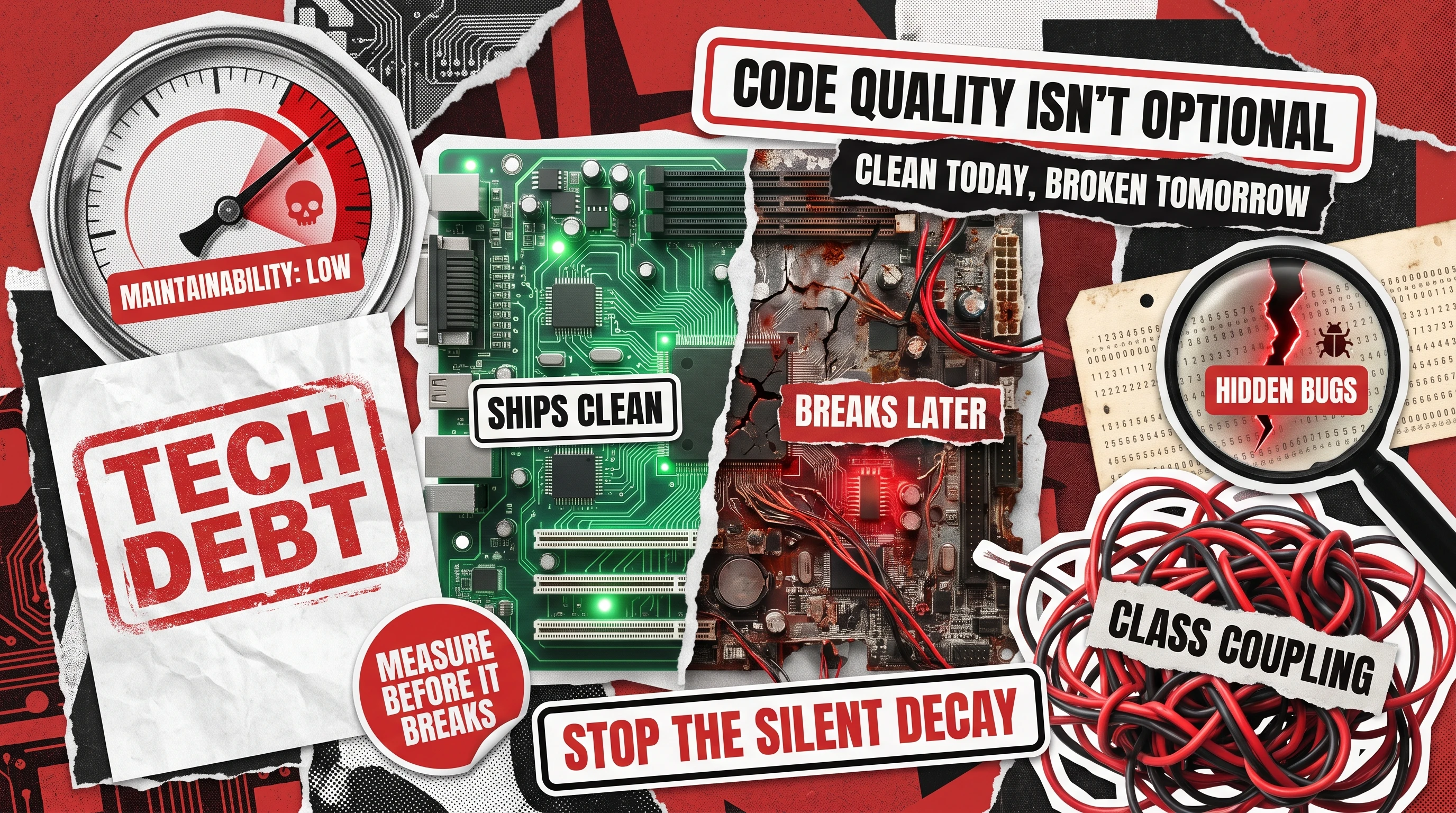
Every engineering leader eventually faces the same quiet decision: ship faster now, or slow down and fix the code underneath. Choose speed too often and the bill arrives later as missed deadlines, production incidents, and features that take three times longer than they should have. Code quality is the variable that decides how big that bill gets, and unlike team morale or market timing, it can be measured, tracked, and controlled.
The stakes are not abstract. In the 2025 Stack Overflow Developer Survey of more than 49,000 developers across 177 countries, technical debt ranked as the single most common source of frustration, cited by 62% of respondents, roughly twice the rate of the next complaint. For founders, managers, and project leads weighing whether to invest in cleanup, an audit, or a delivery partner, the first step is understanding what quality actually is and how to put a number on it.
What Code Quality Actually Means
Code quality is the degree to which software is correct, readable, maintainable, secure, and efficient enough to change safely over time. It is a separate question from whether the app happens to work today. A feature can pass every test and still sit on top of source code quality so poor that the next change breaks two things nobody touched.
Practitioners usually split quality into two halves. External quality covers what users and stakeholders see, meaning correctness, performance, and reliability. Internal quality covers what only engineers see, including structure, naming, test coverage, and how tightly modules depend on each other. Internal quality is the half that quietly determines your future velocity, because it sets the price of every change you will ever make. A product that feels fine to users can be nearly frozen internally, where each new request means untangling code that was never built to grow.
Why Code Quality Is a Business Metric
Poor internal quality does not stay an engineering problem for long. It surfaces on the income statement as slower releases, higher support costs, and revenue lost to downtime and security incidents. According to a 2025 Forbes Technology Council analysis of Tricentis research, 40% of organizations say poor software quality costs them more than $1 million a year, and 45% of US businesses report losses above $5 million annually.
Teams that measure code quality consistently get three advantages their competitors lack. They get early warning before a module becomes unmaintainable, an objective basis for prioritizing refactoring against new features, and a defensible answer when a board or an acquirer asks how healthy the codebase really is. That last point carries real money, since technical debt is one of the first things a serious due-diligence team digs into during a funding round or acquisition. If you want a structured way to translate that debt into hours and dollars, our guide on how to measure technical debt walks through the calculation step by step.
How to Measure Code Quality: Four Metrics That Hold Up
Answering how to measure code quality starts with rejecting vanity numbers. Lines of code and raw commit counts tell you about volume, not health, and they reward the wrong behavior. The four metrics below have survived decades of use because each maps to a specific failure mode, and all four are computed automatically by tools such as Visual Studio Code Metrics for .NET, SonarQube, and their equivalents across other stacks.
A rigorous code quality analysis reads these four together, so that no single number can hide a problem. High test coverage means little if complexity is out of control, and a clean maintainability score can still mask a fragile inheritance chain underneath. Here is what each one actually tells you, and where the danger zone starts.
Maintainability Index
The Maintainability Index rolls complexity, lines of code, and other factors into a single score from 0 to 100. In Visual Studio, 20 to 100 shows green, 10 to 19 shows yellow, and 0 to 9 shows red. It is the fastest way to decide which files deserve attention first, and it works best as a trend line rather than an absolute grade. A slowly falling index across releases is one of the clearest early signs that a codebase is starting to decay.
Cyclomatic Complexity
Cyclomatic complexity counts the independent paths through a piece of code, which is effectively the number of decisions a method makes. A method scoring 1 to 10 is straightforward to read and test with a manageable number of test cases. Once it climbs past 10 the count of tests needed to cover it grows quickly, and past 20 the method becomes a reliable home for hidden bugs. Splitting one overloaded method into several focused ones is usually the cheapest quality win available to a team.
Depth of Inheritance
Depth of inheritance measures how many parent classes sit above a given class. Shallow hierarchies of roughly one to three levels are easy to reason about and safe to change. Deep chains make behavior hard to trace, because a change in a distant base class can alter a subclass in ways no one predicted during the edit. When you see depth creeping upward release after release, favoring composition over inheritance is the standard way to flatten it back out.
Class Coupling
Class coupling counts how many other classes a given class relies on to do its job. Lower coupling keeps changes local, so fixing one component does not force edits across a dozen others. High coupling is what makes a codebase feel brittle, where a small request quietly turns into a week of untangling dependencies. Reducing coupling through clear interfaces and well-defined boundaries is one of the highest-leverage structural improvements a team can make.
How to Improve Code Quality
Knowing how to improve code quality is less about heroic rewrites and more about installing a few disciplines that catch problems while they are still cheap to fix. The four practices below work in sequence: standards prevent issues, reviews catch them, refactoring removes the ones that slip through, and an independent audit tells you the truth when your own team is too close to see it.

Coding Standards and Linting
Standards turn “good code” from an opinion into a checklist a machine can enforce. A shared style guide plus an automated linter, such as ESLint for JavaScript, Ruff for Python, or the built-in .NET analyzers, blocks whole categories of defects before a human ever opens the pull request. The payoff compounds over time. When every file follows the same conventions, new engineers ramp faster and reviewers can spend their attention on logic and design instead of formatting nits.
Code Reviews
A disciplined review process is still the highest-return quality practice most teams have, because a second set of experienced eyes catches design flaws that no linter understands. Effective reviews are small, frequent, and focused on the short list of things that genuinely matter, which is why a shared code review checklist beats ad hoc feedback every time. Teams that lack the senior bandwidth to review consistently often bring in an outside partner through a dedicated code review service to hold the line without slowing delivery down.
Refactoring
Refactoring improves internal structure without changing external behavior, and it is most effective as a steady habit rather than a once-a-quarter cleanup event. The reliable approach is to refactor in small steps under test coverage, so each change stays safe and reversible. This matters more than ever now that AI assistants generate large volumes of plausible but loosely structured code. The same 2025 Stack Overflow survey found 66% of developers frustrated by AI output that is “almost right, but not quite,” and 45% report that debugging AI-generated code takes longer than expected. Cleaning up that output through structured AI code cleanup keeps a fast prototype from hardening into permanent debt.
Independent Audit
Internal teams struggle to judge their own code objectively, because they carry the same assumptions that created the problems in the first place. An independent software development audit brings a fresh senior perspective and a repeatable methodology, and it produces a prioritized list of what to fix along with an estimate of what each fix will cost in hours. Audits earn their keep before a funding round, an acquisition, or a major scale-up, and they are equally worth scheduling for AI-heavy codebases, as our breakdown of a vibe code audit explains in detail.
How to Keep Code Quality from Slipping
Improvement is only half the job. Without a system to hold the gains, quality erodes on its own as deadlines compress and small shortcuts quietly accumulate. Sustained code quality assurance means building the checks into your pipeline so that standards enforce themselves, rather than depending on anyone remembering to care on a busy release day.
A handful of controls keep the trend line pointing the right way:
- Put quality gates in CI, so a build fails when coverage drops or complexity crosses an agreed threshold.
- Track the maintainability index as a trend across releases, and treat a sustained decline as a planning trigger.
- Reserve a fixed share of each sprint, often 15 to 20%, for paying down debt before it compounds.
- Make review and testing non-negotiable for every merge, including small ones, since many regressions hide in “trivial” edits.
- Re-audit periodically, especially after rapid growth, a team change, or a burst of AI-assisted development.
The teams that hold quality steady over years are rarely the ones with the most gifted individual engineers. They are the ones who turned quality into a property of the system, enforced by tooling and process, instead of a matter of daily willpower that fades under pressure.
Making Quality a System
Quality is not something you buy once and forget; it is a discipline you maintain. The teams that treat it as a measurable, managed property of their software ship faster, sleep better, and defend their valuation when it counts. If your codebase is growing faster than your confidence in it, an experienced outside team can give you an honest baseline and a concrete plan to act on. Redwerk has spent more than 20 years auditing, rescuing, and hardening software across .NET, Python, and other stacks, so contact us to talk through where your code stands today.
FAQ
What is code quality?
Code quality is how correct, readable, maintainable, secure, and efficient software is, judged by how safely and cheaply it can be changed over time. High-quality code keeps working predictably as it grows, while low-quality code becomes more expensive and risky to touch with every release.
How do you measure code quality?
You measure it with a combination of automated metrics and human review. The most reliable metrics are the maintainability index, cyclomatic complexity, depth of inheritance, and class coupling, ideally tracked as trends across releases and paired with test coverage and defect rates rather than read in isolation.
How can I improve code quality?
Start with enforced coding standards and automated linting, add consistent peer reviews, refactor in small steps under test coverage, and bring in an independent audit when you need an objective baseline. Building these checks into your CI pipeline is what keeps the gains from slipping back over time.
What metrics are used for code quality analysis?
Common metrics include the maintainability index, cyclomatic complexity, depth of inheritance, class coupling, test coverage, code duplication, and defect density. Using several of them together prevents any single score from masking a real problem elsewhere in the codebase.
What is a good maintainability index?
On the 0 to 100 scale used by tools like Visual Studio, a score of 20 to 100 is considered healthy (green), 10 to 19 is moderate (yellow), and 0 to 9 is poor (red). A value above 85 generally indicates highly maintainable code. The trend matters as much as the absolute number, so a steadily falling index is a warning sign even when it is still in the green.
See how we audited a cross-platform network mapping app pre-release and helped achieve 90% code maintainability

