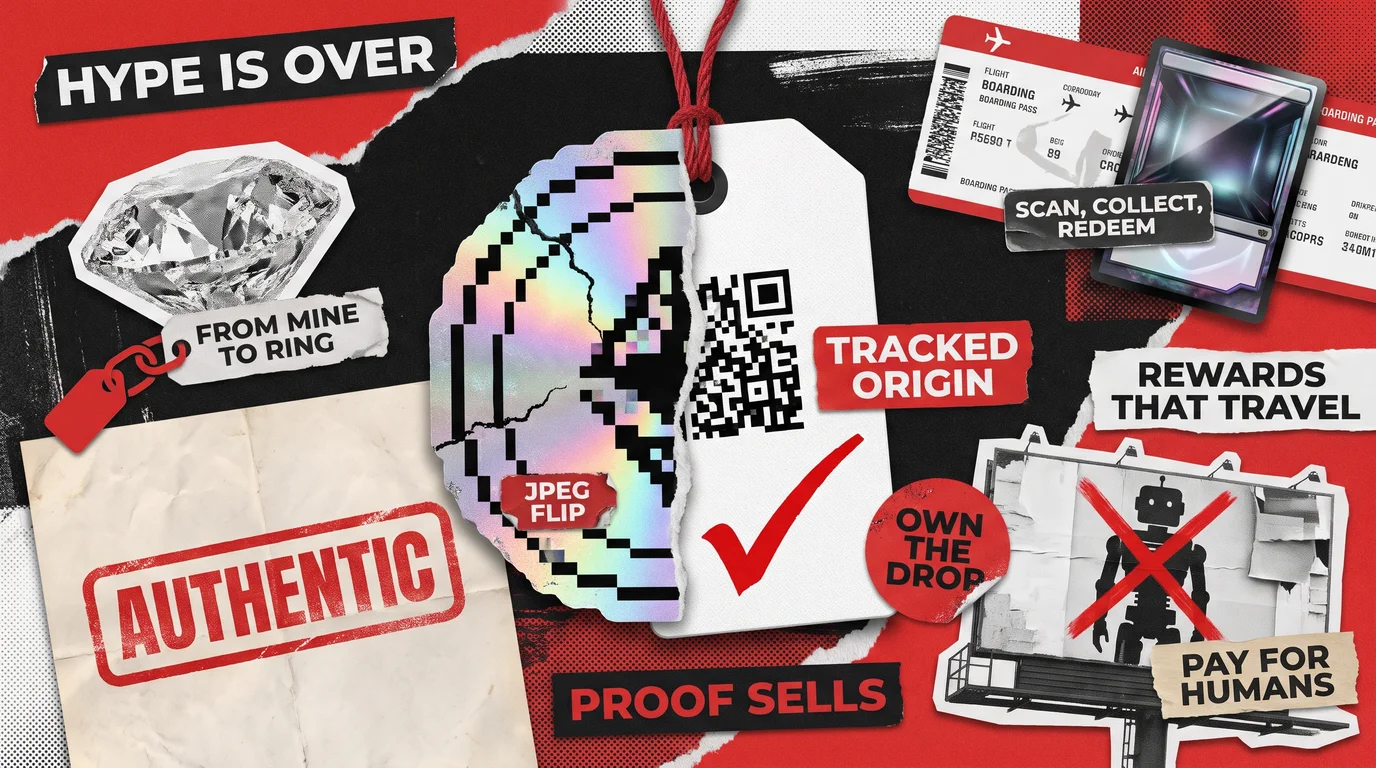
Blockchain in marketing is used today to prove where products come from, run token-based loyalty programs, and sell digital collectibles that customers actually own. De Beers has registered more than 5 million rough diamonds this way, Breitling issues a digital passport with every watch, and Lufthansa Group rewards travelers with collectible cards for their flights.
Advertisers are also testing shared delivery logs with publishers, so payments go out only for confirmed ad views. The decision for a marketing team is which of these ideas will earn back the investment.
Each use below comes with practical advice for trying the approach in your own business. When you’re ready to build, our blockchain development services handle everything from the network itself to the apps your customers use.
What Happened to NFT Marketing?
The first wave of blockchain in marketing was built around NFTs, digital tokens that prove who owns a unique item. Since the 2021 and 2022 peak, NFT marketing has moved from hyped brand experiments to low-cost tokens tied to real products and perks.
Several of the best-known programs have closed. For example, Nike bought RTFKT, a virtual sneaker studio, in 2021. In December 2024, the company announced that the label would wind down by the end of January 2025.
Meanwhile, NFTs became much cheaper and easier to buy. According to DappRadar, the average NFT sold for about $321 in January 2025 and about $54 by October. The lower prices drew in many new buyers. The same report links that growth to brand partnerships and to tokens tied to physical goods. For example, some collectors buy NFTs of trading cards that they can later exchange for the physical, professionally graded original.
What Are the Main Blockchain Marketing Use Cases?
Brands use blockchain today for product provenance, digital product passports, loyalty rewards, brand collectibles, and advertising. Each of these blockchain marketing use cases meets one of two conditions:
- Several parties need to trust the same record.
- Customers need to own something outside the brand’s app.
These products and recent campaigns show each use in practice:
Product provenance
De Beers Tracr
Registers rough diamonds at the source, with more than 5 million recorded so far
Product provenance
Aura Blockchain Consortium
Gives more than 80 million luxury products from LVMH, Prada, Richemont, OTB, and other members a digital identity
Digital product passports
Breitling
Attaches a digital passport to every watch to prove authenticity and transfer ownership at resale
Loyalty rewards
Lufthansa Group’s Uptrip
Turns boarding passes into collectible cards that travelers redeem for miles, lounge vouchers, and status
Brand collectibles
Amazon and Yuga Labs
Offered a limited NFT avatar for regular money in October 2025, which sold out within a day
Brand collectibles
Kellogg’s Froot Loops and Doodles
Bundled NFTs with 500 limited cereal boxes at $50 each, which sold out within hours
Advertising
Brave browser
Rewards users with tokens for viewing privacy-friendly ads, with 101 million monthly users in 2025
In most of these programs, customers scan a code, collect a card, or check a certificate without handling cryptocurrency.
How Does Blockchain Prove Where a Product Comes From?
Each company in the supply chain records its own steps on a shared ledger. No single participant can change those entries later without the others noticing. The result is provenance, a verified history of where the product came from. Brands use this history to back up claims customers often question, such as “ethically sourced,” “made in Italy,” or “authentic.”
A blockchain proves that a record hasn’t changed since someone entered it. However, the ledger can’t confirm the entry was true in the first place. For example, if a supplier records cotton as organic, the blockchain keeps that statement intact. Certificates, audits, and physical checks still decide whether the claim is accurate.
New EU rules make verified product data more important for marketers. For example, in July 2026, the European Commission launched a registry for Digital Product Passports, records of what an item is made of and where it came from. Batteries for electric vehicles, e-bikes, and industrial use will need one from February 18, 2027. In addition, EU consumer rules that apply from September 27, 2026, restrict vague environmental claims that a brand can’t support with evidence. However, the Commission’s battery passport FAQ says blockchain “is not prohibited, but it is not required.”
To try provenance tracking in your own business, start with one product line and one claim that buyers doubt. Next, decide who writes the data and who needs to verify it. If shoppers must check the history without trusting your brand, an open network fits. When only your company and its suppliers add entries, a members-only one is enough. Shoppers can still see the data on your website. The private vs public blockchain choice comes down to these questions. Online retailers can then display the verified history on product pages as part of their e-commerce development work.
Do Blockchain Loyalty Programs Work?
A token-based loyalty program succeeds when customers can earn and redeem rewards without learning anything about crypto. In such a program, every point a customer earns becomes a digital token held in an account linked to a blockchain. Unlike regular loyalty balances, tokens can be set up to move between partner brands or be resold.
Few brands run blockchain loyalty programs yet. Two well-known examples had opposite results:
- Lufthansa Group’s Uptrip: The program is still running in 2026. Travelers scan boarding passes from the group’s airlines, collect digital trading cards, and complete full sets to earn award miles, lounge vouchers, or frequent traveler status. Each collectible can become an NFT on the Polygon blockchain. However, travelers don’t need to know that to take part.
- Starbucks Odyssey: The company ended the program in March 2024, after a beta test. Its only explanation was the need to “prepare for what comes next.”
Crypto wallets add extra tasks that first-time users may find hard. For example, Tingl, the blockchain messenger we built, asked people to set up a MetaMask wallet and pay network fees. Both tasks require some technical knowledge. Ideally, shoppers never have to deal with either one.
If you plan to launch a token-based rewards program, these steps keep it simple for customers and low-risk for your brand:
- Issue tokens inside your existing program first. Add transfers between brands only after a partner signs on.
- Let customers sign in with an email address. Keep the wallet out of sight.
- Before launch, choose success metrics such as repeat purchases or redemption rates.
- Plan how customers recover a lost account.
Can Rewards Work Across Brands?
Rewards work across brands only after the companies involved agree on value, redemption, and who pays whom. Sharing points this way is a frequently cited promise of blockchain in marketing. That promise is also one of the hardest to deliver. The technology can move a token to any account. However, a partner still decides whether to accept it. Settling balances between the companies works much like blockchain payment processing.
Resale also raises legal questions. Once customers can sell their rewards for money, regulators may treat those tokens as crypto-assets under the EU’s Markets in Crypto-Assets (MiCA) regulation. In that case, plan MiCA compliance work before launch.
How Can Brands Use NFTs and Digital Collectibles Today?
Brands use NFTs today as limited collectibles, tickets and access passes, and proof of purchase for physical products. Such NFTs sell when fans get something they value, for example a limited item from a brand they already like.
Brands also give NFTs away to build interest before a product launch. For example, the studio behind the metaverse game Human Park planned to give avatar NFTs to about 30,000 people on its waitlist before release. A giveaway of that size brings many users into the product at once. For that reason, our QA team tested the installation, launch, and avatar configurator beforehand. As a result, the developers could confidently host their mint event, where early adopters claimed their NFTs. The project appears in our roundup of metaverse business ideas.
Two choices shape the cost of an NFT program:
- Where customers keep their NFTs: A wallet built into your app makes the program easier to join but adds development work. Such a wallet needs some of the same parts as the crypto banking app features that show balances and transfers. The NFTs still sit on the blockchain, so their owners can transfer them elsewhere if you allow it.
- Whether customers can resell their NFTs: Resale turns the program into a small marketplace with listings, pricing, and payments between buyers and sellers. The same parts drive crypto exchange development cost.
Our team builds NFT platforms and marketplaces for brands.
Can Blockchain Reduce Ad Fraud?
Blockchain can reduce billing disputes over ad fraud by giving advertisers and publishers one shared record of each ad delivery. Catching the bots themselves still requires separate tools.
Ad fraud happens when bots generate fake views and clicks that advertisers still pay for. Companies have tested blockchain in marketing against this problem since around 2018. So far, no large advertiser has published independent results. Instead, the ad industry relies on non-blockchain standards such as ads.txt and sellers.json.
A shared delivery record is most useful for a company that buys ads directly from several publishers or affiliates. Such buyers often argue with partners about what ran and what should be paid. The safest first step is a small pilot that could work like this:
- Agree on what counts as a valid delivery. Advertiser and publishers define the events that trigger payment, for example a view that a verification service has confirmed as human.
- Record each delivery on a shared ledger. Every party writes its own data. Nobody can change past entries without the others noticing.
- Pay through a smart contract. Code stored on the blockchain transfers the money by itself once the agreed conditions are met.
- Keep independent fraud detection. Bot filtering still decides which views were real. The ledger only stores the result.
- Check the numbers before expanding. Compare costs and billing disputes against your other campaigns.
Paying automatically once outside data confirms an event is a common pattern in blockchain technology. Many blockchain fintech use cases rely on this pattern. Smart contracts for insurance claims use it as well, releasing a payout once a trusted report confirms the loss. In every case, the payment is only as accurate as the data behind it.
When Is Blockchain in Marketing Worth It?
Blockchain in marketing pays off when one specific problem needs a shared record: proving a claim, rewarding customers across partners, or giving fans an item they truly own. Before you commit, check whether a simpler tool would work:
Prove product origin
Supplier certificates and a product page with a QR code
Several companies add records, and none should be able to rewrite them alone
Reward repeat customers
A standard loyalty platform
Customers must be able to use rewards across partner brands or resell them
Sell digital collectibles
Exclusive content behind a customer login
Customers should own, display, or resell the item outside your app
Check ad delivery
Independent verification services and campaign reports
Several partners settle payments from one shared delivery record
Our team can start from a rough idea, so you don’t need a complete specification to begin. From there, we test one use case on a small scale before expanding the project. Our engineers explain every technical trade-off in plain language, which lets you decide what gets built with a clear view of the options. If one of these ideas fits your brand, ask our blockchain engineers where to start.
FAQ
What is blockchain in marketing?
Blockchain in marketing is the use of blockchain records to make brand claims and customer rewards verifiable. With it, a luxury buyer can confirm that a handbag is genuine, and a fan can prove ownership of a limited digital item. The appeal for marketers is trust, since customers can check the record themselves instead of relying on the brand’s word.
How do blockchain loyalty programs work?
A customer earns points as usual, for example by buying a product or taking a flight. The program then records each point as a digital token on a blockchain. A smart contract, a small program that runs on the blockchain, applies the brand’s rules for earning and redeeming. Partner companies can accept these tokens once they agree on an exchange rate.
Does the EU Digital Product Passport require blockchain?
No. A Digital Product Passport is an electronic record of what an item is made of and where it came from. From February 2027, batteries for electric vehicles, e-bikes, and industrial equipment must carry one. The European Commission leaves the technology choice to companies, so a well-managed database is enough. Blockchain is an option when several suppliers write to the same passport.
Can blockchain stop ad fraud?
Not on its own. Traffic-analysis and verification tools catch the bots that fake ad views. Industry files such as ads.txt confirm who may sell a publisher’s ad space. Blockchain adds a different safeguard: a delivery log that advertisers and publishers share and that neither side can edit alone. That log reduces billing arguments. The fraud filtering itself still happens in separate tools.
Are NFTs still used in marketing?
Yes, but the focus has moved from expensive collectibles toward cheaper tokens linked to something useful. Brands now attach NFTs to physical products, event entry, or member perks. Even Amazon has tried the format: its first NFT drop, a limited avatar, sold out in less than a day in October 2025.
See how we helped Kooky develop a web platform for tracking reusable coffee cups and become #1 green tech startup in Switzerland