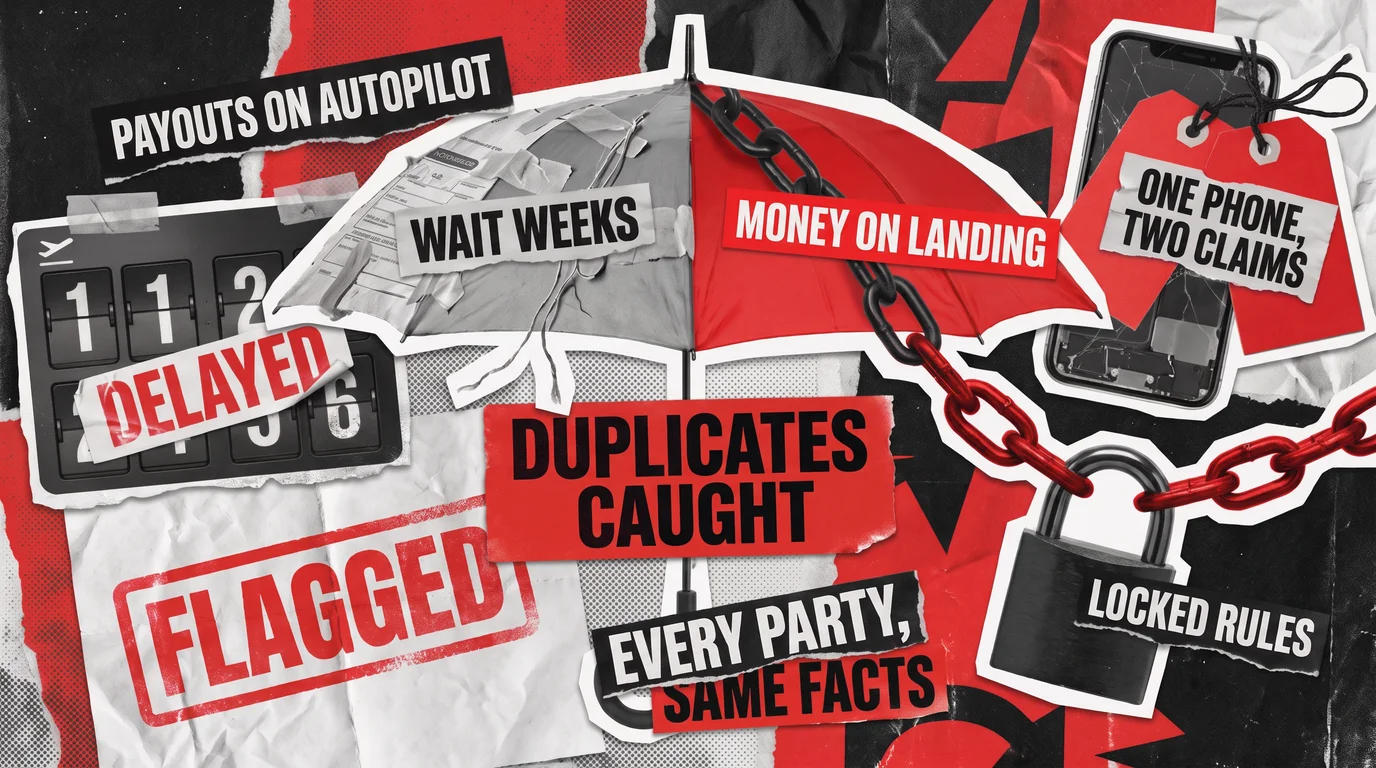
Blockchain in insurance helps carriers pay simple claims automatically, spot a loss submitted to two insurers, and share contract data with reinsurers. Each of these uses saves manual work on tasks that depend on facts several businesses must agree on, such as a flight delay payout or a fraud check.
Insurance runs on records: who bought which policy, what happened, and whether a claim is genuine. Each insurer keeps that data in its own systems, so confirming a fact with a partner takes emails, calls, and spreadsheets. A blockchain gives all parties one shared record that no single member can secretly change.
Below, you’ll see how each use case works, what business problem it solves, and what to watch out for. If you’re weighing a project of your own, our blockchain development services team can help you shape it before the requirements are final.
What Are the Main Blockchain Insurance Use Cases?
Blockchain insurance use cases create business value in three ways: fewer disputes with partners, payments that follow agreed rules automatically, and a full history ready for auditors. A blockchain is a database that runs on the servers of several companies at once. Each new entry is linked to earlier ones, so altering any past record shows up as a mismatch everywhere else.
Every use case in the table below targets a business problem insurers already pay for:
Automatic claim payouts
Slow settlement and high handling costs on small claims
A traveler gets paid for a delayed flight without filing a form
Shared fraud registry
The same loss claimed at several insurers
A stolen phone reported to two carriers gets flagged on arrival
Peer-to-peer cover
Customers who doubt an insurer will pay fairly
Members vote on claims paid from a pool they fund together
Reinsurance
Both sides rechecking the same contract and payment figures
An insurer and its reinsurer work from one copy of the deal
Health insurance records
Proving who opened a patient’s file and when
Every view of a claim adds a permanent log entry
What Do Smart Contracts Change in Claims Settlement?
A smart contract removes manual handling from simple claims by turning the policy’s payout terms into code that the blockchain carries out. Once agreed data shows the insured event happened, the payment goes out automatically. The rules are set when the policy is sold, so neither the insurer nor the customer can change them on their own.
This kind of automation works best for parametric insurance. Such cover pays an agreed amount when a measurable event happens, so nobody has to assess the actual loss. Take delay insurance for air travel: the policy promises a payment if the plane lands more than two hours late. Once official flight records confirm the arrival time, the program sends the money. With smart contracts insurance claims like this one need no form and no adjuster.
As another example, farm insurance shows the parametric model working in places where sending staff to inspect every field would cost too much. In Kenya, a group of partners that included the Lemonade Foundation and the reinsurer Hannover Re covered nearly 7,000 farmers against drought in the 2022 to 2023 season. When harvest data for each area came in, smart contracts triggered the payouts automatically.
For both products, the clearest business case for blockchain in insurance is cost: a claim that settles itself takes little effort to handle. Customers get their money shortly after the event. A claim paid without paperwork gives them a good reason to renew. The money can reach a bank account or a digital wallet. The choice between blockchain payments vs traditional transfers mostly comes down to speed and fees.
Our team has used this technology in a live product. For Tingl, a private messenger we designed and built from scratch, we wrote the smart contracts that run the app’s logic on Polygon, a public blockchain network. As a result, every transaction follows the same code and leaves a record nobody can alter.
What Can Go Wrong With Automated Claims?
Automatic claim payouts face three main risks:
- Bad data: Every parametric product depends on a source of facts that both the insurer and the customer trust. Flight trackers, weather stations, and harvest statistics reach the smart contract through a service called an oracle. A faulty or late feed leads to an incorrect payout or none at all. For this reason, choosing the source matters as much as writing the code.
- Unclear policy terms: Code can’t interpret a vague clause the way a claims handler does, so the wording has to spell out every situation in advance. For example, the contract must state whether a canceled flight counts as a delay and what happens when a passenger is rebooked. Once the code is live, the fixed rules that protect both sides make such gaps expensive to correct. A single missing case affects every claim of that type.
- Too few buyers: In 2017, AXA launched fizzy, a flight delay product built on a public blockchain. The insurer withdrew fizzy at the end of 2019, saying it had missed its commercial targets and never found the right sales channels. A small launch with one distribution partner tests demand before a larger investment.
How Can a Shared Record Help Insurers Catch Fraud?
Fraud detection is one of the most practical uses of blockchain in insurance: a shared record exposes repeat claims across companies. The Coalition Against Insurance Fraud puts the yearly cost to Americans at $308.6 billion or more.
Picture a phone reported stolen and claimed with two different insurers in the same week. Each company sees one ordinary claim and pays it. A blockchain check across insurers would flag the duplicate without exposing customer files to competitors.
An insurer could set up a shared fraud registry in six steps:
- Pick one fraud pattern. Start with a loss that a few details can describe, such as stolen electronics, broken car glass, or water damage in a rental home.
- Find two to four partners. Carriers that sell one product line in one region tend to meet the same fraud rings.
- Check the legal limits. Privacy and competition laws restrict what information insurers may exchange with rivals, even in coded form.
- Agree on the claim fingerprint. Each insurer converts a claim’s key details, such as the device serial number, date, and address, into a short code that hides the original data.
- Screen every new claim on arrival. The system compares the fingerprint with the shared record and flags any match before the payment goes out.
- Let investigators decide. A match only signals that the insurer’s fraud team should take a closer look.
Honest customers barely notice the registry, because their claims pass the check without delay. From the first month, track flagged and confirmed cases to measure the savings.
For other types of fraud, such as a doctored photo or a padded repair bill, AI models are the better tool. Our guide to AI in insurance explains how those checks work.
How Does Peer-to-Peer Insurance Work on a Blockchain?
In peer-to-peer (P2P) insurance, members pay into a shared pool, cover each other’s losses, and track every payment on a blockchain. Many customers suspect that an insurer earns more when it turns a claim down. With no company in the middle, a P2P pool removes that conflict of interest. Of all the uses of blockchain in insurance, this model changes the business the most.
Every member can see the balance, which claims were paid, and why. Smart contracts hold the rules for joining, voting, and payouts, so no manager can change them without the members knowing.
One well-known example is Nexus Mutual, which covers losses from hacks of cryptocurrency apps. Its members vote on each claim. According to the mutual’s own year-end review, it paid out more than $370,000 in 2025. Some pools also return part of the unused money to members who stay claim-free. Such refunds work much like blockchain loyalty programs, which reward customers for staying with a brand.
Most blockchain mutuals cover crypto risks rather than homes or cars, because their members already hold digital currency. People usually join through a wallet app, so the customer side has a lot in common with crypto banking app development. The industry calls such platforms decentralized finance (DeFi) insurance. Building them is part of the DeFi development services we offer. A traditional insurer can apply the main lesson without launching a mutual: customers trust a company more when they see where their premiums go.
How Does Blockchain Simplify Reinsurance?
Reinsurance is one of the strongest candidates for blockchain in insurance, because each deal links several companies that must work from identical contract terms and payment figures. Under this arrangement, a carrier passes part of its risk to one or more reinsurers in exchange for a share of the premium. Today, each side keeps its own records of the contract and claims. Staff then spend many hours matching up the figures before any money changes hands.
A permissioned blockchain admits only invited companies, so the insurer, the reinsurer, and the broker can share one version of the agreement privately. When a large claim comes in, every party sees the same amount at once. The payments between them can then move automatically.
The B3i project shows what such a network needs to succeed. Major insurers and reinsurers set up B3i as a joint platform for the whole market, and Allianz and Swiss Re placed the first reinsurance contract on it in April 2022. By then, the shareholders had paid for a large system, but too few deals ran on it to cover the costs. Without enough business volume, B3i couldn’t raise new funding and closed three months later.
Newer projects start smaller, so they can prove their value sooner. Two or three companies can share one digital record for a single product line, then add members once the savings show. In Bermuda, OnRe holds a regulator’s license to operate as a blockchain-based reinsurer. Other firms sell tokenized risk-sharing deals: digital shares that outside investors can buy. In July 2026, Oxbridge Re raised about $7.1 million through five such offerings. Insurers that want to offer tokens like these directly need a trading platform, so white label crypto exchange cost becomes part of the business case.
Why Does HIPAA Matter for Health Insurance on Blockchain?
For health carriers, HIPAA shapes how blockchain in insurance can be used, because nearly all medical claims contain protected patient information. Diagnosis codes, treatment dates, and doctors’ notes all fall under the law. A breach can bring fines and cost a company its customers’ trust.
HIPAA gives patients the right to ask for corrections to their health records. However, a blockchain is designed so that past entries can’t be changed. Putting patient data into a permanent record would make that right very hard to honor.
Insurers solve the conflict by keeping that information in their own protected database. The blockchain holds only a coded fingerprint of each file and a log of who opened it and when. After a correction, the database entry changes and a new code joins the log. The history then shows that a change happened without exposing any medical details.
For a health insurer, that log answers a question auditors ask often: who saw this patient’s file? Encryption, access controls, and staff training are still required. Our HIPAA compliance checklist lists those safeguards in detail. For insurers that also sell savings or payment products, our article on blockchain in fintech covers the financial rules.
Your lawyers confirm the exact legal requirements for each product. Our engineers plan the system around them from the first design session. Each insurer gets a service package shaped by its own needs.
Where Should Insurers Start With Blockchain in Insurance?
Start with the process that creates the most manual checking for your staff today, such as small payouts that wait for a handler or duplicate claims your fraud team spots too late. The best candidates follow fixed rules that can be written down in advance, such as a delay threshold or a matching rule for repeat losses.

The new system can also fit into software your claims department already has. For example, a fraud registry check can run on the intake screen your handlers use now, and a parametric product can send its payouts through your current payment tools. Staff keep working as usual, while the blockchain runs in the background.
Many insurance IT teams look after core policy and claims software. Few have blockchain specialists on staff. Our engineers bring that expertise: they write and test the smart contracts and connect them to the software you already run.
Tell us which part of your claims process takes the most time, and our team will suggest a first blockchain project around it.
FAQ
What is blockchain in insurance?
Blockchain in insurance means running claims, fraud checks, and reinsurance deals on a database that several companies operate together. Each participant holds the same history, protected against hidden edits. As a result, insurers can pay simple losses automatically, compare new claims with partners’ records, and settle accounts with reinsurers without reconciling figures by hand.
How do smart contracts pay insurance claims?
A smart contract pays an insurance claim in three steps. First, the payout terms are written into code at the moment of sale, such as a fixed sum for a delayed flight. Next, an outside data feed reports what happened. If the reported facts meet the terms, the code releases the money without a claim form. Losses that need human judgment, such as fire damage, still go to an adjuster.
How can blockchain help detect insurance fraud?
Blockchain helps insurers detect fraud that crosses company lines, such as one car accident or stolen item claimed with several carriers. Partner companies add a coded summary of every claim to a common database, and any new submission that matches an existing entry gets flagged for review. Because the summaries contain no names, customer details stay private. Doctored evidence and inflated invoices still call for AI tools and trained investigators.
Can a blockchain meet HIPAA requirements?
Yes, as long as protected health information never goes on the blockchain itself. HIPAA lets patients request corrections to their records, which permanent entries can’t accommodate. A common design stores medical data in a secured database and writes only coded references and a record of who viewed each file to the chain. The insurer’s legal team should still confirm encryption, access rights, and other HIPAA safeguards for each product.
Which insurance lines benefit most from blockchain?
Insurance lines with measurable triggers or many trading partners gain the most from blockchain. Travel delay and crop drought cover can pay automatically, since flight trackers and weather stations confirm each event. Auto and property carriers benefit from screening claims across companies. Reinsurance programs save time by keeping one contract copy for all parties, and health insurers can use blockchain for tamper-proof access logs.
See how we extended a screen-watermarking platform that now protects 50+ major fintech and telecom enterprises from data exfiltration and insider fraud.