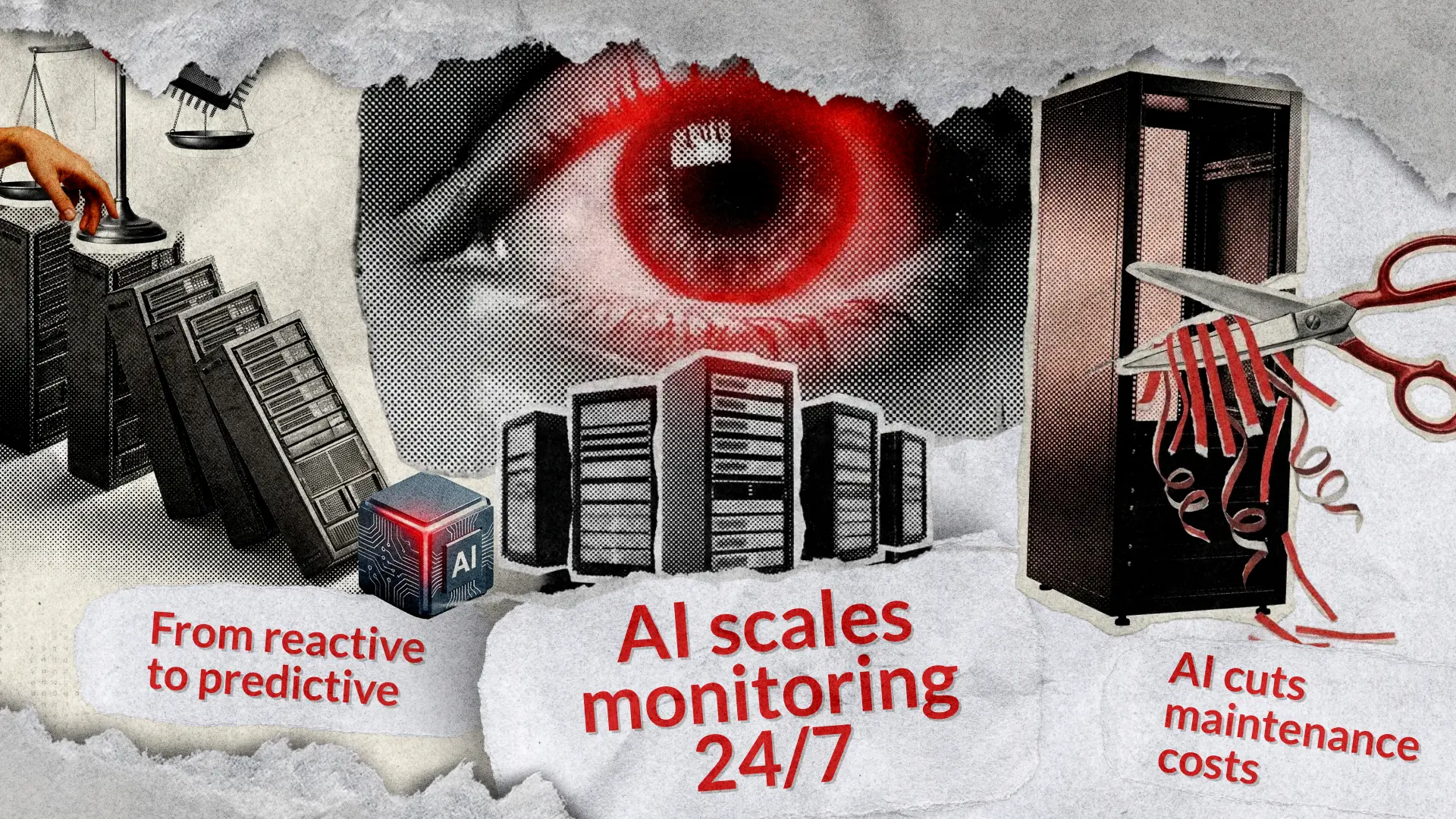
The implementation of AI in software support and maintenance is revolutionizing businesses and, most importantly, their budgets. But of course, this tech can make a noticeable difference for you in this economy only when managed efficiently. That’s exactly what we are going to discuss here today.
If you run software at medium or large scale, you already know the uncomfortable truth: support is where budgets go to disappear.
It doesn’t happen because your teams are careless. It happens because modern systems are complex, always-on, and constantly changing. Therefore, software maintenance is almost as sophisticated as development itself.
To give you some perspective, research indicates that 60-80% of product lifecycle costs go toward support, updates, and regular fixes. This number is the highest for long-lived enterprise systems because the legacy code they develop soaks up your budget like a sponge.
So, we asked experienced Redwerk software engineers about where AI helps, where it doesn’t, and how to use it to reduce maintenance costs without creating a quality or security hangover later.
What Tasks Can Be Handled by AI Software Maintenance?
First of all, let’s define the boundaries of what AI-assisted development is truly capable of today, including core functions like AI code analysis and bug detection.. This way, you’ll be able to set realistic expectations and KPIs to evaluate exactly how workflow optimization and other AI-driven maintenance benefits can help your business.
Automated Code Monitoring, Analysis, and Refactoring
One of the greatest advantages of implementing AI for software maintenance is that it can continuously scan the code to:
- Identify bugs and vulnerabilities
- Evaluate performance and resource management
- Detect deviations from your coding standards
- Identify refactoring opportunities and generate pull requests
AI agents can be trained to recognize your coding standards, automating the majority of routine tasks and drastically reducing the manual review workload. Moreover, AI-driven maintenance increases overall consistency due to the machine’s precision in following learned patterns.
The overall result is that your human expert team frees up time to focus on essential and highly sophisticated tasks. In addition, automated refactoring helps manage and reduce technical debt over time.
AI Predictive Maintenance, Bug Detection, and Optimization
AI predictive maintenance is gaining popularity — and with good reason. Modern machine learning algorithms are delivering transformative results in predictive analytics. If the model is trained right, it will be able to:
- Analyze app performance to forecast failures (based on the correlation of historical incident data and current telemetry)
- Identify areas of the system with the highest risk of failure based on real-time data
- Detect degrading system components before they cause a massive breakdown
- Guide software engineers to the areas that need priority maintenance
The main advantage you get from implementing AI in predictive maintenance is that you have a much higher chance of avoiding costly breakdowns and downtime. Therefore, you turn your whole software support and maintenance approach from reactive fixes to proactive failure prevention.
Machines are not yet capable of generating 100% accurate forecasts. However, AI input is invaluable for risk management, especially for larger businesses where maintenance-related downtime is unacceptable. To imagine how a software-related failure looks on a large scale, remember the Great Cloudflare Outage of 2025 or the AWS Crash that brought down web services of more than 2,000 businesses worldwide, including Roblox, Snapchat, Duolingo, and Signal.
Automated Testing, Test Maintenance, and Bug Resolution
AI can perform automated bug detection and even basic resolution with ease. It can also maintain your testing infrastructure, significantly reducing QA teams’ workload. The most important benefit for the business here is that automated tests can run continuously and have an accuracy of up to 90%. Therefore, you have about a 90% chance of catching any critical bugs before they reach production with minimal effort on your part. These AI testing tools can:
- Generate and adapt test cases independently
- Run test suites continuously
- Prioritize regression tests and adjust priorities over time
- Maintain the so-called ‘self-healing’ test scripts that adjust to overall software changes
Some more advanced AI software maintenance solutions can go as far as auto-debugging. Meaning they can identify faulty code and suggest or even implement corrections automatically. At the moment, this is only possible for issues that don’t require deep architectural reasoning. However, AI is already an integral part of professional-grade QA testing services.
Documentation and Knowledge Management
Any software specialist will agree that creating and managing documentation, especially for large, long-term projects, is a huge hassle. Using AI in software support is an enormous help with this task because the machines can generate documentation and update it with every code change.
Therefore, your specs will always be accurate and up to date, without the need to allocate time and resources to regular documentation. AI agents can also be integrated with the knowledge base to help developers quickly find information about legacy systems. This is highly valuable for onboarding and will save your business from vendor lockdown as you won’t be completely reliant on a handful of people who ‘were there when it was built’.
Implementing AI in Software Support: Pros and Cons
As usual with all things artificial, AI-driven maintenance has both strengths and limitations. To derive value from this type of innovation while minimizing risk requires balancing automation with carefully planned manual control.
Pros of AI Software Maintenance
The benefits of using AI for software maintenance mostly come from process optimization and a general productivity boost. Machine learning and AI models allow you to achieve these improvements through the following:
- Consistent and Scalable Performance
Unlike humans, AI can process thousands of files simultaneously and apply your coding standards consistently across all of them. Machines also do this in a fraction of the time compared to manual testing. Automation also reduces the risk of error in such tasks. - Fast Issue Detection
Because it processes data extremely quickly, AI speeds up anomaly detection. Even if the tool is just flagging suspicious areas for the human experts to check, this approach greatly reduces the time it takes your team to perform a code security review. It’s a critical advantage for enterprises that run large-scale systems that affect multiple client businesses. - Pattern Recognition Across Projects (Globally)
AI code analysis tools learn from global data. Therefore, they should be able to detect and identify vulnerability patterns and optimization opportunities that your business’s historical data cannot teach. - Predictive Maintenance
AI software maintenance tools with predictive capabilities can help you identify potential issues before they even occur. This means that you become not merely fast but proactive in issue resolution. This is a major factor that saves your business money by reducing potential downtime. Even if your product has a well-designed and scalable architecture, an update deployment carries some risks. Predictive analysis minimizes these risks. - Software Maintenance Cost Optimization
By automating multiple processes and implementing AI directly in software support, you can reduce the time developers spend on routine, repetitive tasks. Instead, they can focus on process management and resolving sophisticated issues that require human intervention. - 24/7 Monitoring
Let’s be honest, very few global businesses can afford to have an IT department that runs 24/7 and checks the code every minute of every day. AI has no such issues as the tools will run non-stop without losing accuracy due to fatigue or missing potential vulnerabilities. As long as the setup and model training are done right, automated AI software maintenance protocols require only occasional reviews to run effectively 24/7.
Cons of Using AI for Software Support
Understanding the limitations of AI software maintenance will allow you to set realistic expectations. Therefore, you will be able to build a code review process that delivers all the business benefits with minimal risk. The most notable weaknesses of AI implementation are:
- Limited Context Understanding
At the current level of tech, AI agents cannot understand deep business logic and domain-specific nuances. These tools are also unable to catch issues that go beyond code into product architecture. Overall, machines have a limited understanding of any context. Therefore, human review is still a must for any sophisticated tasks. - False Positives
Some AI models are particularly prone to generating false positives (hallucinations). These could lead to alert fatigue and general loss of trust in the tool. Moreover, developer teams will lose valuable time investigating these false claims. - Training Data Dependence
Machine learning models are only as good as the data they are trained on, and it’s the same for any AI solution. Therefore, your AI-driven maintenance depends entirely on the quality and robustness of the model training data. If it’s cluttered or insufficient, the output will have mistakes and be limited. Therefore, it won’t bring much real value. - Integration Complexity
Big and sophisticated systems with legacy infrastructure struggle due to their inflexibility. Implementing AI for software maintenance will require a significant upgrade, including at the architectural level. Digital transformation on such a scale requires investment and partnering with an experienced service provider. You can start with a DevOps consultation and go from there to evaluate the project’s scale and the changes needed for maximum optimization over time.
Examples of AI Software Maintenance Tools and Their Capabilities
To get some idea of what you can expect from these solutions, check out the list of the top five AI code analysis platforms used by Redwerk software engineers.
GitHub Copilot / Copilot tools
AI coding & maintenance suggestions
Speeds up debugging and offers code fixes
Widely adopted in developer workflows (currently, Copilot is ubiquitous in dev pipelines).
AI Self-Healing Test Platforms
(Testim / Mabl / Virtuoso)
AI-driven testing & maintenance
Automatically adapt tests to system changes and reduce test maintenance overhead.
CodeScene
Behavioral code analysis
Uses machine learning to predict code health issues and maintenance risks.
AI Debugging Bots
(Cursor Bugbot)
Automated bug detection
Flag errors and suggest fixes in real time during commit/PR workflows.
Predictive Analytics & Observability Platforms
(Datadog + AI models)
Ops & monitoring
Detect anomalies in system behavior and proactively identify root causes.
Where Human Expertise Is Necessary During Software Maintenance
Using AI in software support offers a great productivity boost. However, experienced professional software engineers remain indispensable for this process. The following tasks can only be handled by humans:
- Making Strategic Decisions
Machines can highlight patterns but cannot reason about product goals, scalability trade-offs, or systemic implications. Therefore, AI software maintenance requires expert human supervision. The development team will consider AI suggestions and factor in the business goals, direction, and budget. Most importantly, with their deep understanding of software architecture and design, engineers can build an optimized strategy and be held accountable for its implementation. - Judging Security Risks
AI can flag vulnerabilities more effectively and quickly compared to humans. However, security maintenance is on a much larger scale. You need human professionals in testing and defense building to translate the AI’s highlights into real business risks. They will need to monitor machine-learning-powered audits for security and compliance. - Communicating with Stakeholders
Stakeholders usually don’t have highly specialized technical knowledge. Therefore, even a detailed AI-generated report won’t provide them with sufficient information to make strategic business decisions. Therefore, you need a senior-level developer with good communication skills to translate technical maintenance needs into a format that the boardroom can understand. - Diagnosing Complex Problems
When production incidents involve cascading failures across multiple systems, human engineers remain essential for root cause analysis. They synthesize information from logs, user reports, infrastructure metrics, and institutional knowledge in ways that AI cannot yet reliably replicate.
To sum it all up: AI is a powerful assistant but not a replacement for expert maintenance engineers.
Final Thoughts: How to Make the Most of AI in Software Support
Introducing AI for software maintenance reduces business costs drastically. However, to maximize this value and improve your budget efficiency, you’ll need to partner with an experienced development team that can set up automation tools tailored to your unique business needs.
Start this process with a thorough software audit to evaluate the code you have and identify vulnerabilities and opportunities for improvement. Here, at Redwerk, we helped multiple clients optimize their software and build continuous automated maintenance flows. Check out our case studies and read testimonials from many satisfied customers.
Let’s work together to make the most of your product and ensure its maintenance is both more affordable and more effective. Contact us today to start a conversation!
See how we audited Complete Network's Project Science software, boosting code maintainability by 80%