You can build fast, you can build beautifully, but building the wrong thing still sinks the roadmap. And that raises the real question for any founder: why do strong engineering teams still ship features users ignore?
A McKinsey global survey on The State of AI shows that most organizations are still in pilot mode when introducing new digital solutions, largely because assumptions — not user validation — shape early decisions. When teams skip early user input, they risk misalignment that becomes expensive to correct later.
Early user engagement changes that trajectory. It reduces rework, sharpens prioritization, and aligns development with real customer behavior. Early engagement is also a financial lever that protects development budgets and accelerates time-to-revenue. Teams that wait for late-stage user feedback always pay more, sometimes with entire quarters lost. Since 2005, we’ve championed one core principle: the sooner validation happens, the faster you build momentum. It’s the cornerstone of our product development services.
Here are five effective, fast-to-apply ways to involve users early and ensure your product lands exactly where the market needs it.
Why Early User Engagement Matters in the Software Development Process
Early user engagement helps serious companies avoid their tech investments turning into very expensive experiments. Deloitte’s Tech Trends report shows a clear shift: organizations are under pressure to move from “playing with technology” to proving business impact, with AI and digital products expected to deliver real, measurable value instead of endless pilots.
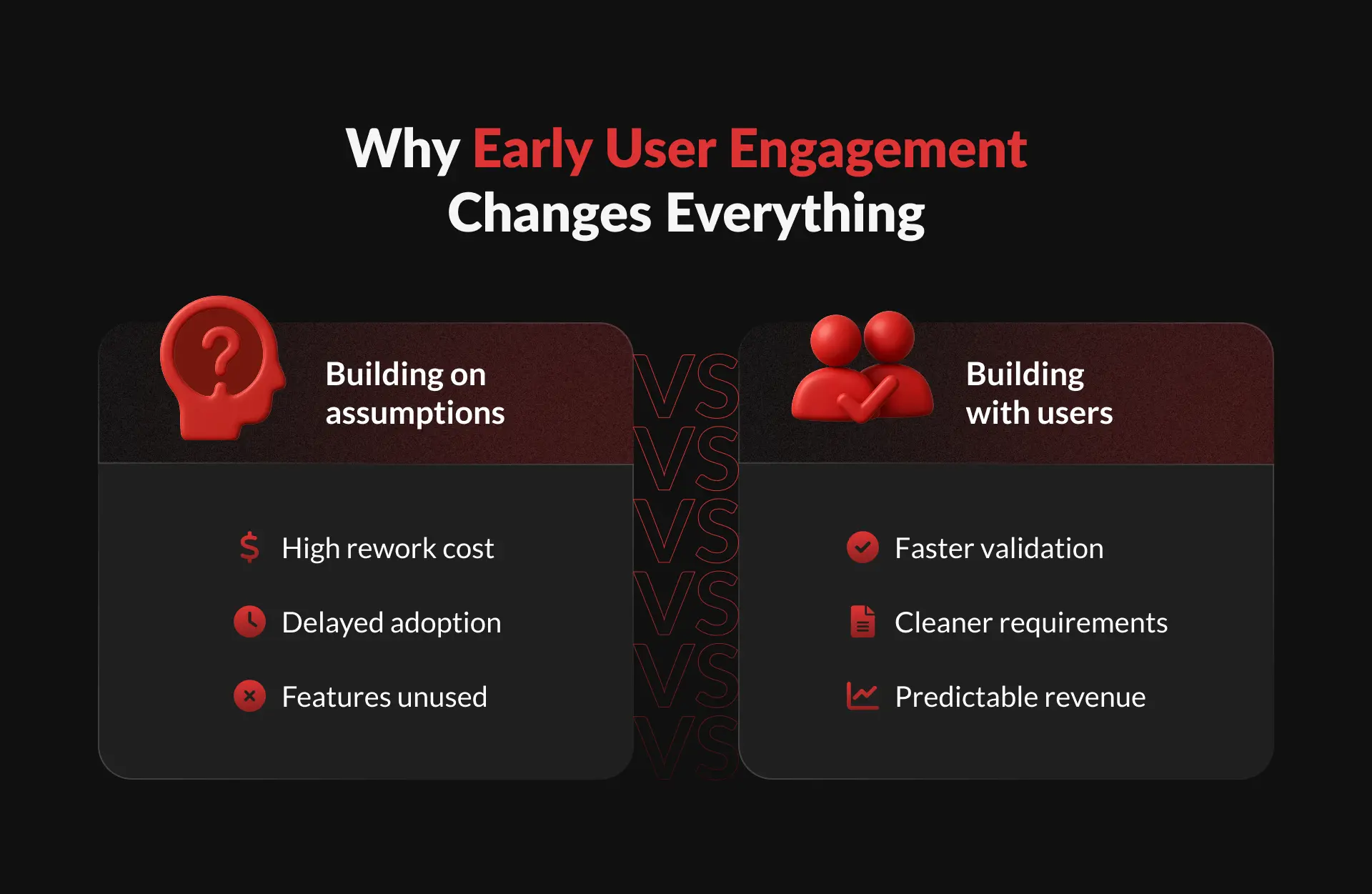
That pressure is reshaping how teams should approach building digital products. When teams make early decisions based only on internal opinions, they increase rework, delay adoption, and end up optimising features no one truly needs. A user-centered software development approach flips that pattern: real users validate which problems are worth solving before committing serious engineering time.
Early engagement becomes the cheapest validation you’ll ever get, while rebuilding is the most expensive therapy session your roadmap can endure. And the goal is to bake user input into the process quickly enough that it guides decisions.
So let’s break down the first practical way to make user involvement fast and in a way that aligns with how your team builds.
1. Start With Users Who Feel It Most
The fastest way to strengthen user engagement in software products is to involve the people who experience the problem most intensely. These are your high-signal users, the ones whose feedback steers your product in the right direction long before code becomes expensive.
Identify High-Signal Users
Look for users who demonstrate:
- Frequency of the problem — they face it daily or weekly, not occasionally.
- Urgency — the problem affects revenue, productivity, or critical workflows.
- Authority — they can approve adoption or directly influence purchasing decisions.
- Tolerance for early imperfections — they’ll test rough ideas if it helps solve their pain sooner.
This type of involvement reveals truths that “friendly testers” or internal opinions never will. High-signal users expose what actually matters.
Use Problem-First Conversations
Keep discovery conversations structured and user-focused:
- 70% on their current workflow
- 20% on the hacks, shortcuts, or workarounds they rely on
- 10% on your potential solution
This ensures you’re studying behavior.
We saw this clearly in the Cleanagents project, where professional cleaners were the highest-signal users in the ecosystem. Their daily workflows shaped the earliest prototypes — from how they previewed and accepted jobs to how routing appeared in the app — long before engineering scaled the solution. Involving real cleaners early prevented costly redesigns and ensured the product matched the realities of field work.
2. Validate Ideas Before You Build
Before engineering hours start piling up, fast prototype validation gives teams the clarity they need to avoid costly detours. Lightweight prototyping brings end-user participation in software development into the process early, letting real users shape what gets built next. It’s the quickest way to understand whether an idea works in practice.
Choose the Right Fidelity for the Question
Not every idea deserves a polished demo. Match your prototype to what you’re trying to learn:
- Sketches to test overall flow and interaction paths
- Clickable prototypes to validate comprehension and navigation
- No-code mockups to check whether users understand and value the concept itself
Each level removes risk before it becomes expensive. For solo founders and lean teams, MVP development with AI makes it possible to build and validate these prototypes without a full engineering staff.
Run 30-45 Minute Friction Sessions
Short, structured user testing reveals more than long planning meetings ever will. A simple format works:
- Ask users to complete key tasks
- Observe where they hesitate or get confused
- Note what they expect to happen next
Emerging tools now accelerate this process dramatically. Recent advances in AI-driven design tools enable teams to generate prototype variations in minutes rather than hours, accelerating testing cycles and helping them validate concepts earlier.
Fast prototypes plus fast feedback keep the roadmap honest and keep engineering focused on solutions users actually understand and want. A new generation of vibe coded apps is proving that when you focus on the user’s intent rather than the syntax, you can scale significantly faster. Check out these vibe coded apps, some of which have already gained thousands of users.
3. Make User Discovery a Weekly Habit
The most effective user engagement strategies in software development aren’t built on massive research phases, but rather on rhythm. A steady flow of insight during early-stage development gives teams the clarity they need to make confident decisions before engineering effort multiplies.
Adopt a Low-Burden User Touchpoint Rule
One hour a week watching or speaking with users is enough to reshape how your team builds. That single hour drives:
- faster iteration
- stronger prioritization
- fewer last-minute rebuilds
It’s a small habit with a big impact, keeping teams grounded in real behavior, whether they’re working on internal tools, SaaS platforms, or AI chatbots for e-commerce.
Three Simple Habits That Keep Teams Aligned
These rituals fit seamlessly into agile delivery without slowing sprints:
- Weekly discovery standup: Share what was learned and what needs exploring next.
- Evidence-tagged backlog: Mark items as hypothesis, validated, or observed behavior to keep priorities honest.
- Monthly user-inclusive demos: Invite real users into reviews and uncover friction points through lightweight usability testing supported by your UX design team.
This rhythm replaces the old “research → build → pray” pattern with continuous learning – a far more reliable foundation for products that resonate with users from day one.
4. Build Your Inner Circle of Design Partners
Some teams rely on occasional testers. Strong teams build a collaborative circle of users who stay with the product from early shaping through launch. Design partners help validate direction, stress-test assumptions, and refine early requirements before they turn into costly engineering work. It’s one of the best software development practices consistently used by companies to avoid expensive detours.
Who Belongs in Your Inner Circle
Look for customers who feel the problem every week and are actively searching for workable improvements. Teams replacing outdated workflows or experimenting with alternatives often provide the clearest signals. Prioritize partners who tie the problem to measurable KPIs, revenue impact, or operational efficiency. Their input is grounded in outcomes.
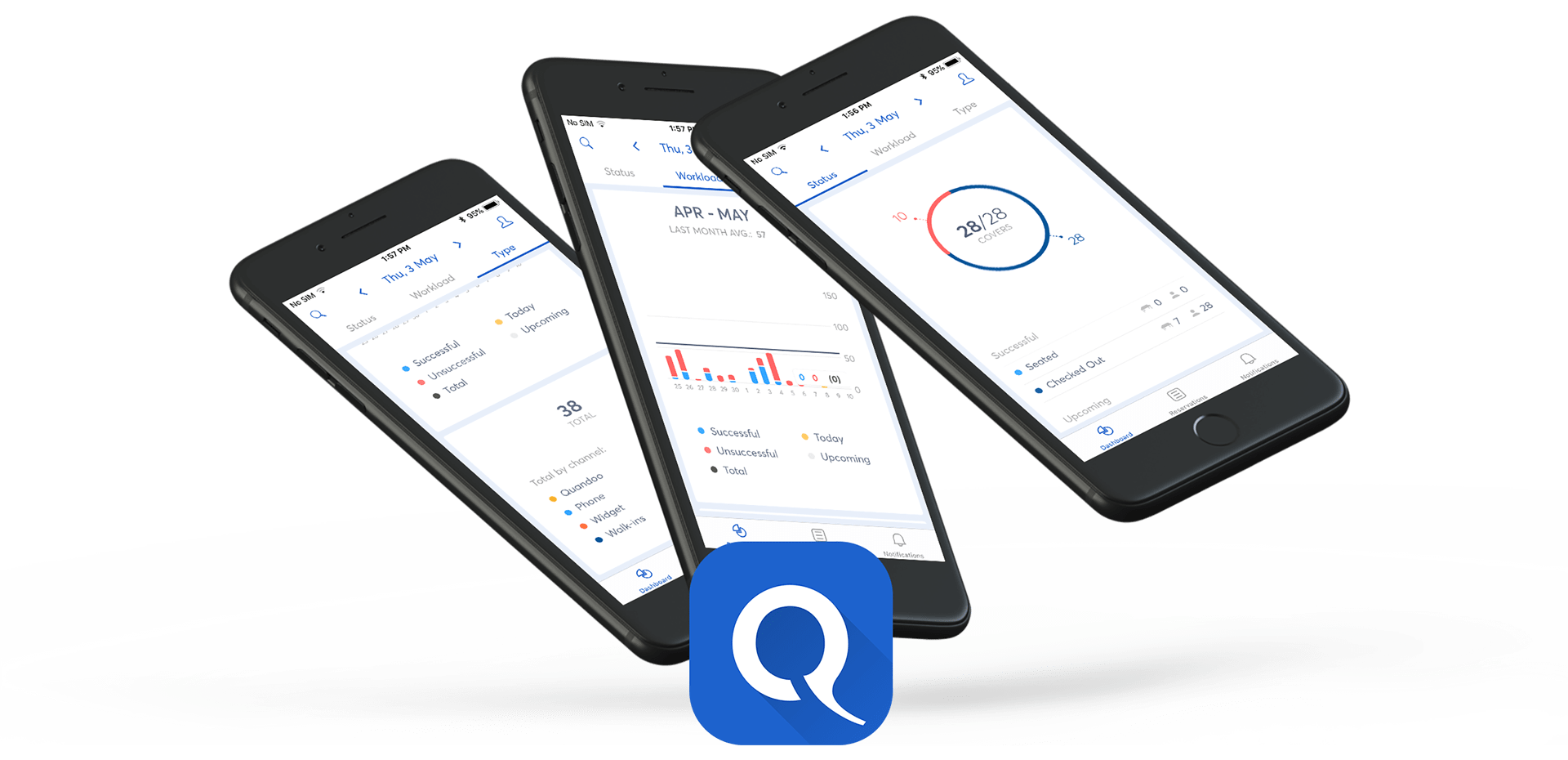
A good example is our work with Quandoo, where their team effectively became a design partner throughout development. Restaurant owners and admins provided continuous insight into how reservation data, operational stats, and daily workflows actually played out. By combining their on-the-ground experience with our product expertise, early prototypes and UI flows were refined quickly, and operational requirements were validated long before launch. This kind of structured collaboration turns complex domain workflows into a market-ready solution
How to Structure the Collaboration
Keep the rhythm light but predictable: short strategic check-ins, early previews of meaningful changes, and conversations focused on direction rather than polish. Align on shared success outcomes from day one so you’re optimizing toward the same results. The process should accelerate momentum.
Why It Pays Off
A thoughtful partner circle becomes your first source of real-world validation, case studies, and strategic advocates. Their continued involvement naturally accelerates adoption inside their organization and strengthens the market credibility of any team delivering web development services or building digital products in competitive spaces.
Done well, this inner circle becomes your compass and your earliest wave of champions.
5. Learn Fast Through Real Product Signals
Even the most insightful conversations have limits. To keep learning as your MVP grows, you need signals from end users — automatically, continuously, and without scheduling a single call. High-performing teams treat their product as a listening system, using real behavior to guide feature prioritization throughout the entire lifecycle.
Instrument the Essentials Early
Before launch, instrument the core flows that determine whether users understand the product. Activation steps, drop-off moments, comprehension cues, and time-to-first-value reveal friction long before it becomes a support issue. Early instrumentation pays for itself by showing where reality diverges from your assumptions.
Use Lightweight In-Product Feedback
Contextual micro-feedback captures emotional signals in real time. This reveals where users thrive, where they hesitate, and where the product unintentionally slows them down. It’s the fastest way to understand real behavior without interrupting the experience.
Close the Loop Transparently
Show users that their feedback matters. Publish simple changelogs, highlight “Shipped thanks to your feedback” updates, and communicate progress in a way that’s easy to follow. Visible improvement encourages more feedback, more engagement, and a stronger sense of partnership.
When your product listens at scale, learning becomes continuous, and every release gets sharper than the last.
Silent Killers of User Engagement in Your Software Development Strategy
Early engagement fails less because of bad interviews and more because of the hidden habits inside a team. These friction points quietly distort decisions and disconnect the product from real user feedback. Spotting them early strengthens your entire software development strategy.
- Treating early users like “volunteers,” not stakeholders
When users feel like they’re doing you a favor, feedback dries up. Treat them like strategic contributors whose input shapes real outcomes. - Revealing ideas too late
Teams wait for polished designs before sharing anything — by then it’s too late to change direction. Early sketches invite honesty instead of politeness. - Testing workflows without real context
Asking users to “imagine a scenario” produces unreliable insight. Bring them real data, their own tasks, or actual edge cases so feedback is grounded in reality and strengthens your UX strategy. - Collecting feedback but hiding constraints
When users don’t know the technical, legal, or time constraints, they give unusable ideas. Transparency helps them focus on what’s feasible within your methodologies. - Failing to reconnect after changes ship
Shipping a fix without circling back turns engagement into a dead end. Showing users how their input shaped the product builds long-term trust and keeps users engaged across the software development lifecycle.
Build Smarter by Bringing Users In Early
Early engagement is the highest-leverage move a product leader can make. Teams that learn from users early spend less time rebuilding and see adoption accelerate instead of stalling. It’s the difference between building with users and building for them, and it shows up everywhere: cleaner requirements, clearer priorities, faster validation, and more predictable revenue.
If your team wants a fast, expert audit of your early engagement approach — including friction points, blind spots, and quick wins — contact us today. One conversation can save months of rework.
See how early user engagement helped us build a restaurant management app used by 18,000+ venues worldwide.