Code review is a must in the development process if you strive to avoid overspending, breakdowns, and extremely dangerous security breaches. AI-powered code reviews make this service both cheaper and more efficient, but only when the automation is done right.
Keep reading to learn everything you need to know about AI code reviews, how they work, which tools to use for them, and their strengths and weaknesses. The Redwerk code review team shares their insights and realistic assessments of the benefits and risks of using AI-powered solutions. We’ll also provide a high-level roadmap for implementing the most effective hybrid strategy to evaluate your code and prevent serious issues from reaching production and crashing your systems.
How Do Automated Code Reviews Work?
The first important thing to understand about AI-powered code reviews is that there are multiple tools and approaches. Many of them offer varying degrees of automation, especially for the validation of results. Moreover, their integration into the review pipeline will also differ greatly. Some of the tools specialize in detection, while others focus on risk evaluation and pattern analysis.
Considering all this, it’s impossible to evaluate AI code reviews as a single entity. You need to assess each solution and its role in your overall code review pipeline to make an accurate evaluation of its contribution, accuracy, and cost savings.
However, to make this subject easier to understand for non-professionals, our team at Redwerk roughly separates all AI code review tools into two main categories:
- Deterministic Analysis (Static Analysis)
This type of analysis is best used to find known bugs or evaluate security patterns. Implement it as part of your strategy for enforcing standards, as this testing easily produces repeatable results. It covers data flow analysis, SAST rules, pattern matching, and taint tracking, among other practices. - LLM-Based Analysis (Generative/Reasoning Layer)
That’s where code review automation truly harnesses the power of artificial intelligence development through LLM integration. Tools designed for this type of analysis rely on AI models trained to collect and interpret context. As a result, they can not only identify issues but also summarize changes, identify and flag suspicious logic, suggest improvements/fixes, and triage alerts.
AI-Powered Code Review Solution Pipeline
That said, Redwerk experts who test various AI code review tools to stay apprised of tech developments say that the top solutions today combine these approaches. Each tool is unique, but their general pipeline usually goes like this:
- Collecting context from filenames, commit messages, nearby code, pull requests, repository instructions, and architecture documents
- Running deterministic scanners for quality and security rules, dependency checks, and secret scanning
- LLM interpretation to explain and prioritize issues before generating proposed fixes
- Posting results in the format used by the tool (inline comments in PRs, IDE hints, status checks, or review summaries)
- Learning and adjusting based on the processed data (only for some tools)
Top AI Code Review Tools Available Today
To understand what exactly you can expect from code review automation solutions, check out the list of the top options used by developers today:
- GitHub
Copilot See the documents to understand how GitHub Copilot can be used for AI code reviews. It’s one of the most popular tools today, and it’s unmatched in GitHub PR reviews, summaries, and fast remediation suggestions (Autofix Code QL). However, it’s not very good at complex logic and security evaluations. - Snyk Code
This is a security-focused SAST that offers very dev-friendly guidance. However, Snyk requires a lot of tuning to reduce ‘noise’, and it will get expensive at scale. - Semgrep (+ Semgrep Assistant)
Semgrep Assistant is great for custom guardrails and AI-powered triage and remediation help. However, it’s adding up to be expensive in terms of efficient use, and it requires rule engineering to deliver the best performance. - CodeRabbit
It’s an LLM-first PR reviewer that delivers summaries and walkthroughs. CodeRabbit is effective for PR acceleration and offering a ‘second-party evaluation’. However, the model is highly prone to hallucinations. - Codacy
This tool is great for multi-repo governance and maintaining consistent standards. Codacy excels in AI guardrails workflow and standardized quality and security checks. However, it suffers from frequent hallucinations and requires close human review. - Greptile
If you are looking for a reliable tool that will work with deep codebase context and custom rules, Greptile is a good choice. However, it can produce a lot of noise in the output, and the tool’s cost quickly becomes steep.
AI-Powered Code Reviews: Pros and Cons
When evaluating the strengths and weaknesses of AI-assisted code reviews, keep in mind that no artificial tool can fully cover all the gaps. Therefore, any automation must be a part of a broader code review checklist that offers comprehensive coverage.
Advantages of Automated Code Reviews
The main benefit of any automation is speed. With code review, you can use a trained machine learning model to perform routine tasks much quicker and with greater accuracy than a human is capable of. From the business standpoint, this offers the following advantages:
- Productivity boost = revenue growth
The overall productivity of your team increases because human team members can focus on more sophisticated tasks while machines take over routine checks. - Security improvements = lower risks
Code review automation improves security because tests can run faster and with higher accuracy. Therefore, your business is better protected against potentially devastating attacks from both external and internal threats. - Early detection = lower costs
If you catch issues before deploying the code, they are easier and much cheaper to fix. Moreover, you avoid reputational damage and other losses that may occur if you release a buggy product.
Weaknesses of AI Code Reviews
AI shows outstanding results in pattern recognition. However, it’s not yet able to perfectly understand contextual nuances. Therefore, you need to set realistic expectations for AI-powered code reviews and implement a strategy to address the machine’s weaknesses. The most notable among those are:
- Poor system-specific adaptability
Machine learning models trained on generic code repositories aren’t easily able to adapt to specific practices and workflows within organizations. They also struggle with legacy systems. - False positives and negatives management
One of the biggest issues associated with automated code reviews is managing false results (both positives and negatives) flagged by AI. The most effective strategy for dealing with this right now includes advanced workflow orchestration and a human-in-the-loop overview. - Coverage gaps
As mentioned before, all AI code review tools are limited in some way. Therefore, it’s imperative that you don’t treat them as ‘universal soldiers’ during adoption. You must understand exactly what the solution can and cannot do and ensure the gaps are covered by human reviewers or, at least, other AI tools.
Manual Vs. Automated Code Reviews: What’s Best?
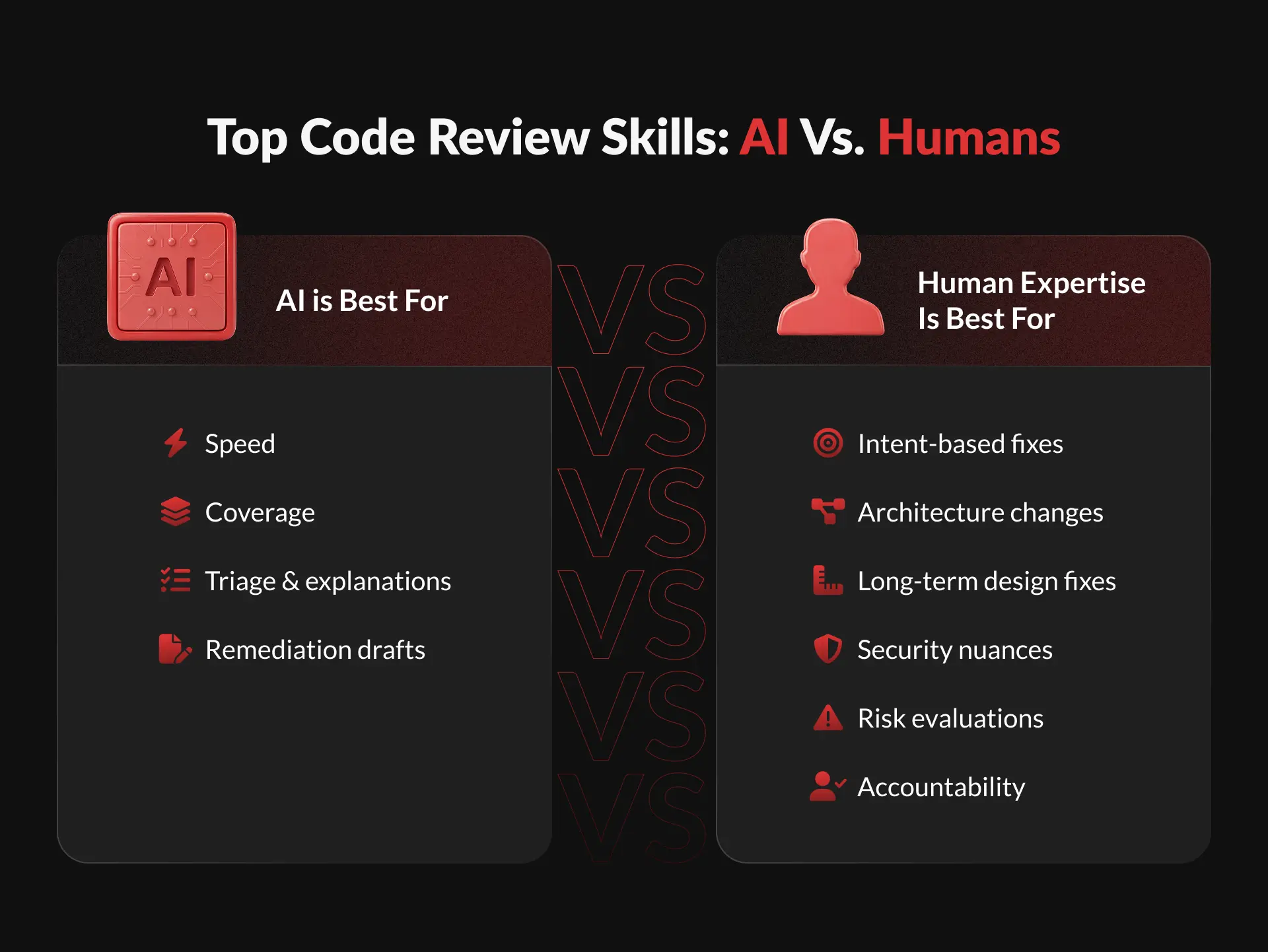
In the endless debate of whether manual or automated services are best, the truth, as usual, lies somewhere in the middle. When dealing with code review, you should treat the involvement of machines in a similar way to AI-assisted software development. It means you implement automation and AI-powered insights where they’re most useful, but the actual ‘brainwork’ is managed by experts who have worked with code for years and can understand and notice things that go beyond regular ML training data.
Here’s how this ‘hybrid’ AI-assisted code review model should look in practice:
- Layer 1: Automated Gates
It’s a non-negotiable layer in automated code reviews that covers linting and formatting, unit and key integration tests, as well as SAST, dependency, and secret scanning. As a result of these automated processes, you must set a quality-gate baseline, for example, ‘no new critical issues’. - Layer 2: AI Review
The next layer of code review automation should involve a more advanced form of AI, an always-on assistant that adds an agentic component to the mechanical deterministic analysis. This tool should handle generating test suggestions, triaging scanner alerts, drafting fixes for simple issues, and PR summaries with risk highlights. - Layer 3: Human Review
Finally, human professionals should take over, making these processes AI-assisted code reviews rather than 100% AI. Human intervention is required in risky areas and high-leverage tasks. Only qualified professionals should validate and implement architectural changes or adjust critical features. Their expertise is also needed when going down the code review security checklist, as humans can identify complex dependencies better than machines, which still ‘think’ in mostly linear ways. Unlike AI, humans can focus on intent rather than formatting, allowing them to catch issues invisible to machines because they aren’t inherently ‘wrong’.
Bottom Line: How to Set Up the Most Efficient Code Reviews?
So, to sum it all up, AI-powered code reviews are exceptionally helpful for boosting review speed, productivity, and accuracy. Automation also makes the process more affordable. However, humans are a crucial part of this process. Therefore, to achieve the best results, you need to clearly answer the following questions:
- What parts of the code review process are managed by tools?
- What is checked by AI agents?
- What is checked and validated by human experts?
At Redwerk, we have a team of specialists who know exactly how to use AI-powered tools to maximize the value for our clients. Contact us today and let’s develop an AI-assisted code review pipeline tailored to your unique business case.
Check out how we audited Complete Network's Project Science software, achieving an 80% increase in code maintainability