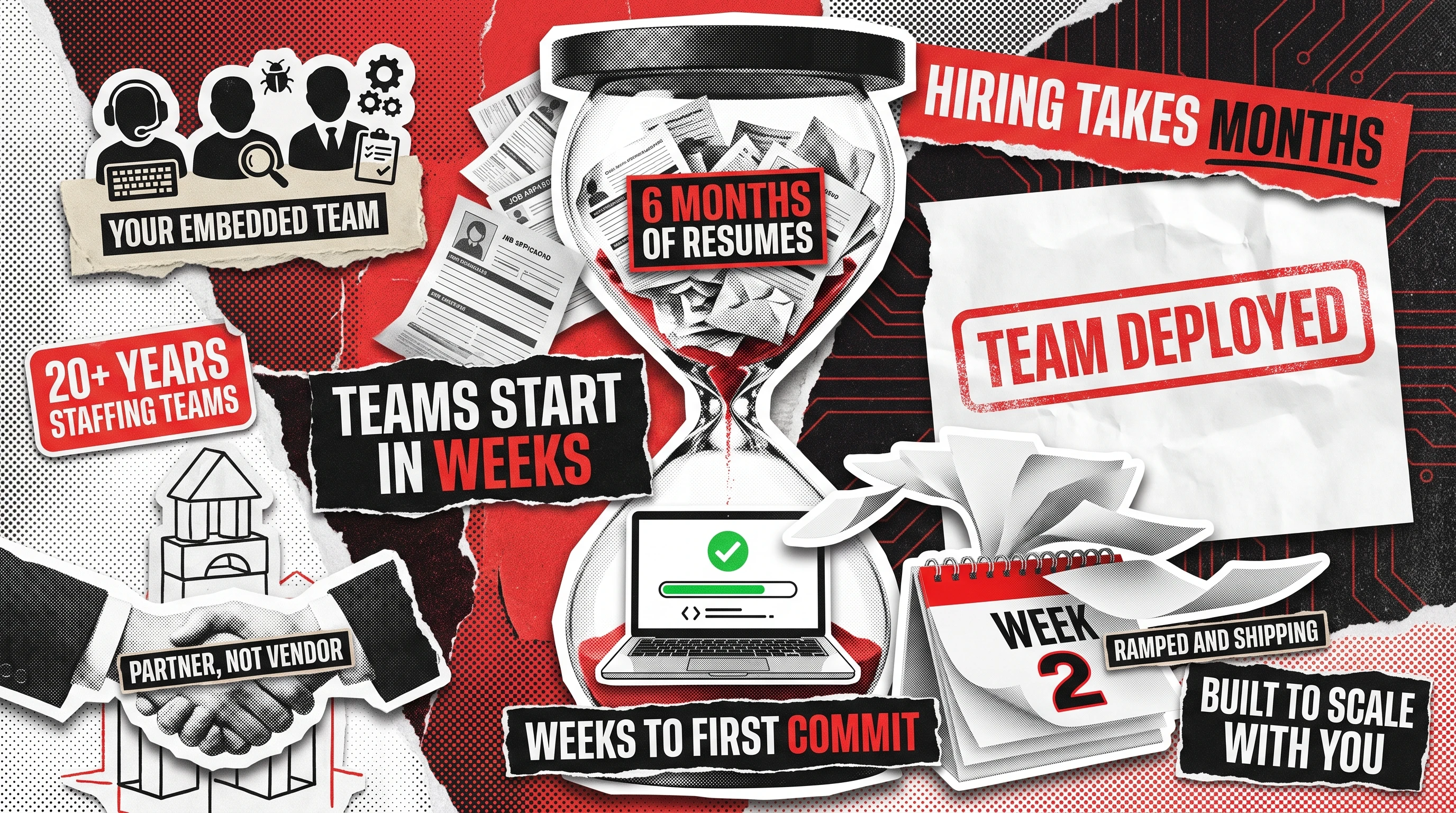
Hiring one senior engineer in-house can take three to six months from job post to first useful commit. The U.S. Bureau of Labor Statistics projects about 106,100 openings a year for software developers, QA analysts, and testers through 2035, and ManpowerGroup‘s 2026 Global Talent Shortage survey of 39,063 employers in 41 countries found 72% still cannot find the skilled people they need.
When you hire a dedicated development team, you contract a self-contained group of engineers, QA specialists, and a project manager who work only on your product and plug into your existing process. You pay a predictable monthly rate for that capacity instead of running a recruiting funnel. This guide is for heads of product and engineering managers who own a roadmap they cannot staff, and it comes from over 20 years and 250+ releases of staffing dedicated teams, including the cases where we say don’t buy this.
What a Dedicated Development Team Actually Is
A dedicated software development team is one unit of people assembled for your product and working on nothing else: developers, QA engineers, and a project manager who owns delivery coordination, plus a tech lead once the system needs one. The defining feature is the embedding rather than the headcount. The team joins your board, your repository, your standups, and your release cadence instead of running a parallel process and reporting across a wall.
It fits when work is ongoing and requirements are still moving: roadmaps that keep generating scope, platforms needing maintenance alongside features, modernization measured in quarters. It also fits when you need capacity faster than you can hire it, which is most of the time at a company between 10 and 5,000 people, and it is the usual shape of custom software for startups that have funding and a deadline but no engineering department yet.
Dedicated Team vs. Staff Augmentation vs. Project-Based
These three get used interchangeably in sales conversations and they are not the same purchase. What matters is who owns the outcome and how much of your own management time the model consumes. Here is how they compare on the dimensions that change the decision.
Best for
Ongoing product work with evolving scope
Filling a skill gap inside a team you already run
A single deliverable with a fixed end date
Who manages day to day
The provider’s PM, embedded in your process
You
The provider, against the agreed scope
Requirements at kickoff
Can start loose and firm up as you go
Already defined, since you run the roadmap
Must be locked before the price is set
Team shape
Full unit: devs, QA, a PM, a tech lead as needed
Individual specialists slotted into your team
Whichever mix the provider assigns to the scope
How it’s priced
Monthly rate for dedicated capacity
Hourly or day rate per person
Fixed price for the fixed deliverable

When a dedicated team is the right call
Choose this when the work outlasts any single deliverable and you want the same people accumulating context instead of relearning your domain every quarter. It also fits when you would rather hire dedicated developers than manage them, since the provider’s project manager absorbs sprint planning and capacity juggling. The economics improve past roughly a quarter of continuous work.
When staff augmentation wins
If you already have real process, code review discipline, and a tech lead with bandwidth to direct extra hands, augmentation is cheaper and simpler. You are buying skills, not a delivery function you own. The trap is buying it when your process is the actual bottleneck, because adding people to an unmanaged backlog makes throughput worse.
When project-based is the honest answer
Sometimes scope really is fixed: a migration with a known endpoint, an integration against a documented API, a compliance deadline with a checklist. Project-based outsourcing suits that work, because a fixed scope at a fixed price transfers estimation risk to the provider. If you cannot tell which of the three you need, that uncertainty is the finding, and a short software development consulting engagement resolves it cheaper than a twelve-month contract for the wrong team.
How the Engagement Runs, Week by Week
The opening stretch reduces unknowns before anyone commits to a roster: a discovery call covering the product, the stack, the state of the codebase, and the deadline driving the conversation, then a written proposal naming roles and people. Ramp-up runs in parallel with the first real tickets, so access, environments, and orientation happen while the team ships small low-risk changes. When requirements are thin, a paid discovery phase turns a vague brief into something estimable.
Most companies that approach us arrive without a finished specification, and a provider who demands one is telling you how they work. The workable alternative is to agree the next two or three weeks in detail, keep the quarter directional, and let the team surface questions a spec would have missed. One client put it better than our own marketing copy: “we do not always have full requirements, so it is good that we can figure out things together.”
From there the cadence should look like yours: your sprint rhythm, your standups at overlapping hours, reporting through tools you already use. Ask about time-zone overlap in hours, who your escalation contact is, and whether you get direct access to engineers or only an account manager. Communication is what clients most often say they were burned on before, and it is the easiest thing to test early.
What Actually Drives the Cost
Four variables move a quote more than anything else: seniority mix, region, team size, and engagement length. Seniority is a trade rather than a line item, since senior engineers cost more per hour and buy the difference back in fewer rework cycles. Team size compounds, because every specialist added raises the run rate and the coordination load, and longer engagements price better because onboarding spreads across the term. Any credible dedicated team pricing model shows those four inputs separately instead of one blended number.
The regional gap shows up in official statistics, not just vendor rate cards, though public data is coarser than any provider’s real pricing. Eurostat reported in March 2026 that average hourly labour costs across the EU economy were 34.90 euro in 2025, from 12.00 euro in Bulgaria and 13.60 euro in Romania up to 47.90 euro in the Netherlands. At occupation level, the U.S. Bureau of Labor Statistics puts the median annual wage for American software developers at 135,980 dollars as of May 2025, while Statistics Poland recorded an average gross monthly wage of 15,334.67 zloty in information and communication for July 2026, the best-paid sector in the Polish enterprise economy. Treat those as directional evidence of a real gap at comparable mid-to-senior quality, with caveats: the Eurostat figure spans all industries, and the Polish one blends IT with telecom and media across all seniority levels. Our explainer on what offshore software development is covers the delivery mechanics behind it.
Whatever the headline rate, a handful of line items decide whether that number holds. Force these into the open before signing:
- Whether project manager, QA, and DevOps time sits inside the rate or is billed on top
- The notice period for scaling down, and whether it differs from scaling up
- Who pays ramp-up hours when the provider replaces one of their own people
- Whether on-call or release-weekend work carries a different rate
- Which licences, cloud costs, and tooling land on your invoice
How to Vet a Provider Before You Hire a Dedicated Development Team
Most providers pass a reference check, because references are selected. These questions separate a team that holds up under a real deadline from one that does not. Onboarding speed leads deliberately: it is the biggest risk factor on a short runway and the differentiator our clients raise most often in dedicated development team engagements.
- How fast can this team be productive on our stack, and who is on the bench today? A provider who recruits your specialists after you sign has moved your hiring delay, not removed it.
- Have you worked on our exact stack before? A team that already knows your framework, database, and deployment model stops guessing weeks earlier.
- Can we speak to the engineers who would actually be assigned? Sales engineers often communicate better than the people doing the work, and that gap predicts a lot.
- What happens in month four when we change direction? The answer reveals whether they run a dedicated team of developers or are quietly selling a fixed-scope project with a monthly invoice.
- Show us a codebase you inherited half-finished. Taking over a partly-built system is a distinct skill, and it is where you land if your current arrangement fails.
- What is your reporting rhythm and escalation path? You want a named person, a response-time expectation, and access to the working tools.
Read the sceptical case too. Our piece on why you should never outsource if you do not want hidden charges is a counterpoint from the provider side, and its cost traps are what this list catches.
When a Dedicated Team Is the Wrong Choice
Turning work down is part of doing this well, and three situations get a direct no from us. Each has a better-fitting alternative, and forcing this model onto it makes both sides unhappy.
- A fixed specification with a fixed budget. If scope is locked and the number cannot move, buy a fixed-price project rather than monthly capacity offering flexibility you agreed not to use.
- You need one specialist, not a team. A single senior Kubernetes engineer for eight weeks is a staff augmentation contract. Wrapping a project manager and QA allocation around that need adds cost without adding much.
- You are building in-house within six months. If the internal team is funded, approved, and recruiting, ask whether you need a bridge at all, or whether the choice to build in-house versus outsource deserves another look.
That last one is where the decision to outsource development team capacity most often gets made for the wrong reason. A bridge team that hands over cleanly to a growing internal group is legitimate. A bridge team hired because the in-house plan is behind schedule and nobody wants to say so is an expensive way to reach the same delay.
What Fast Onboarding Looked Like in Practice: AWE Learning
AWE Learning sold Early Literacy Station, proprietary learning workstations installed in public libraries. When the 2020 pandemic closed those libraries, its distribution model stopped working and the company needed a cloud platform children aged 2 to 12 could reach from home. The constraint was internal capacity, and CEO Deborah B. Sorgi has been publicly direct about it: the company “did not have the resources or the expertise in-house to build a cloud-based product.”
Redwerk staffed a team of eight specialists against that gap and built the platform from scratch. It runs as microservices on Microsoft Azure using ASP.NET Core, Azure SQL, and Vue.js, with Azure Kubernetes Service handling elastic scaling, and shipped with a Playground of more than 175 STREAM titles, an admin panel, customizable bundles, reporting, and a child-safety extension. The engagement came to more than 35,000 lines of code and roughly 4,000 man-hours. The platform is now used by half of all U.S. public libraries and won a Modern Library Awards Platinum award in 2021. Sorgi’s summary: Redwerk’s “support was outstanding. They are very focused yet extremely flexible.”
The transferable lesson is the sequencing rather than the Azure architecture. AWE Learning had no time to hire a cloud group, evaluate a stack, then start building, so the team that arrived already knew the stack and built while the rest was still being decided. That ordering is the part to copy.
The Short Version, and Where to Take It Next
The model earns its place when work is ongoing, requirements are still moving, and you need people productive sooner than a recruiting cycle allows. It is the wrong purchase for a locked scope, a single specialist, or a company whose internal team is about to arrive anyway. Everything else is execution, and the part clients say mattered most is how quickly a team became useful rather than merely present.
That is what we have optimized for across more than 20 years and 250+ releases: specialists who already know the stack, so the first weeks produce shipped work instead of orientation. Talk to us about your team. If you would rather open with the awkward questions from the vetting list than a sales pitch, contact us and ask them.
Frequently Asked Questions
How fast can a dedicated team actually start?
It depends almost entirely on whether the provider already has people with your stack available, so ask who is on the bench today rather than what the average is. The practical sequence is a discovery call, a proposal naming actual people, then ramp-up alongside the first small tickets.
Can I scale the team up or down mid-engagement?
Scaling both directions is normal here and is a main reason companies choose it, but terms vary widely. Get the notice period in writing, check whether it is the same for adding as removing, and ask how fast an addition becomes productive, since a right to scale up is worth little if the new person needs six weeks.
Who owns the code and IP?
You should own all of it, and the contract should assign intellectual property to you as work is paid for rather than at the end. Confirm repositories, cloud accounts, and CI configuration are in your organization’s name from day one, and ask whether every contributor including subcontractors signed an assignment agreement, since that is where ownership gaps appear.
What happens if a team member leaves?
People leave, so what matters is whose problem it becomes. A reasonable arrangement has the provider finding the replacement, overlapping the outgoing and incoming person, and absorbing the ramp-up hours rather than billing you. Push for documentation as standing practice, since a team where one person understands a subsystem is a risk regardless of who employs them.
How is a dedicated team priced compared to in-house hires?
A monthly rate per person gets compared against a salary, which is not the real comparison. The in-house number has to carry recruiting fees, benefits, payroll taxes, equipment, licences, management overhead, and the vacancy months before the person starts. The provider rate bundles most of that, so it looks higher per hour and often lands lower per delivered feature.
See how we built an AI-powered recruitment app acquired by a US staffing giant