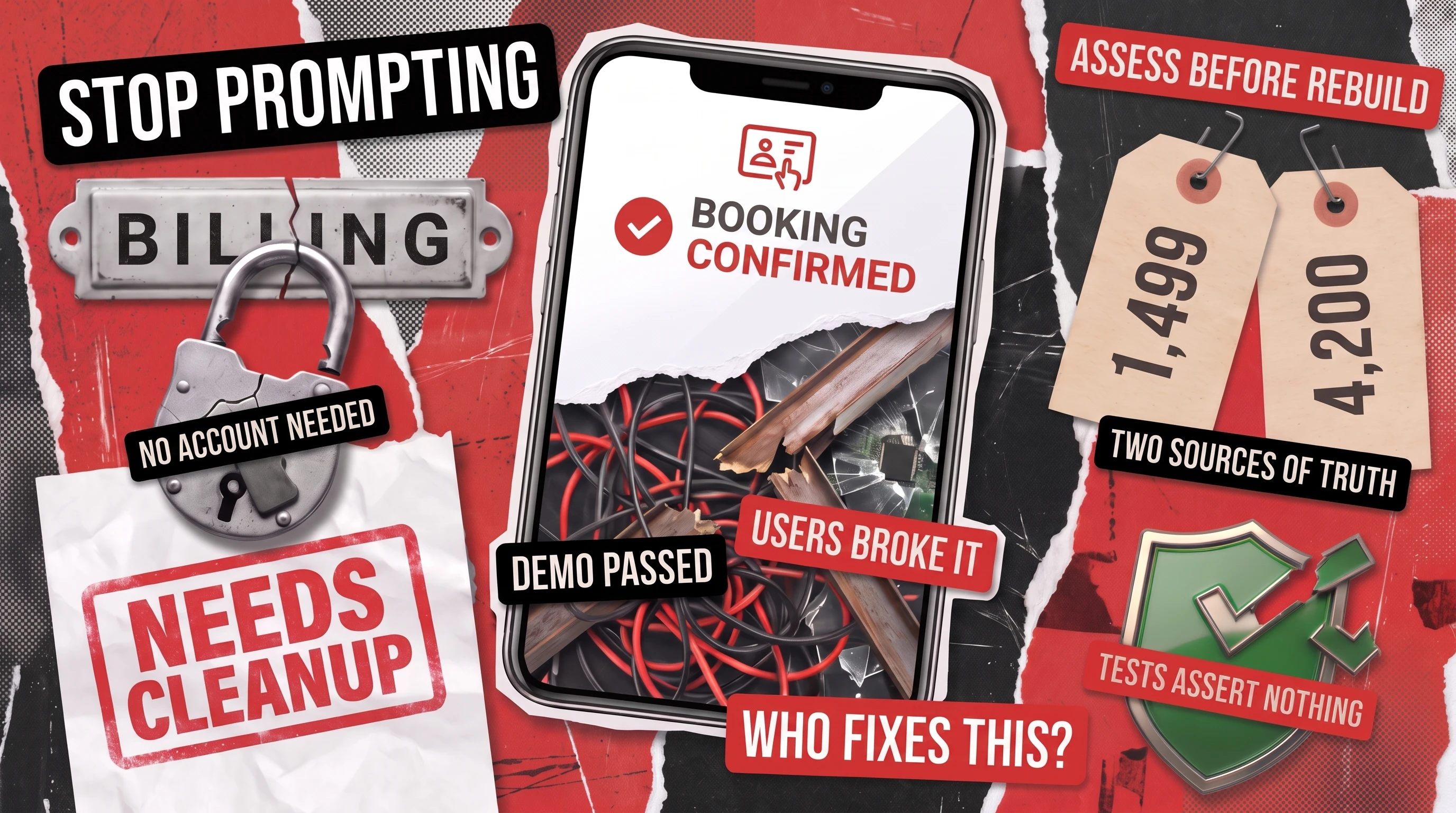
Is a “vibe code cleanup specialist” a real, emerging profession, or just tech hype? With recent stats showing that about 63% of vibe coding platform users lack a programming background, everyday people are building their own apps, and eventually hitting a wall. When things break and they can’t debug the AI-generated code themselves, they need someone to step in.
A vibe coding cleanup specialist is an engineer who takes an AI-generated codebase and makes it dependable. They assess what is actually in there, stabilize whatever is losing money or leaking data, then refactor or rebuild only the parts that carry real risk. The output is a product you can safely change, not just a prettier repository.
If you’re currently in a situation like this, you can explore our vibe code cleanup services to get a free estimate. In this article, we cut through the jargon to explain exactly what a cleanup specialist does day-to-day, the warning signs that it’s time to hire one, what the week-by-week timeline looks like, and what a truly “fixed” app actually means for your business.
What a Vibe Coding Cleanup Specialist Actually Does
AI already wrote the code, so the specialist is not being hired to type. The value is judgment: deciding which parts of that codebase are an asset, which are a liability, and which need attention this week.
Turning an AI-generated first version into dependable software is an engineering job. AI is genuinely good at producing screens, forms, workflows, and standard features quickly, and it is excellent at following a strict design system. Production software still needs architecture, secure data flows, tests that assert something, monitoring, documentation, and a human who owns it. A booking screen can look finished while the real question goes unanswered: do bookings stay consistent across Stripe, notifications, permissions, and the database when a customer loses signal halfway through?

The hardest problems to find are the ones that never show up on screen. A crash is easy to notice, while a wrong payment status, an unchecked permission, a duplicate booking, or slowly corrupting data can sit in a live product for months without anyone seeing it. Most builders test the one path they had in mind when they wrote the prompt, and real users end up testing everything else, which is the class of gap a security audit of an AI-built MVP is designed to surface.
Research now puts numbers on this. A large-scale study of 302,600 AI-authored commits across 6,299 repositories found that more than 15% of commits from every AI coding assistant introduced at least one issue, and that 22.7% of those issues were still present at the repository’s latest revision, including issues introduced more than nine months earlier.
Scale does not protect you either. In March 2026, according to internal documents reported by the Financial Times, Amazon held a mandatory engineering meeting about a trend of incidents with a “high blast radius” that internal briefs linked to “Gen-AI assisted changes.” Amazon disputes that framing and told Fortune that only one incident discussed involved AI and none involved AI-written code. Even on Amazon’s own account, the company that built modern deployment safety is working through this question internally, and smaller teams with far less review should assume the same risk applies to them.
Five Signals It Is Time to Stop Prompting and Hire One
Founders usually wait longer than they should, because each symptom looks like an isolated bug rather than a pattern. These five are the pattern. One of them on its own is worth a conversation, and several at once usually means the work is overdue.
1. You changed one thing and something unrelated broke. This is the signature of hidden coupling. The file structure looks tidy and modular, and underneath it everything reaches into everything else.
2. Two screens disagree about the same fact. On one real project our team found a pricing page where two separate components each fetched their own list of paid plans, with different values in some fields. You cannot see it in the browser. You see it when you update the price in one place, ship it, and a customer finds the other one. Duplication is the single most common thing our engineers expect to find in AI-generated code, because agents keep adding and almost never consolidate.
3. You cannot answer “who is allowed to see this?” On the same project, a 13-route app navigated perfectly along the intended flow and had no route protection at all. Anyone could open the billing route without an account. That is a missing layer rather than a bug in a feature, and no amount of clicking around the interface will reveal it. Our vibe code audit checklist covers how to look for this class of gap yourself before you call anyone.
4. Your tests pass and you do not believe them. AI writes tests eagerly. A lot of them assert nothing and simply record which lines got executed. Green coverage plus no confidence is a very specific and very common state.
5. You have stopped being able to debug your own product. A systematic review of 101 practitioner sources and 518 firsthand accounts of vibe coding named this outcome directly: the practice creates “a new class of vulnerable software developers, particularly those who build a product but are unable to debug it when issues arise.” If you are prompting in circles, that is the wall. It is a common place to arrive and a bad place to stay.
Why Cleanup Does Not Automatically Mean an Expensive Rewrite
The fear that keeps founders prompting is the assumption that a professional will look at the codebase, wince, and quote a full rebuild. That does happen. It is not the default, and a specialist who leads with it has skipped the only step that matters.
We assess first, for economic reasons rather than diplomatic ones: rewriting something that already works correctly is the most expensive way to change nothing. That first pass is the same discipline as a software development audit, applied to a codebase that is weeks old rather than years old. The rule our engineers apply to every module comes down to three questions. Is the business logic correct? Is the performance acceptable? Can the next developer maintain it? The answers decide the verdict.
Logic correct, performance fine, structure readable
Keep
Add tests that assert behavior, document it, leave the code alone
Logic correct, but structure blocks change or performance drags
Refactor
Consolidate duplicates, introduce boundaries, add route guards, fix semantics
Logic wrong, performance bad, and nobody can maintain it
Rebuild that part
Replace the module behind the same interface, keep the interface users already know
Most vibe-coded products land in all three rows at once, which is exactly why a blanket rewrite wastes money. We keep what creates value: the interface, the validated workflow, the product concept, the features your users already understand. We replace what creates risk: permissions, payment logic, data structures, and the backend systems that fail expensively.
Before touching a module, the question is whether the refactor is worth doing at all. Plenty of AI-generated code is not to an engineer’s taste while being perfectly fine for the business, and refactoring it buys you a marginally nicer file and no value at all. Cleanup that cannot name the business risk it removes is redecorating.
Cheap first versions get expensive later, in debugging, security work, infrastructure, and every future change that breaks something else. McKinsey’s research on tech debt found CIOs diverting 10 to 20% of the budget meant for new products into resolving debt-related issues, and companies paying an additional 10 to 20% on top of project costs to deal with it. Those are enterprises with governance in place. An unreviewed AI codebase runs the same dynamic with none of the brakes, which is the mechanism we unpack in how technical debt accumulates in AI-assisted coding.
What a Cleanup Engagement Looks Like Week by Week
Timelines change with the size of the codebase, but the order of the work stays the same. We look at the whole system before looking at individual files, because fixing one component well inside a broken architecture does not get you anything. Nothing gets rewritten until we understand how the pieces connect.
Week One: Assess and Estimate
The engineer reads the system from the outside in: overall architecture, the packages you depend on, the business logic processes, and the main feature modules, then downward into implementation details, build and deploy processes, routing, and third-party library usage. Only after that picture exists does the bottom-up sweep start, looking for duplication, missing boundaries, unsafe handling of user-created content, and the rest.
The output is a written issue list, ranked by impact rather than by how much the code offends anyone: which flows are affected, what business logic is at stake, how fragile each fix is. You get priorities and an estimate before any work starts, so the decision to proceed is yours and it is informed.
Week Two: Stabilize What Is Failing
Anything losing money, exposing data, or corrupting records gets fixed first, in priority order. Route guards on restricted routes. One source of truth for prices and plans. Idempotency on payment webhooks, so a retry stops creating a second charge. None of this work is exciting to look at, and it is usually the point where the emergency ends.
Weeks Three to Six: Refactor or Rebuild the Ranked List
Now the ranked list gets worked through, verdict by verdict. Original work survives wherever it is sound. In one real example, that 13-route system was not deleted, it was restructured with a guard specific to each restricted route. In another, forms that had inputs, styles, and validation but no actual form elements got a proper semantic structure added around the existing inputs, which brought the product in line with WCAG 2.2 accessibility guidelines and made it usable with a screen reader.
Ongoing: Document the System for Whoever Comes Next
The deliverable that decides whether you are back here in three months is written guidance. That means general and project-level guidelines plus architecture notes, so the next developer inherits rules instead of guessing at intent. Our teams rely on exactly this to keep code understandable across people who have never worked together. It also gives your next AI session a specification to follow, which is the cheapest way to stop the same problems from reappearing.
Ongoing: Put AI to Work on Review Instead of Writing
Cleanup does not mean banning the tools that got you here. Our engineers use AI during cleanup, aimed at different work than the original build: checking code for compliance against project guidelines, looking for overengineering and unnecessary complexity, and scanning for possible security leaks as a final pass. Our review of the current vibe coding tools covers which ones hold up for that kind of work. A person still signs off on every change, because responsibility does not transfer to a tool.
What Fixed Means When the Work Is Done
“Fixed” needs to be a list of things you can verify, otherwise you are buying a feeling. Lines of code deleted does not belong on that list. Deleted lines measure activity rather than value, in the same way that lines written never measured productivity.
A finished cleanup hands you:
- A prioritized issue list with each item’s verdict and how it was resolved
- The stabilized flows themselves, starting with payments, permissions, and data integrity
- Tests that assert real behavior on the paths that matter
- Permissions and route protection that hold when a user goes off-script
- Consolidated single sources of truth for business-critical data
- Project guidelines and architecture notes for whoever comes next
- A maintenance plan you can either run yourself or hand back
The success criteria are just as concrete. Every business process still works exactly as it did before. The product looks and behaves the way your users expect, because cleanup that changes the experience has failed regardless of code quality. And where performance was a target, the affected metrics moved. Fewer bugs, faster reviews, honest coverage, and quicker future changes all count.
When You Should Not Hire a Cleanup Specialist Yet
If your app has no users, no payments, and no data worth protecting, keep prompting. That is genuinely what AI is best at, and paying an engineer to harden a prototype you may abandon next week is a bad trade. Vibe coding earns its reputation as a scaffolding and prototyping tool, which is roughly where the honest assessments land in our 2026 report on the state of AI-built apps.
Two more cases deserve the same answer. If you are still hunting for product-market fit and this build is a disposable experiment, cleanup is premature. And if the week-one assessment finds that the business logic is wrong, the performance is poor, and the code is unmaintainable across the entire system, then the honest answer is a rebuild that is planned and priced as a rebuild from the start, rather than a cleanup that grows into one along the way. A specialist worth hiring tells you that in week one, instead of discovering it halfway through your budget.
Why Teams Bring Redwerk In for Vibe Code Cleanup
We help businesses save vibe-coded prototypes, and sometimes entire applications, by putting a real foundation under them. Every engagement starts with a discovery phase to establish what the business actually needs, which is how we find out whether the app needs more than code-quality work and has architecture or security problems underneath. You get an estimate before we start anything.
The engineering principles behind that work are not new, which is the point. We have spent decades building custom software for companies across North America and Europe, including Fortune 500 organizations such as Siemens, J.B. Hunt, and Universal Music Group, and the security and architecture practices we apply to a three-week-old AI codebase are the ones we developed on systems that were not allowed to fail.
Pridefit shows what the sequence produces. We cleaned up the issues left by a previous vendor, improved the infrastructure, added analytics, and then built new features on top. The stronger product helped increase subscriptions by 45%. Today the Pridefit team prototypes ideas with AI while our engineers handle production development, review, and technical control. AI did not remove the need for engineering there, it moved where engineering adds value, which is the same argument IBM makes about pairing vibe coding with systems thinking.
If your AI-built app has hit the wall, get in touch and we will tell you which parts are worth keeping.
FAQ
What does a vibe coding cleanup specialist do?
A vibe coding cleanup specialist assesses an AI-generated codebase, stabilizes what is actively failing, then refactors or rebuilds only the parts that carry real business risk. The work covers architecture, business logic, permissions, data integrity, integrations, tests, and documentation, and it ends with guidelines so the next change does not reintroduce the same problems.
Who can fix my vibe coded app?
An experienced software engineering team that works top down rather than file by file. The skill you are paying for is prioritization: deciding what to keep, what to refactor, and what to replace, then proving the product still behaves the way your users expect afterward. Anyone who quotes a full rewrite before assessing the code has skipped the step that saves you money.
When should I hire someone to fix my AI-built app?
When you have real users, real payments, or real data, and any of these is true: one change breaks something unrelated, two screens disagree about the same fact, you cannot say who is allowed to access what, or you can no longer debug your own product. Before that, with no users and nothing to lose, keep building with AI.
What happens during a vibe code cleanup?
Week one is assessment and a ranked issue list with an estimate. Week two stabilizes anything losing money or exposing data. The following weeks work through the ranked list with a keep, refactor, or rebuild verdict for each module. The engagement closes with tests, documentation, and project guidelines.
Can I fix my vibe coding project myself?
Sometimes, and it depends on which layer is broken. Cosmetic and dependency-level problems are reasonable to take on yourself. Permissions, payment logic, and data integrity are the three areas where a small mistake stays hidden and then gets expensive, so those are worth a second pair of experienced eyes even if you handle everything else.
See how Redwerk took over a struggling fitness app from another vendor, cleaned up the inherited technical debt, and helped Pridefit grow subscriptions by 45%