Only about one in ten healthcare organizations run robotic process automation today, against roughly a third of manufacturers and tech companies running it already. That gap is odd, because RPA is the cheapest, fastest automation a health system has available, sitting in a market Precedence Research values at $2.80 billion in 2025, on track to reach $27.23 billion by 2035.
The reason most healthcare IT teams haven’t started usually isn’t a good one. RPA and AI-driven automation get talked about as the same project, so the easier win sits on a roadmap somewhere behind the harder, more ambitious one.
This guide covers RPA on its own: what it actually is, where it pays for itself in a hospital or health system’s admin operations, and the implementation problems that trip up most first deployments. Where the AI-driven layer takes over, you’ll get a pointer to it rather than a blurred-together pitch for both, because they’re bought, built, and staffed differently, and conflating them is usually why the RPA project never leaves the roadmap.
What Is RPA in Healthcare (and How It Differs from AI-Driven Automation)
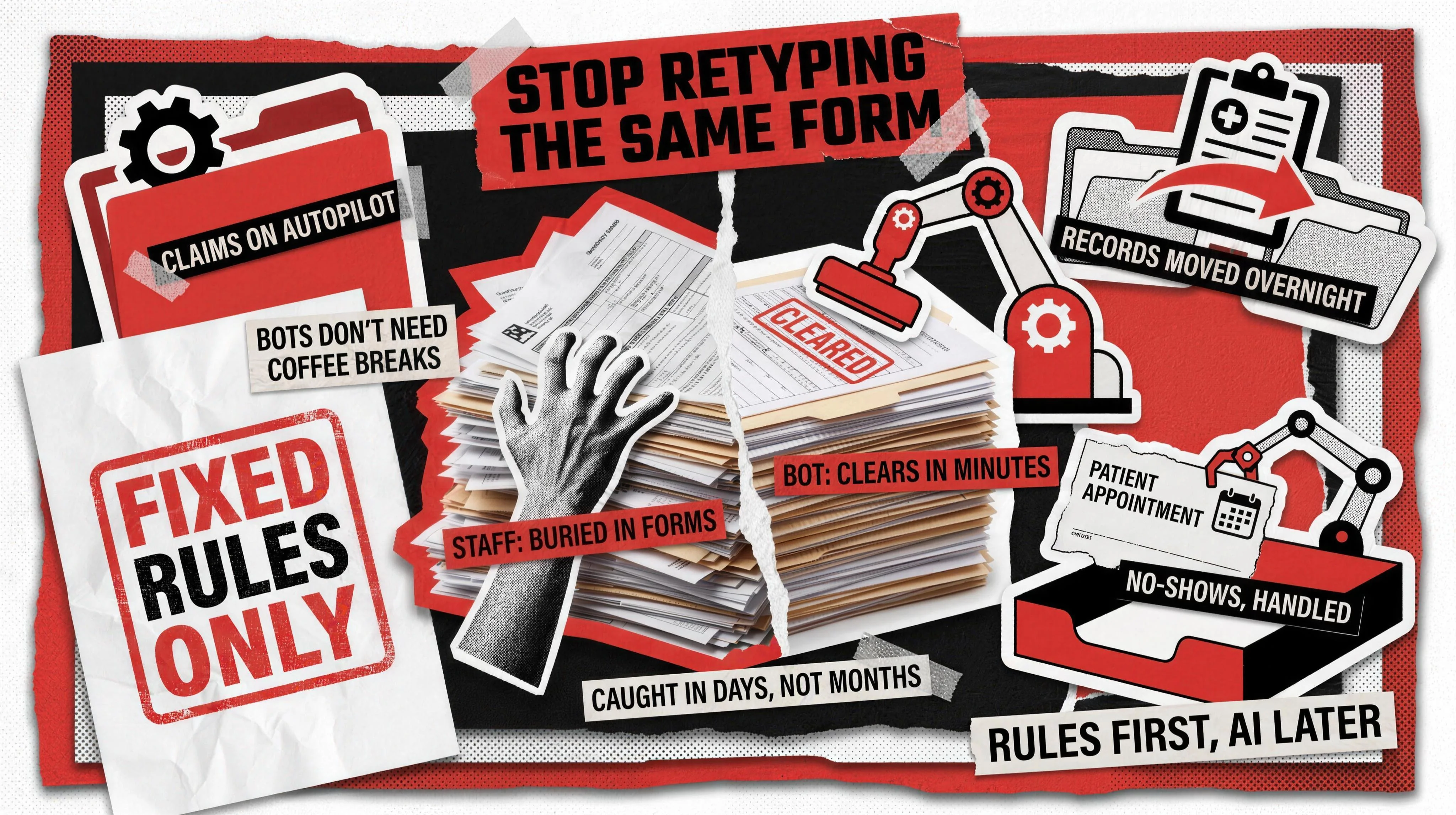
Robotic process automation in healthcare is software that copies a fixed, rule-based admin task, entering a patient’s insurance ID into a claims system, moving a record from one database to another, the exact way a staff member would do it by hand, just without the typos, the coffee breaks, or the hourly rate. It doesn’t decide anything. It follows the same steps every time, on the same kind of input, and stops the moment something doesn’t match the script.
AI-driven healthcare automation is a different technology solving a different problem. It handles the parts of a workflow that need a judgment call: predicting whether a claim is likely to be denied before it’s submitted, drafting a clinical note summary, routing a patient through triage based on symptoms that don’t fit a template. A bot can’t do any of that, because there’s no fixed rule to follow. That’s the line between the two, and it matters more than the marketing on either side usually admits.
How it decides
Follows a fixed script, same steps every time
Weighs context and makes a judgment call
Best fit
Repetitive, structured, high-volume admin work
Tasks with ambiguity or a decision to make
Healthcare examples
Claims data entry, eligibility checks, appointment reminders
Denial prediction, prior-auth triage, patient intake routing
Breaks when
The upstream screen, field, or system changes
Rarely, but drifts and needs monitoring over time
Typical build time
Weeks
Longer; needs a model and training data
In practice, the two often sit inside the same revenue cycle system doing different jobs: a bot moves the eligibility check through, and separately, a model flags which of those claims is likely to get denied before it’s ever submitted. One is deterministic plumbing. The other is a prediction. Confusing them is how a healthcare IT team ends up scoping a full AI platform for a problem a much smaller, much faster RPA build would have handled on its own.
If the piece you actually need is the AI-decisioning side, patient intake, eligibility pre-checks, prior authorization, that’s covered separately: see the breakdown of AI-driven patient journey automation and AI workflow automation for medical offices. The rest of this piece stays with RPA.

Robotic Process Automation Use Cases in Healthcare
The use cases that show up across the RPA-in-healthcare ecosystem are almost all the same handful of admin workflows, because they share one trait: high volume, low variation, and rules that don’t change often.
- Claims processing and eligibility verification. A bot checks a patient’s coverage against payer portals before the appointment and flags mismatches, instead of a staff member logging into five different portals by hand for every visit on the schedule.
- EHR data migration and entry. During a system-to-system record transfer, an EHR migration being the obvious case, bots move structured fields (demographics, insurance IDs, medication lists) so staff only touch the exceptions the bot can’t match. This is also where legacy formatting quirks surface fastest, which is why migration projects tend to double as the first real stress test of a health system’s data hygiene.
- Appointment scheduling and reminders. Bots cross-check provider calendars, send reminders, and rebook no-shows without a person triggering each step, which matters most in high-volume specialty clinics where a single scheduler manages hundreds of slots a week.
- Revenue cycle management and billing reconciliation. Bots match remittances against invoices and flag underpayments the moment they land, rather than at month-end close, so a discrepancy gets caught while there’s still time to appeal it.
- Supply and inventory management. Bots trigger reorders at defined thresholds and reconcile purchase orders against receiving records, which keeps clinical supply chains from running on someone’s memory of what usually runs low.
- Compliance reporting. Bots pull the same fields from the same systems on a fixed schedule, built for the audit trail, instead of someone assembling the report by hand every quarter and hoping nothing was pulled from a stale export.
None of these require a model or a judgment call, and none of them need the underlying system rebuilt first. That combination, real cost relief without a platform migration, is exactly why they’re the right starting point.
Benefits of RPA in Healthcare
Reported first-year ROI on healthcare RPA deployments runs 30% to 200%, and claims automation specifically can cut processing costs by up to 30% once the bulk of claims tasks run through bots rather than a person. That range is wide, and it should be: a high-volume, well-structured process like eligibility checks lands near the top of it, while a process with more exceptions and manual routing lands closer to the bottom.
Past the cost line, the two benefits that matter most day to day are fewer administrative errors and less burnout on repetitive tasks. Claims and scheduling staff who spend their day re-keying the same fields into different systems are doing work a bot does faster and without a transcription mistake, which frees that staff time for the calls and exceptions that actually need a person.
There’s also a cash-flow effect that doesn’t show up in the headline ROI number. Reconciliation and eligibility checks that used to run in a weekly batch can run continuously instead, so a denied claim or an underpayment gets caught days earlier than it would in a manual process. Over a year, that shift alone can matter more to a finance team than the per-claim cost saving does, because it’s the difference between chasing a denial the week it happens and chasing it two billing cycles later.

Implementation Challenges (and How to Avoid Them)
RPA in healthcare fails less often on the technology and more often on three specific, well-documented problems.
Legacy system integration is the most-cited hurdle industry-wide, and healthcare has it worse than most sectors. EHR platforms and billing systems were rarely built with an API a bot can call cleanly, so automation often has to work at the screen level, clicking and reading fields the way a person would, instead of through a proper data layer. That’s more fragile by design. If your systems are old enough that this is already a known pain point, the legacy ERP integration work Redwerk has done is directly relevant, and in some cases a purpose-built integration layer is worth commissioning before the bots go in, which is custom enterprise software development territory rather than an off-the-shelf RPA tool.
Staff resistance is the second problem, and it’s usually a communication failure, not a real objection. Billing and scheduling staff have seen “automation” pitched to them before as a headcount conversation, so the framing matters as much as the technology. Say plainly that RPA removes the repetitive part of the job, not the job itself, and say it before the rollout, not after someone notices a bot doing the task they used to own. Teams that skip this step get quiet workarounds and shadow spreadsheets instead of adoption.
Bots breaking when upstream systems change is the third, and the one teams underestimate most. A routine EHR vendor patch or a UI update can silently break a bot’s screen logic, and nobody notices until claims stop moving or a scheduling queue backs up. RPA is not a deployment you set and forget; it needs the same ongoing monitoring, alerting, and support as any other production system, with someone accountable for noticing when a bot goes quiet instead of assuming quiet means it’s working.
Where RPA Ends and AI-Driven Healthcare Automation Begins
RPA follows the rule you gave it and stops the moment a decision needs to be made. AI-driven automation is where that decision happens, and the direction the technology is moving in is toward agentic bots that decide the next step rather than execute a fixed script, appointment booking that adapts to what a patient actually needs, an insurance claim that routes itself differently depending on the payer’s specific denial pattern.
That’s the gap Redwerk’s AI automation agency work is built for, covering the healthcare patient journey specifically, from booking an appointment through processing insurance claims and filing appeals. It’s the natural next step once the rule-based layer described above is running and the remaining bottleneck is a decision, not a repetitive task, and it’s also why the two are worth planning together even when you’re only building one of them first. A bot that hands off a clean, structured exception queue is a much better starting point for an AI layer later than a manual process with no consistent data trail at all.
Where Redwerk Fits In
RPA isn’t a smaller version of AI-driven automation or a competitor to it. It’s the layer underneath: the fixed-rule work that, once cleared, lets AI and your staff spend their time on the calls that actually require judgment.
Redwerk builds both. The rule-based RPA layer covered here, for healthcare organizations that need one, the other, or both working together. That includes the legacy-integration work that most RPA projects stall on, and delivery built for compliance-heavy environments, the same enterprise and forecasting work Redwerk has done for government agencies applies directly to the compliance bar healthcare systems have to clear.
What that means practically: an assessment of your current admin workflows to find the ones with the highest volume and the lowest variation (the RPA-ready ones), a build that plans for the legacy systems you already run rather than assuming a clean API, and a team that stays in the loop with your IT staff instead of handing over a black box and disappearing after go-live.
If your admin workflows are still running on people re-keying the same fields between systems, talk to Redwerk’s healthcare IT team about where to start.
FAQ
What's the difference between RPA and AI in healthcare?
RPA follows a fixed rule and repeats the same steps on structured input, claims entry, scheduling, eligibility checks. AI-driven automation makes a judgment call on input that varies, like predicting a claim denial or triaging a patient’s symptoms. RPA doesn’t learn or decide; AI does.
What's the difference between RPA and business process automation?
Business process automation is the broader category, any technology that automates a workflow, including RPA, AI, and simple rules engines or workflow tools. RPA is one specific method inside that category: software bots that mimic a person’s exact clicks and keystrokes across existing systems, without needing those systems to be redesigned or integrated first.
Is RPA HIPAA-compliant?
RPA itself is just software following rules, so compliance depends on how it’s implemented, not the technology itself. A compliant deployment needs access controls scoped to what the bot actually touches, an audit log of every action it takes, and encryption in line with your existing PHI handling policy. Treat a bot the same way you’d treat a new employee’s system access: least privilege, logged, reviewed.
Which healthcare processes shouldn't be automated with RPA?
Anything that requires interpreting context rather than following a rule: clinical decision-making, denial appeals that need a human read on payer intent, triage, patient communication that depends on tone or circumstance. If the process has meaningful exceptions that a human currently resolves by judgment, RPA will either fail on them or need so many hard-coded exception rules that it stops being worth maintaining. That’s AI-driven automation territory, or a person’s job, not a bot’s.
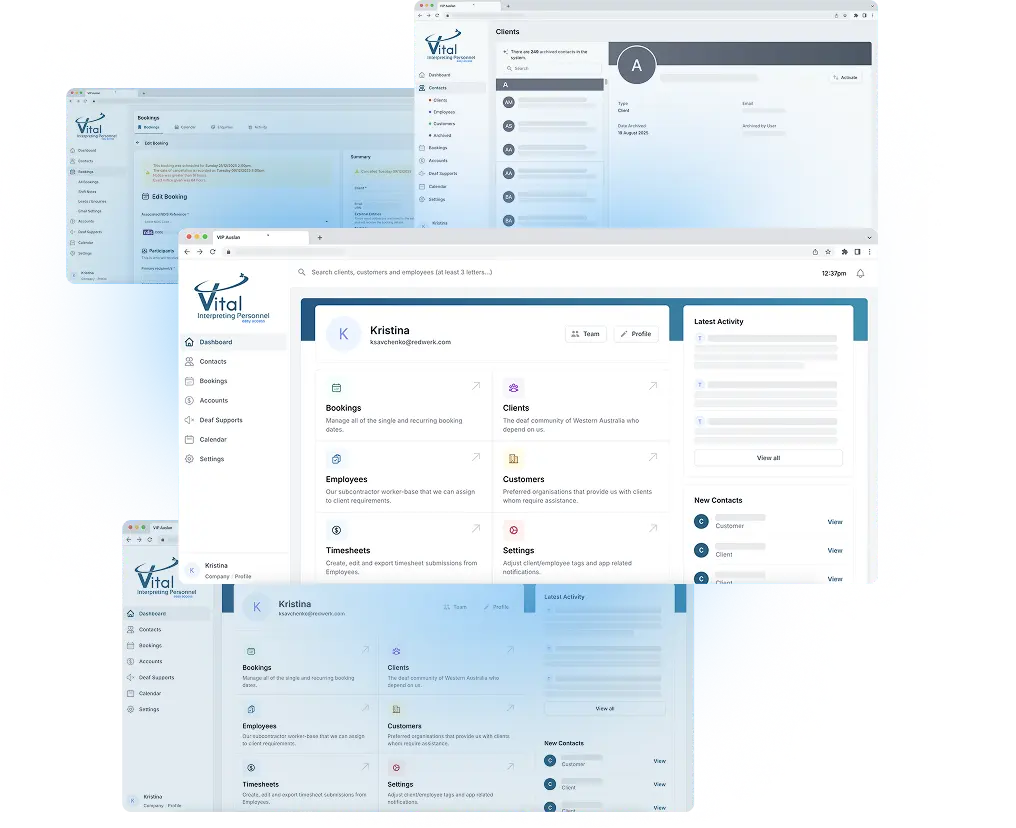
See how we built a booking platform that cut manual admin tasks by 40% and scaled across 100+ government institutions.