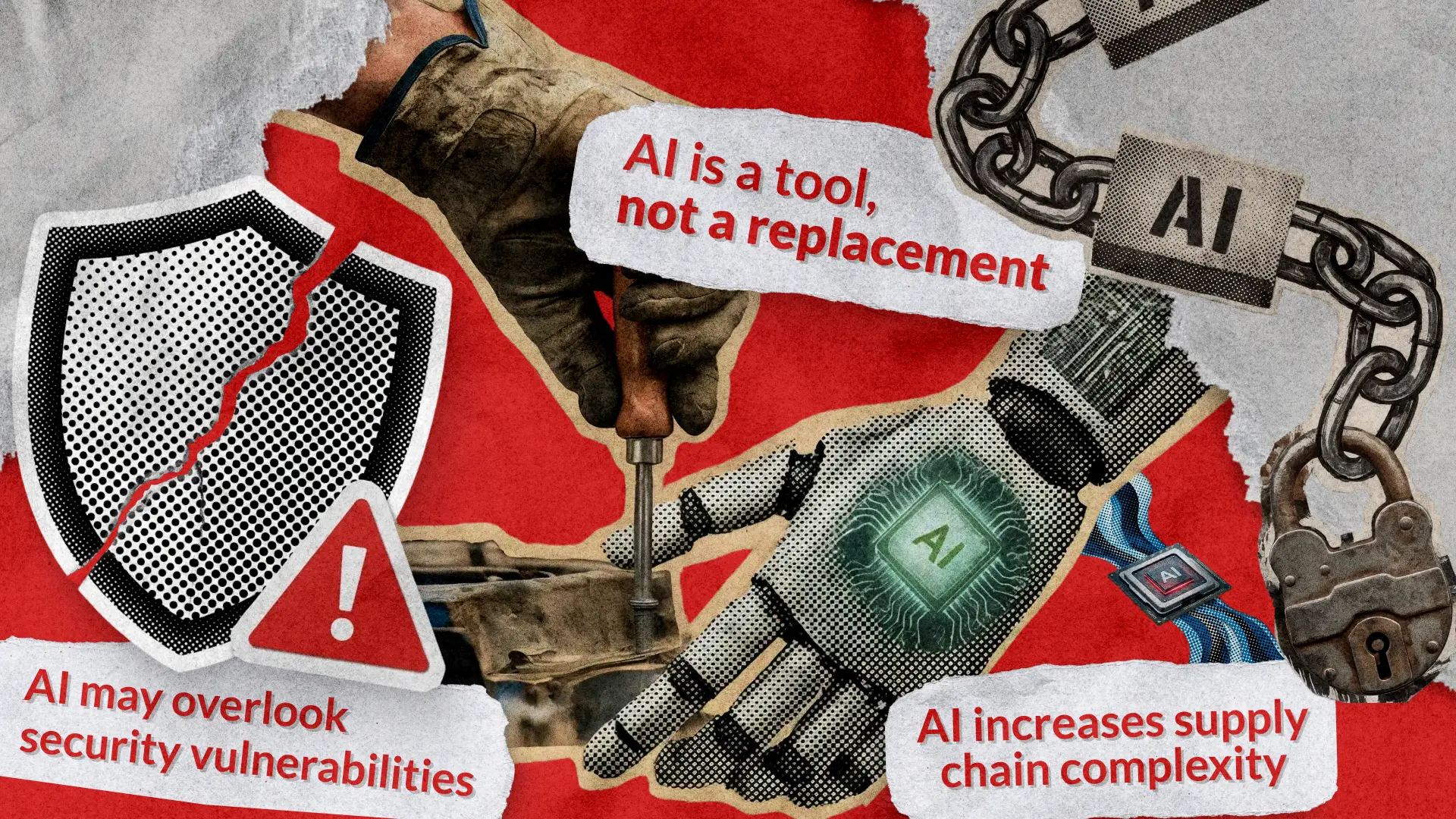
AI adoption in engineering teams is now standard practice. McKinsey (2025) reports that 88% of organizations use AI in at least one business function. In software development itself, the usage keeps on growing as companies integrate coding assistants and automated agents into their pipelines.
Meanwhile, the WEF Global Cybersecurity Outlook 2025 reports a sharp rise in software supply-chain exploitation, driven by dependency complexity, opaque AI-generated components, and limited visibility into how modern systems assemble final artifacts. Security leaders identify supply-chain compromise as one of the most difficult risks to contain because AI-assisted development increases the volume of code and configurations entering produ ction without proportional improvements in governance.
Drawing from our hands-on experience, we’ll examine AI-augmented development security through the lens of practitioners actively navigating these challenges. We will demonstrate how companies can practically integrate modern risk assessment practices into their specific development lifecycle and vendor selection process, focusing on real risks, widespread myths, and the compliance expectations shaping engineering strategy today.
AI-Augmented Development as the New Normal
As in other segments, AI has also become a routine part of software development. Now, most engineering teams rely on AI tools for scaffolding, refactoring, and implementation speed. Automated assistance can free up even a day of developers’ time. However, these gains don’t automatically translate into faster delivery. Productivity capacity for planning, review, and release processes stays the same. While boosting output, AI doesn’t repair workflow bottlenecks.
Security Quality: More Code, More Weak Spots
As AI use grows, familiar security issues take new forms. Generated code tends to follow common patterns in training data, which means it may reproduce subtle weaknesses. They typically show up as:
- insufficient input validation
- insecure default configurations
- weak error-handling logic
- unsafe serialization or deserialization flows
Individually, these issues may seem small. At scale, they compound into meaningful vulnerabilities, especially when developers trust seemingly polished suggestions. This expanding volume of machine-authored changes increases AI security risks in parts of the codebase that teams don’t expect to review closely.
Supply Chain Expansion Through Automation
AI tools now influence areas far beyond simple code snippets, impacting dependency choices, configuration templates, and build pipelines. However, because AI learns from human-produced data, it inevitably mirrors human error — something we see frequently in our professional code reviews.
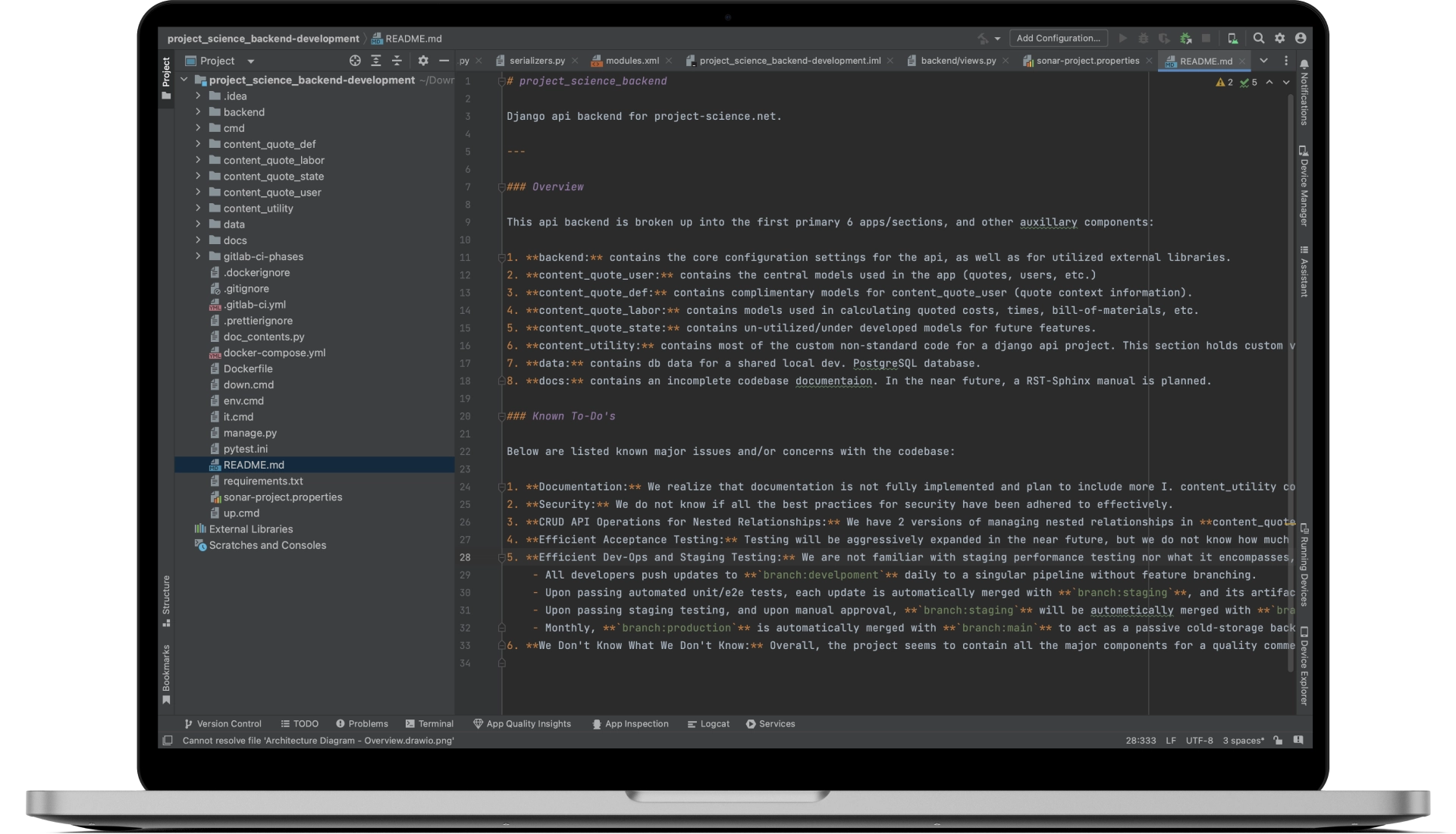
For instance, while auditing Project Science (a quote management platform for IT projects), we identified a critical security vulnerability: sensitive data was being stored in a publicly accessible folder. Despite the use of automated tools, the AI failed to flag this risk.
This illustrates a growing concern in the software supply chain. Automated suggestions can quietly introduce:
- configuration files that no one manually edited
- modified CI/CD steps
- permissive defaults chosen for convenience
Every automated insertion adds new points to track for AI compliance and supply-chain integrity.
Five Myths Holding Back Secure AI Use
Teams adopting AI often assume automation can be layered onto existing development habits without changing their approach to risk, governance, or code quality. That assumption is exactly what exposes companies to the hidden costs of poor AI integration — issues that stay invisible until they slow delivery, complicate audits, or create openings for attackers. After reviewing and troubleshooting AI-augmented software development environments across different products, these are the five misconceptions that most often lead teams into trouble.
Myth 1: AI Writes Safe Code
AI generates code that works, but not code that withstands pressure. In practice, assistants often reproduce the most statistically “common” solutions, many of which contain subtle weaknesses. I’ve seen generated handlers pass security reviews because they looked polished, yet they quietly skipped proper validation or relied on permissive defaults. These are small cracks that widen with scale and undermine AI software security when left unchecked.
Myth 2: Our Scanners Will Catch It
Traditional scanners specialize in known patterns, dependency mismatches, and signature-based flaws. What they don’t catch is AI’s tendency to alter the shape of the system itself. In several client projects, routine scans passed cleanly while an AI-suggested build step downloaded an unverified binary, which security tools never surfaced because it sat outside the code path they examined. These gaps become especially risky when AI influences configs, pipelines, or automation rules that no one has manually touched.
Myth 3: SBOM Means Our Supply Chain Is Secure
A standard software bill of materials (SBOM) captures libraries, packages, and versions. But as we learned through our experience, it reveals almost nothing about how code was generated or transformed by automation. We’ve audited systems where the SBOM listed three dependencies while the generated deployment template pulled in two more during runtime. Without a parallel record that describes the model, generation settings, and AI-derived artifacts, compliance teams end up with an incomplete view of how software is actually assembled.
Myth 4: The LLM Vendor Handles Compliance
Vendor certifications don’t extend to how your team uses the model day to day. Safe outputs depend on your own prompts, review steps, and access controls. You can use a fully certified enterprise LLM, yet leak sensitive business rules into prompt logs because internal controls don’t match the model’s governance level. The tool seems compliant, but the workflow is not. This is where well-intentioned innovation becomes operational risk.
Myth 5: Regulators Don’t Look at AI Code
Today, regulatory bodies treat AI-generated artifacts as part of the software supply chain. SDLC audits now include how teams validate generated code, record model usage, and govern automated decisions. We’ve guided companies through reviews where their traditional security posture passed, yet they failed when asked to show how AI-influenced changes were traced, validated, and approved. The gap starts where there are no clear operational guardrails.
The New Risk Surface: When AI Becomes Part of Your Supply Chain
Once AI participates in code generation, it stops behaving like a harmless productivity boost and starts acting like an external supplier embedded in your toolchain. This is where most AI development risks originate. Teams that extend their governance practices to AI workflows stay in control; teams that don’t often inherit fragile systems without realizing it. To make this clear, here’s how the risk breaks down.
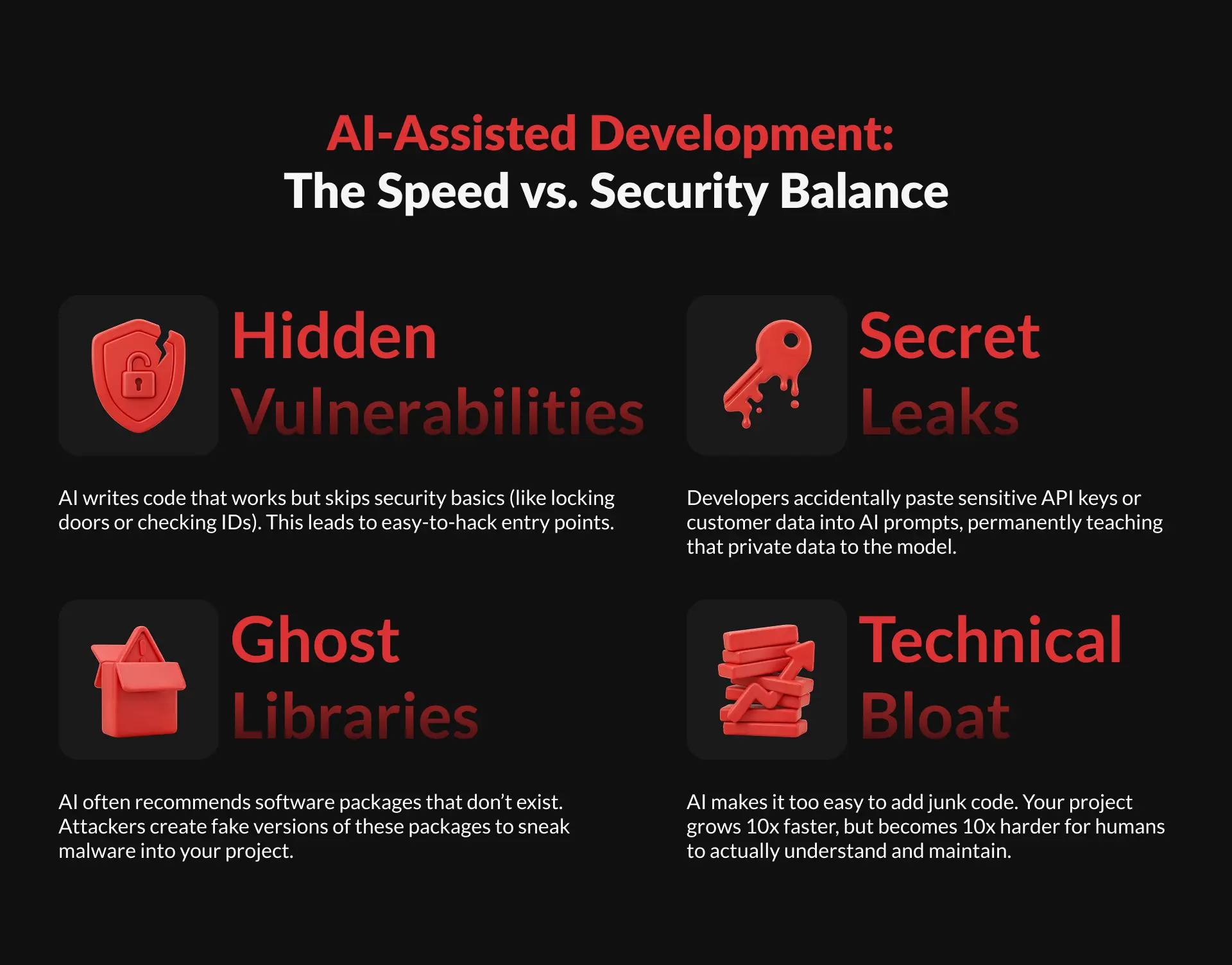
Layers of AI-Augmented Risk
AI reshapes the software supply chain by introducing new decision-makers, new artifacts, and new avenues for errors to enter the system. Each layer introduces a different way for risk to grow if left unmonitored:
- Model layer: External models come with opaque origins. Hidden biases, inherited weaknesses, or tampered weights can influence output, especially as teams begin scaling AI models without validating provenance.
- Data layer: Training and fine-tuning data may contain flawed or manipulated examples. These patterns resurface in generated code, disproving the common AI security myths that “better models automatically mean safer output.”
- Prompt / usage layer: Developers often paste sensitive logic into tools or unintentionally steer models toward insecure defaults. Everyday usage habits turn into long-term exposure.
- Pipeline layer: AI suggestions modify CI/CD steps, scripts, or permissions. Small automated “convenience” changes alter system behavior in ways scanners rarely detect.
- Artifact layer: Some issues appear only in the compiled application, like generated configs, startup routines, or deployment templates that never received human review.
Human-Only vs. AI-Augmented
As AI becomes part of the toolchain, the threat model shifts from linear, human-driven to layered, partially opaque. The contrast becomes obvious when you compare a traditional development workflow with one shaped by AI involvement:
Who writes code
Employed devs
Devs + external LLMs
Main supply-chain risk
Third-party libraries
Libraries + models + prompts + AI-suggested configs
Visibility
SBOM captures core components
SBOM often misses AI outputs and model lineage
Review focus
Manual review and tests
Review + tool, model, and workflow governance
AI changes not only what enters the system but how it evolves, making proactive oversight essential as projects scale.
Compliance and Rules Already Reshaping AI in Software Development
Regulators now treat AI as part of the software supply chain, not a peripheral experiment. Nowadays, several frameworks already influence how teams design and validate systems that rely on code generation. The EU AI Act requires risk-based controls, documentation of model behavior, and traceability of automated decisions, while NIST’s AI Risk Management Framework establishes expectations around governance, monitoring, and responsible model use. National cybersecurity bodies, such as CISA in the U.S., extend these principles to software supply-chain integrity and AI-enabled attack surfaces.
Across all three, the message is consistent: traceability and control. Teams must show where AI is used, how AI-generated changes are reviewed, and how data protection is enforced across the development lifecycle. Audit logs, model provenance, and extended SBOMs are now foundational signals of secure AI-augmented development, aligning directly with enterprise buyer expectations.
These frameworks also require AI to be included in modern threat modeling. Since models influence dependencies, logic paths, and automated workflows, regulators view them as part of the attack surface rather than tooling. For any organization providing artificial intelligence development services, the alignment with these evolving regulatory standards is proof of engineering maturity.
This regulatory clarity creates an advantage: teams that operationalize these requirements early build products ready for scrutiny and enterprise adoption.
Secure AI-Augmented Development in Practice
Founders adopting AI-assisted software development often ask what “secure” actually looks like when AI becomes part of the delivery pipeline. In practice, it is about establishing the right guardrails so AI accelerates progress without introducing silent liabilities. Mature engineering teams handle this through a small set of repeatable patterns that protect the business, not just the code.
- Defined AI usage rules: Clear boundaries on where AI is allowed in the product ensure that sensitive logic, proprietary ideas, and client data never end up in unmanaged systems. This means your AI-augmented application grows safely without risking IP exposure or compliance gaps.
- Impact-based approval flow: Not every AI-generated change carries the same risk. High-impact logic, like authentication, payments, workflow rules, requires human validation, while routine scaffolding moves faster. This keeps velocity high while protecting the parts of the product that determine trust and revenue.
- Model and artifact traceability: More and more companies expect visibility into the origin of models, generated files, and automated dependencies. Tracking these components within secure workflows shows the professional approach reduces the chance of supply-chain surprises.
- Validation of the final build: Real-world incidents increasingly stem from what lands in the compiled artifact. Scanning containers and packaged builds catches hidden files or behaviors AI may introduce. This minimizes the operational risk of unexpected runtime issues.
- Team readiness for AI patterns: Companies that get ahead train their developers to understand how AI behaves, when to trust it, and when to override it. This cultural discipline reflects best practices and demonstrates a responsible approach to AI adoption.
These capabilities are what a strong engineering partner brings from day one. They allow AI to accelerate development without compromising safety, compliance, or long-term scalability, letting founders innovate confidently while protecting the business.
Designed Security Wins
AI-augmented development offers immense leverage, and your choices around governance, workflows, and engineering partners determine whether it becomes a competitive advantage or a growing liability. The risks are real, from flawed generated code to supply-chain exposure, and the myths that “tools will catch everything” or “the vendor is compliant, so we’re covered” remain some of the most damaging assumptions in fast-moving teams.
The good news is that secure AI adoption is entirely achievable. When founders treat AI as part of their supply chain, build guardrails into their process, and work with partners who understand both software and security, they position their products for smoother enterprise onboarding and stronger investor confidence.
Ready to build with confidence instead of guesswork? Contact us today to see how our team can deliver secure, AI-driven development tailored to your business.
See how we helped a quote management platform strengthen its backend architecture, remove critical security flaws, and future-proof its codebase for scalable growth