Legacy modernization is not optional today. Without it, your business won’t be competitive, especially in this economy where every saved cent matters. But modernizing your systems is a big and expensive project that can backfire spectacularly, causing breakdowns and loss of trust. Today, we are here to share success stories from Redwerk’s clients and explain how they achieved growth by implementing a strategic approach and best-in-class transformation practices.
To give you some perspective on the value of legacy code modernization, consider that, according to Gartner research, 70% of IT budgets go toward maintaining current operations. Now, imagine what you could achieve through innovation by freeing up that money. Does that seem like an attractive proposition?
Below, Redwerk developers explain exactly how to achieve this result while minimizing business risks.
Best Practices for Legacy Code Modernization
The list below reflects hard-won lessons from programs that actually delivered results to our clients. We won’t bore you with yet another listing of the challenges businesses face in legacy system modernization. Instead, we’ll focus on the actual solutions and approaches that are sure to deliver value and ROI.
Start with Business Outcomes, Not Architecture Preferences
You should always start by defining success in measurable terms, such as:
- Release frequency
- Defect rate
- Lead time to change
- Uptime
- Infrastructure cost
- Security patch SLAs
- Conversion rates
Tie each legacy code modernization initiative to a business KPI with an accountable owner.
To clarify, keep in mind that the majority of modernization programs that fail typically start with “we need microservices” or “we need to be cloud-native.” The ones that succeed start with “we need to cut release cycles from six weeks to three days” or “we need to reduce incident response time by 80%.”
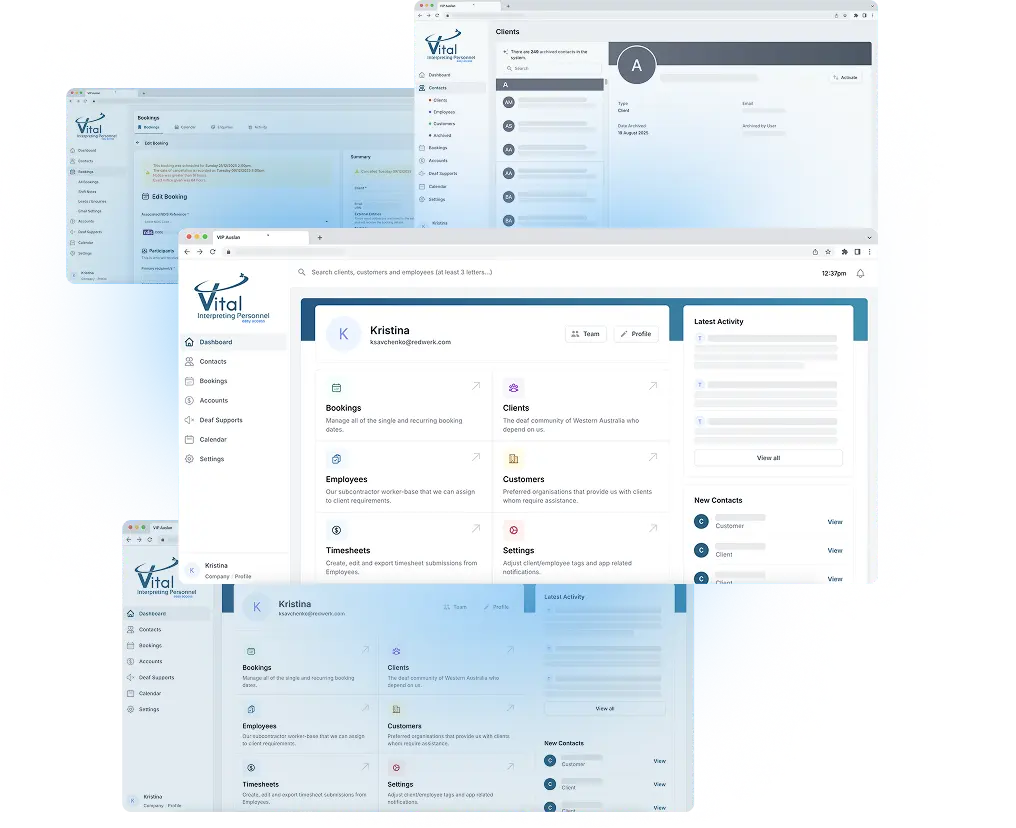
Feel the difference? That’s what defines success in any digital transformation strategy. Take our work with VIP Auslan, an agency serving the Australian Deaf community. We began by stabilizing their interpreter booking platform — a process that required reverse-engineering business logic and resolving critical documentation gaps within a dense legacy codebase. With the platform stabilized, we then transitioned to automating manual workflows and improving the user experience.
We saw similar success with Evolv. They completely transformed the legacy solution owned by Sentient Ascend (after acquiring it) to release upgraded Evolv 1.0. Based on the legacy tool, this iteration is an innovative, scalable SaaS platform already used by dozens of Evolv clients and growing rapidly.
Build and Maintain an Application Portfolio Map
To support your progress evaluation, create an inventory that captures each system’s business-criticality, cost, risk profile, change frequency, dependencies, data sensitivity, and user impact. Also, include runtime and infrastructure details, interfaces (APIs, files, queues), operational metrics, and incident history.
Having this information documented and mapped for easy access will help you avoid the so-called “random acts of modernization”. It’s an approach where teams modernize whatever’s convenient rather than what matters. Update this map continuously to track your transformation and measure its effects. It should be a living document that you can reference when calculating the digital transformation ROI.
We gained extensive experience with legacy mapping while working on the immense project for Justin Alexander, a renowned US bridal fashion brand. Redwerk started with an old website that we turned into a multi-brand web platform with a custom page builder so each brand can express its unique style, all the while maintaining the original site running smoothly to ensure there is no downtime and losses during the massive platform upgrade.
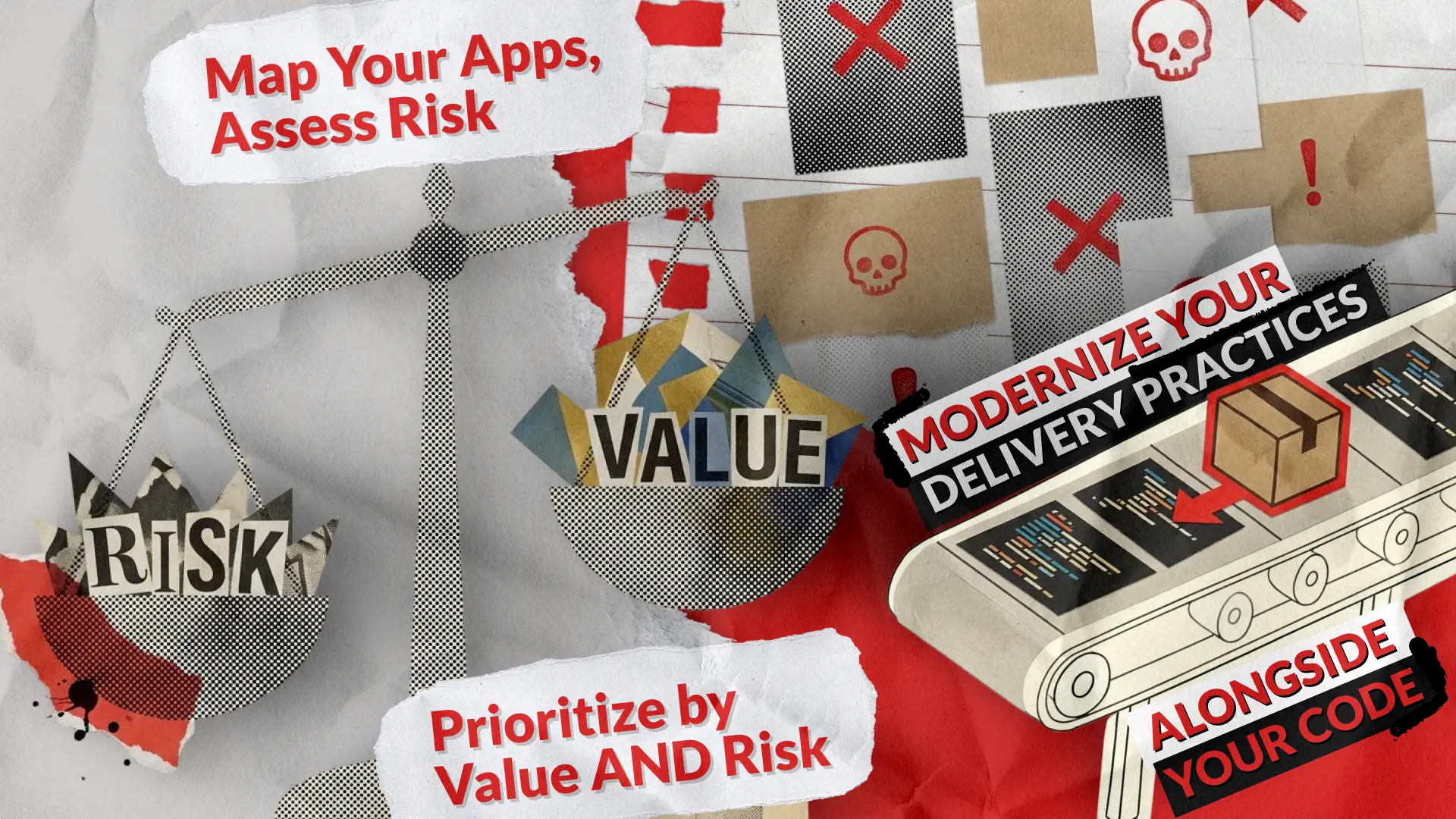
Prioritize by Value AND Risk
Use the basic 2×2 matrix for maximum efficiency:
- High value, high risk: Prioritize early but deliver incrementally. These systems matter too much to ignore, but they are also too risky for big-bang approaches.
- High value, low risk: This is where you get some quick wins. Legacy modernization best practices state that you should prioritize these to build momentum and credibility. However, you can’t rely on them entirely if you want to achieve a meaningful transformation.
- Low value, high risk: Don’t invest in modernizing systems that should be allowed to disappear. A necessary part of transformation is retiring the flows, apps, and maybe entire departments that don’t fit into a modern, efficient enterprise and only compound unnecessary bureaucracy and consume resources.
- Low value, low risk: If you have systems that fit this pattern, they can wait. If they don’t need to be replaced entirely, you should leave them alone until the development team completes all priority tasks.
Remember that your legacy system modernization must also factor in regulatory deadlines and security posture when setting priorities. Once these fundamentals are addressed, the focus typically shifts toward higher-order goals, such as integrating AI into legacy systems to unlock new efficiencies.
Now, what if you need the upgrades done fast, without compromising the flow and quality? We had a project like this with Incling, a client that required a complete transformation within weeks. So we delivered without compromising legacy modernization best practices. Redwerk implemented the strategic approach, starting with a detailed code review. That alone helped us clean up and shrink the code base by 15,000 lines. Next, several teams worked on different areas of optimization simultaneously. The result is that we met the app evolution deadline of three weeks with a fully documented modernization path.
Similarly, we successfully upgraded the EU Parliament’s e-voting solution on a tight timeline. We had one month to migrate a legacy JBoss-based application to a modern, maintainable framework. We immediately broke the project into manageable subtasks and established global communication channels between teams in Ukraine, Italy, and Belgium. By moving task tracking out of messy email threads and into modern bug-tracking software, we created a seamless feedback loop: code written in Ukraine was tested in Brussels the same day, giving our developers instant feedback from end-users.
Choose the Right Modernization Pattern for Each Workload
You should always avoid one-size-fits-all thinking. Choose legacy application modernization patterns based on ROI, complexity, and the frequency of system changes.
For example, a system that rarely changes and carries low risk might only need rehosting. A high-change system with significant coupling needs refactoring. A system where your competitive differentiation doesn’t live in custom code should probably be replaced with SaaS.
The worst outcomes usually come from applying the wrong pattern, such as rewriting systems that should be refactored or refactoring systems that should be replaced.
If you wonder how exactly you could know which transformation pattern to apply where, you should start with expert code review. For example, the Redwerk team worked with Project Science to audit its backend API. We helped them improve code maintainability by 80% by offering custom-tailored suggestions for every part of the system.
Modernize Your Delivery Practices Alongside Your Code
It’s great that you implement best practices for legacy code modernization. However, you need to modernize at every level to achieve growth. Implement continuous integration with fast feedback, automated deployment pipelines, feature flags for progressive delivery, and comprehensive observability with logs, metrics, traces, SLOs, and alerting.
This way you reduce change risk and improve mean time to recovery. Teams that modernize code without modernizing delivery typically find their velocity gains are smaller than expected. It means that you just move the bottleneck to another spot in the pipeline.
Also, think in scale, like our clients at Utility Revenue Services (URS). When they began their digital transformation, they had only a Windows-exclusive legacy app. It was a good app when it was designed, but the world has moved on since then. So, what we did together included recreating the original solution as a web app and migrating all relevant data. Then, we expanded the functionality to add additional reporting features, invoice functionality, and much more. URS modernized not only their app at the code level and their update delivery paths, but also pushed their service delivery to customers into the 21st century, which helped them attract new clients.
Decouple Architecture Deliberately
One of the legacy modernization best practices that often gets overlooked is how you deal with coupling. Sadly, many businesses choose the easier route, hoping it resolves itself. However, it most likely won’t, so be sure to plan for it using concepts like modularization, APIs, and eventing.
Here’s how you can go about decoupling architecture safely and effectively:
- Define bounded contexts: Domain-driven design thinking will help greatly here.
- Extract services and modules around stable domain concepts: Focus on established concepts rather than technical layers.
- Add API facades: It will help stabilize external integrations.
- Use events: This will work for some of the asynchronous workflows.
The reality is that decoupling is expensive but necessary for long-term technical sustainability. We suggest doing it where it creates options you’ll actually use, not everywhere just because it’s theoretically cleaner.
All in all, being over-dependent (‘coupled’) with anything too tightly isn’t a good quality in terms of a scalable software architecture. You should always strive for independence and flexibility, which you can achieve.
For example, at Redwerk, we worked with Green Valley, an e-government solutions provider based in the Netherlands. Green Valley had a plugin used by many government authorities. However, it was directly tied to Microsoft Word. Therefore, every time Microsoft updated its software, the plugin became, in a word, unusable. Together, we created CMSOI, a platform that supports multiple versions of Microsoft Office Suites and can port the plugin to OpenOffice if necessary. It’s an example of how modernization solves seemingly critical dependency problems.
Treat Data as a First-Class Workstream
Did you know that even when using best practices for legacy system modernization, many programs fail on data, not code? To avoid this unfortunate outcome, you should plan explicitly for data ownership and canonical models, migration approaches (bulk plus delta, dual-write, change data capture), reconciliation and auditability, and retention and compliance requirements.
In addition, plan for reporting and business intelligence continuity during transition. Executives who lose access to dashboards during modernization will not remain patient supporters.
The good news is that there are many ways to work with data effectively and improve your business outcomes, particularly in this area. We achieved this by working with Encode, a cyberthream management platform. The client needed to upgrade their Enorasys Security Analytics platform, which lacked the infrastructure to scale quickly enough to keep pace with data growth. We helped them migrate to Elasticsearch while maintaining access to the data they previously stored in MySQL. The results were an overall upgrade and future-proofing of the product, a reduction in software maintenance costs, and recognition from IBM.
Integrate Security and Compliance from Day One
Every legacy system modernization today should start with thinking about how to ensure compliance and security at every step of your transformation. Some of the things you should consider from the start include:
- Dependency management and software bills of materials
- Patching SLAs with automated vulnerability scanning
- Secrets management
- Least-privilege access with network segmentation
- Threat modeling for key flows
This directly addresses the risks posed by “vulnerable and outdated components” that disproportionately affect legacy systems. Remember, retrofitting security is expensive and often incomplete, but building it in costs less and works better.
One of our code review projects involved a detailed health and security evaluation, so we’ve seen how much more effective a business can be when they plan for security from the get-go. Site Compass, owned by the Reivernet Group of Companies from Australia, is our example. We completed a thorough review of their codebase, identified vulnerabilities, and offered remediation suggestions. As a result, Reivernet Group could plan and implement improvements that brought a 90% increase in code maintainability.
Run Old and New in Parallel with Clear Cutover Criteria
One of the most important things you must understand about legacy modernization best practices is that you should always move incrementally. It’s not about making big showy changes in one day. In fact, that’s a huge and often unwarranted risk. Instead, you should:
- Define entry and exit criteria for each migrated capability
- Outline performance baselines that the new implementation must meet
- Build rollback plans
- Establish your “definition of done,” including documentation and runbooks
We suggest using canary releases and phased rollouts to limit blast radius. The ability to route traffic between old and new implementations, and to roll back quickly if necessary, transforms modernization from a high-stakes bet into a manageable series of experiments.
We implemented this approach during the modernization of the Pridefit app, resulting in a 45% increase in subscriptions by gradually introducing new features while simultaneously updating and streamlining core functionality.
The Key to Success When Implementing Legacy Modernization
Let us be honest, there are two key factors that will determine whether your transformation succeeds or fails:
- Your attitude towards the strategic planning and implementation of the modernization process
- Having a reliable and experienced partner who goes the extra mile to understand your business
Legacy systems are so deeply rooted in your very foundation that changing them in any way is not merely a matter of technology. Sometimes, your very approach to everyday tasks must change as well.
At Redwerk, we pride ourselves on working closely with every client to truly understand their business from the inside. We will study your processes and analyze your goals before offering a strategic approach to change.
Want to see how this can work for you? Contact us and let’s start a conversation today!
See how we helped VIP Auslan upgrade their product and cut manual admin by 40%