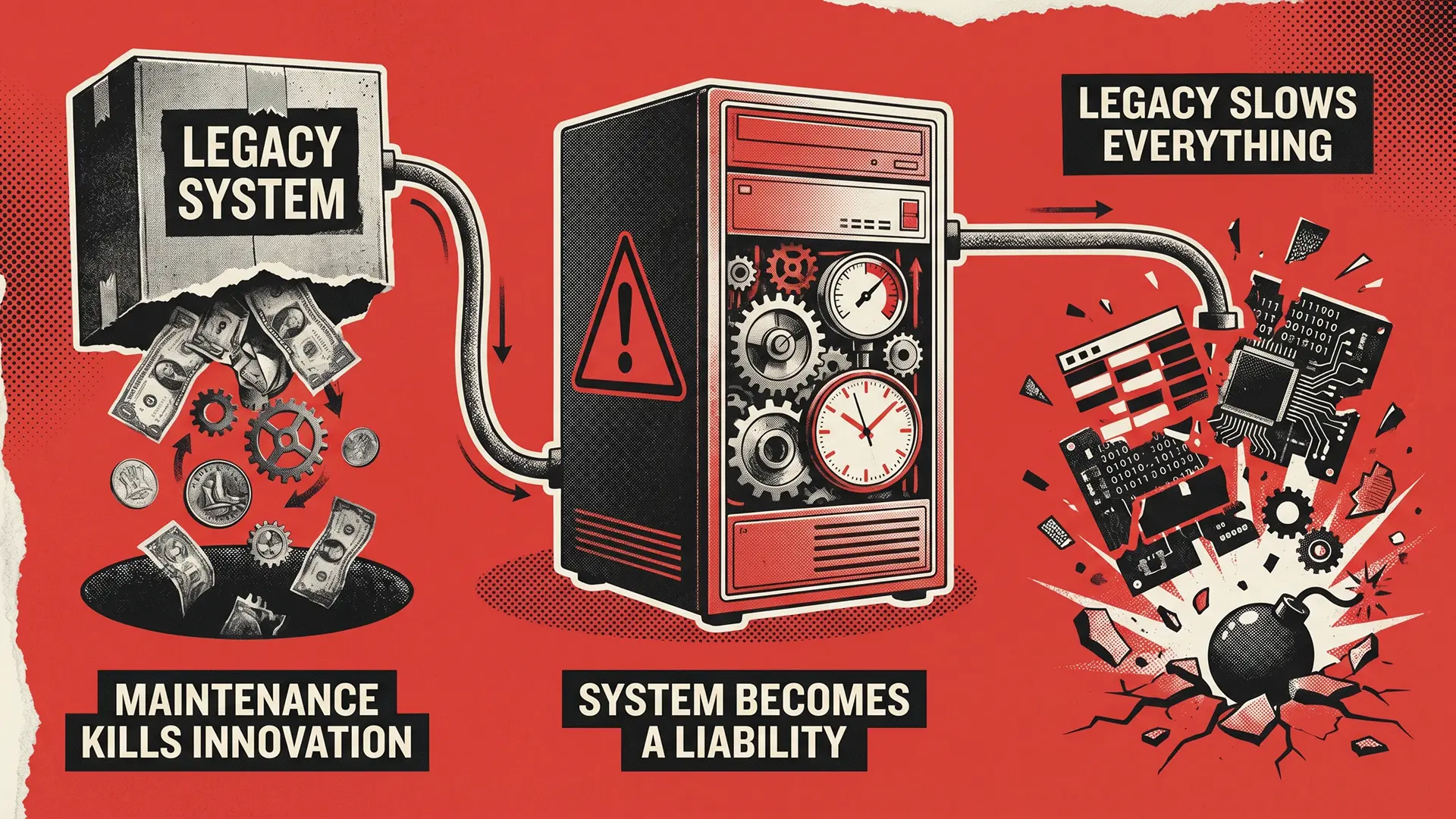
Let’s be honest about something most banking executives don’t say out loud: 70% of these institutions globally still run on legacy banking systems in 2025. It’s not because they work well, but because switching feels risky, expensive, and complicated, so they wait.
The problem is that waiting has its own price tag, and it keeps going up. This article is a self-diagnostic tool to help you understand whether digital banking transformation is necessary for your organization. Work through each sign, check if it sounds familiar, and by the end, you’ll know whether your system is a manageable inconvenience or an active threat to your competitive position.
What Is a ‘Legacy Banking System’?
Before we get into the signs, let’s agree on what we’re diagnosing. A legacy banking system isn’t just ‘old software’. It’s any core system built on assumptions that no longer align with how banking actually works. The main examples of such misalignment are:
- Batch processing instead of real-time transactions
- Monolithic architecture instead of modular services
- Closed infrastructure instead of API-first design
Some legacy cores are 40-year-old COBOL (Common Business-Oriented Language) mainframes, while Others are 2010-era platforms that missed the cloud-native era entirely. Age matters less than architecture, so the question isn’t when it was built but what it costs you to keep it running today.
Does Your Legacy Banking System Need a Digital Transformation: 7 Questions to Answer
There are many guides listing all kinds of tech issues associated with legacy systems. However, we won’t be focusing on that. Instead, here is a list of seven questions about the possible issues your business might have right now. Analyze your answers to them to understand whether you need to take the first steps to digital transformation.
Is Your IT Budget Mostly a Maintenance Bill?
Pull up your last IT budget breakdown and see whether the majority of spending goes toward keeping existing systems alive rather than building new capabilities. If that’s the case, this is your first signal to look into digital transformation strategies.
Banks spend between 70% and 75% of their IT budgets maintaining legacy infrastructure. According to Deloitte’s research on technology investment, the average IT department allocates more than half (55%) of its technology budget to maintaining existing operations and only 19% to building new capabilities. McKinsey puts it another way: just 5 to 10 cents of every technology dollar in a legacy-bound institution delivers actual business value. The rest goes to patches, workarounds, and infrastructure maintenance.
Here’s what that looks like in practice:
- Infrastructure cost reviews trend upward quarter over quarter
- Engineering backlogs are dominated by patching cycles, not product features
- Third-party vendor support contracts eat into the “new projects” budget every renewal cycle
Meanwhile, an IDC Financial Insights study projects global spending on legacy banking technology will climb from $36.7 billion in 2022 to $57.1 billion by 2028, growing at 7.8% annually. Therefore, your competitors running on modern platforms will spend their IT budgets building the next product, while you spend yours keeping the current one breathing.
Does Shipping a Simple Update Take Months?
Speed is a product feature now, so if your customers have to wait months for capabilities that newer banks ship in weeks, that gap shows up in churn numbers. Traditional banks need 6 to 18 months to bring new products to market. Meanwhile, digital-first banks do the same in 2 to 3 months. That’s not an engineering productivity gap but an architecture gap.
In a legacy monolithic core, a “simple” change is rarely simple. Everything is connected to everything else, so changing one module means testing the entire system, which turns a two-week feature into a four-month project.
You’re probably living with this if:
- New compliance requirements require months of planning before a single line of code is written
- Launching a new product means coordinating across 6 or more siloed internal systems
- Your dev team’s sprint planning is dominated by risk assessments rather than feature work
The fintech down the street isn’t waiting while you’re running impact analysis. They’ve already shipped and started capturing your customer segment.
Is Your Compliance Team Building Workarounds Every Cycle?
Regulations don’t wait for your system to catch up, and if every new requirement lands as a custom middleware project rather than a configuration change, you’re paying for regulatory complexity twice: once in engineering time and once in compliance risk.
The pressure is real, and it has deadlines attached, for example, the EU’s Regulation (EU) 2024/886 on Instant Payments required euro-area payment service providers to receive instant payments by January 9, 2025, with sending capabilities mandated by April 2027. Those requirements assume modern API capabilities and real-time processing that most legacy systems simply don’t have. On top of that, DORA (the Digital Operational Resilience Act) now requires banks to demonstrate ICT third-party risk management and to monitor operational resilience. Legacy architectures weren’t designed with that visibility built in.
The pattern to watch for:
- Every new regulation requires a custom connector or workaround rather than a platform update
- Compliance audits take 4 to 6 weeks of manual data gathering instead of dashboard exports
- Your compliance team spends more time documenting exceptions than reporting results
Workarounds compound as each one adds cost, adds technical debt, and makes the next one harder.
Are Cybersecurity Threats Outpacing Your Patching Speed?
Legacy systems don’t just slow your operations but also create attack surfaces your team can’t close fast enough. The numbers here are not abstract; for example, according to IBM’s 2024 Cost of a Data Breach Report for the financial industry, data breaches in the financial sector now cost an average of $6.08 million per incident, which is 22% above the global cross-industry average. That figure excludes reputational damage and regulatory fines.
The structural vulnerabilities in a legacy core include:
- Outdated encryption standards that predate modern threat models
- Unpatched software in components that take weeks of testing before any update can go live
- Third-party integrations with access points your team didn’t build and can’t fully audit
43% of global banking systems still run on COBOL, a language introduced in 1959. That’s not an insult to COBOL but a statement about the complexity of applying modern security tooling to infrastructure that predates the internet. If your security team’s biggest recurring conversation is about how long it takes to deploy patches safely, the system architecture is the problem, not the team.
Are Your Customers Benchmarking You Against Fintechs?
Your customers aren’t comparing you to the bank across the street anymore. They’re comparing you to Revolut, Monzo, and whatever their friends told them about last week. That’s the benchmark now, and it’s a hard one to meet when your core processes transactions overnight in batches.
More than 2,500 bank branches closed in 2023, according to FDIC Summary of Deposits data, continuing a 14-year consecutive decline in branch numbers. Customers migrated to digital channels, and when those digital experiences didn’t meet expectations, some kept switching to digital-only competitors with no legacy architecture holding them back.
The experience gap shows up in specific, measurable ways:
- Mobile app ratings are declining or stagnant, while fintech competitors trend upward
- Customers asking why their account balance doesn’t reflect a transaction they just made (batch processing)
- Onboarding flows that require in-branch visits or multi-day wait times versus digital-native competitors who complete onboarding in under 10 minutes
- No real personalization because customer data sits in 4 or 5 disconnected systems
55% of banks cannot support real-time payments due to legacy limitations, according to research by 10x Banking. Real-time payment volume is projected to reach $8 trillion, and banks that can’t participate are forfeiting a significant share of that market. Customers don’t wait for systems to catch up, instead they switch and tell people why.
Are Your Best Engineers Leaving Because of Your Tech Stack?
This one is uncomfortable to talk about, but it matters. The talent market has shifted, and engineers with options choose modern stacks. If your core requires skills that fewer people want to learn, you’re building a skills cliff. 43% of global banking systems still rely on COBOL, and 60% of organizations that use it say finding qualified developers is their biggest operational challenge. The COBOL developer pool is shrinking as experienced engineers retire, and very few younger engineers are entering the field to replace them.
The operational picture looks like this:
- Recruiting for core system roles takes 3 to 6 months longer than equivalent modern stack positions
- Senior engineers leave for companies with modern tooling, and institutional knowledge leaves with them
- Engineers who stay spend up to 25 hours per week managing patches and workarounds rather than building features
When your last experienced legacy engineer retires or resigns, you have a business continuity problem. The system that processes all your transactions is now owned by no one who fully understands it. A legacy banking system modernization project solves this proactively rather than reactively. The choice is to plan a migration now or to scramble when an irreplaceable engineer gives notice.
Can You Actually Act on Your Own Customer Data?
Your system has years of transaction history, behavioral data, and customer relationships. If you can’t analyze that data in real time, it’s just storage instead of an asset. Legacy cores were built for batch processing. Transactions settle overnight, balances update periodically, and customer profiles are distributed across multiple siloed systems that don’t communicate in real time. That architecture made sense in 1985. In 2025, it means your data team works with exports and manual workarounds instead of live dashboards.
The practical consequences:
- AI or machine learning tools your team has invested in can’t connect cleanly to your core data layer
- Personalization is impossible when customer profiles are fragmented across systems
- Risk models run on yesterday’s data, not current behavior
- Fraud detection operates with a lag that attackers can exploit
Only 32% of banks have successfully completed AI integration into their legacy core systems. That’s not because the AI tools don’t exist but because the underlying data infrastructure isn’t designed to feed them. Data engineering and core modernization are what close that gap. Without them, every AI or analytics investment sits on a foundation that limits what it can actually do.

Quick Self-Assessment for Digital Transformation: How Many of These Apply to You?
Let’s do a quick recap, go through the checklist, and see what rings true:
- More than half of your IT budget goes to maintaining existing systems.
- Product updates or new feature launches take more than 3 months from decision to deployment.
- Every new regulation requires a custom workaround or integration project.
- Security patches require planned downtime and weeks of regression testing.
- Your mobile app ratings are declining while fintech competitors’ ratings trend upward.
- You’ve lost senior engineers to companies with modern tech stacks in the past 2 years.
- Your analytics team works with data exports, not live data.
If you ticked 3 or more, your legacy banking system is no longer just a technical problem. It’s a strategic liability you must address to remain competitive.
What Does Digital Banking Transformation Actually Look Like?
Core banking modernization doesn’t mean replacing everything overnight. That’s the version that scares most executives, and reasonably so. From our experience, we can recommend three practical approaches for this industry:
- Full Core Replacement
Migration to a new platform is done in phases. Highest disruption during the project, highest long-term payoff. Works best for institutions ready for a fundamental architectural shift. - Component-Based Upgrade (sidecar strategy)
Modernize individual modules while keeping the core intact. New capabilities are built on modern infrastructure and run alongside the legacy system. By 2026, 40% of global banks are expected to pursue this approach. - API-Based Augmentation
Wrap the legacy core with a modern API development layer to enable new integrations and digital channels without replacing it. This offers the lowest risk, but a limited long-term ceiling.
The numbers support acting rather than waiting. According to Accenture’s 2025 Banking Technology Outlook, institutions that completed core modernization reduced total cost of ownership by 38% to 52%. A phased migration can deliver a 62% faster time-to-market for new products within 18 months of completion.
At Redwerk, we’ve been doing legacy application modernization and digital transformation for financial and enterprise clients for over two decades. Before any migration project, we start with a software audit, which gives you a clear picture of what you’re working with, the migration risks, and which approach fits your timeline and risk appetite. We don’t have a pitch deck or an abstract roadmap. Instead, we provide a real assessment of where your system stands and what it would take to move it forward.
Ready to find out where your system actually stands? Contact us and let’s help you modernize.
See how we helped VIP Auslan optimize and automate a booking platform trusted by the Australian government