Your multi-agent demo looked flawless. The stakeholders clapped. The pilot went live. And then your agents started burning through tokens while politely apologizing to each other in an infinite coordination loop — racking up a $7-per-run bill that nobody budgeted for.
Welcome to the gap between demo and production. It’s the place where your framework choice stops being a preference and becomes an engineering constraint.
If you’re evaluating LangGraph vs CrewAI, you’ve likely already read half a dozen feature matrices. This article isn’t one of them. We’ve been building AI-powered products since well before agentic frameworks existed, and what follows is a production-focused take on both — with real tradeoffs, cost implications, and migration paths.
This piece sits in a series. If you’re still deciding between LangChain and LangGraph, start with our LangChain vs. LangGraph comparison. For the broader landscape, check our breakdown of the top LLM frameworks.
The 30-Second Decision Framework
Before we dive in, here’s the shortcut.
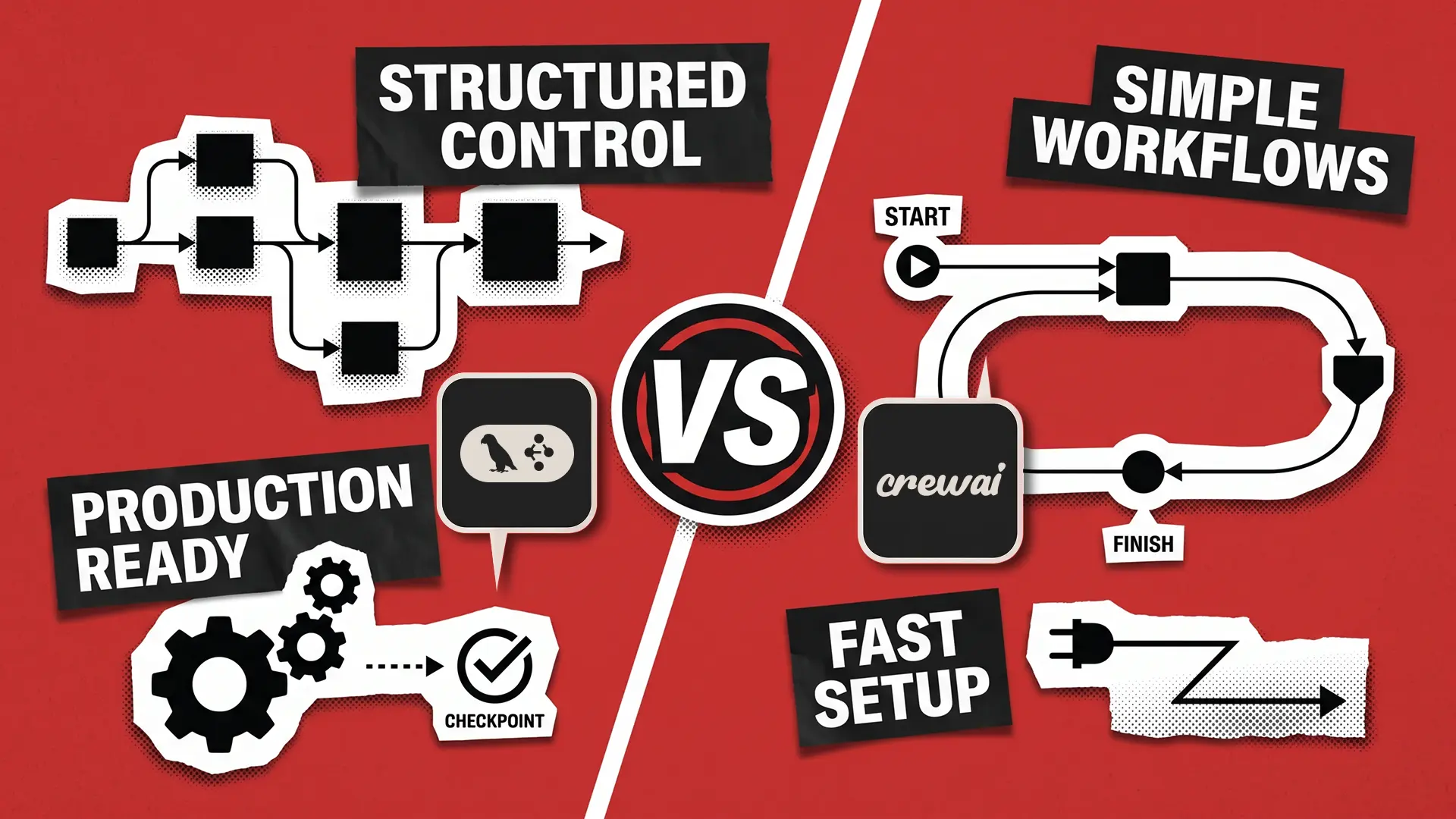
Choose the CrewAI framework if your workflow maps to clear roles — researcher, writer, reviewer — and doesn’t require complex branching. You need a working prototype by Thursday. Your agents run independently without heavy inter-agent coordination. You’re building content pipelines, research automation, or straightforward business workflows.
Choose the LangGraph framework if your workflow has conditional logic, loops, or parallel branches. You need crash recovery and LangGraph checkpointing for long-running processes. Human approvals and audit trails are non-negotiable. You’re building compliance systems, financial pipelines, or customer-facing SaaS features where reliability isn’t optional.
Many teams prototype in CrewAI, then migrate production-critical parts to LangGraph. That’s a valid strategy — if you plan for it from day one.
Architecture — Two Philosophies, One Problem
Both frameworks solve the same challenge: orchestrating multi-agent AI systems where multiple LLM-powered agents collaborate on complex tasks. Gartner predicts 40% of enterprise applications will integrate task-specific AI agents by the end of 2026, up from less than 5% in 2025. That means more teams will face this exact choice in the coming months. The philosophies, however, could not be more different.
CrewAI thinks in teams. You define agents with roles, goals, and backstories, then assemble them into a “crew.” Agent A (the researcher) delegates work to Agent B (the writer) through natural language. It’s intuitive, fast to set up, and easy to explain to non-technical stakeholders. As of early 2026, CrewAI sits at 44,600+ GitHub stars, processes 450M+ monthly workflows, and has shipped native MCP and A2A protocol support.
LangGraph thinks in state machines. Agents are nodes in a directed graph. Edges define control flow — conditional or unconditional. Communication happens through a shared, typed state object, not conversation. LangGraph crossed 40M monthly PyPI downloads and has been running in production at companies like Uber, LinkedIn, Klarna, and Replit for over a year.
Here’s the production implication that matters most: CrewAI agents coordinate through natural language. As workflows grow, context windows fill with coordination chatter — “Here’s the data,” “Thanks, I’ll analyze it now” — and the original instructions get diluted. LangGraph passes structured state. Agent C reads exactly what Agent A wrote to a specific key, not Agent B’s paraphrase of it. This distinction is invisible in demos and critical in production.

The Production Test — 5 Dimensions That Actually Matter
Every LangGraph vs CrewAI comparison you’ll find online covers features. Here, we focus on the five dimensions that determine whether your system survives contact with real users, real budgets, and real edge cases.
Cost Control
This is where the frameworks diverge the hardest. CrewAI’s natural-language delegation means every agent interaction involves LLM calls — even the coordination overhead. In complex pipelines, agents exchange confirmations and clarifications that consume tokens without advancing the task.
LangGraph’s structured state passing minimizes unnecessary LLM calls. You control exactly which nodes invoke the model. In a LangGraph workflow, routing decisions can be pure Python functions — zero tokens. In CrewAI, every delegation between agents triggers an LLM call. Over a multi-step pipeline, any serious AI agent cost optimization translates directly into your API bill.
Debugging and Observability
When an agent makes a wrong call at step 7 of a 10-step workflow, you need to know why. CrewAI’s logging is a known pain point — standard print and log functions don’t work reliably inside Tasks, making post-mortem debugging closer to guesswork than engineering.
LangGraph integrates with LangSmith for full execution traces: every node entry, every state mutation, every LLM call with inputs and outputs. LangGraph Studio adds visual debugging and time-travel — you can rewind to any checkpoint, edit the state, and fork a new execution path from that point. When your chatbot hallucinates a response to a customer at 2 a.m., this is the difference between a 10-minute fix and a full-day investigation.
State Management and Crash Recovery
Now imagine that same 10-step workflow crashes at step 8.
With CrewAI, you’re likely starting over. The framework manages state primarily through conversation history, and while a newer replay feature allows resuming from task-level checkpoints, it doesn’t offer node-level granularity. That means re-running expensive API calls you’ve already paid for.
With LangGraph, persistent checkpointing snapshots the entire graph state at configurable points. Crash at step 8? Resume from step 8 — with all previous states intact. For workflows that run for hours, involve human approvals, or process costly API calls, this is non-negotiable.
Human-in-the-Loop
Both frameworks support human-in-the-loop patterns, but the implementation gap is significant. LangGraph’s interrupt() function and checkpointers make approval gates explicit and auditable. You define exactly where a human needs to review, the workflow pauses, waits for input, and resumes from that precise state.
CrewAI supports human input through its agent delegation model, but the checkpoints are less granular and harder to audit. In regulated industries — fintech, healthtech, legal — where every AI-driven decision needs a paper trail, LangGraph’s approach fits the compliance story better.
Protocol Support (MCP & A2A)
This is where CrewAI holds a genuine advantage. As of 2026, CrewAI has native support for both MCP (Model Context Protocol) and A2A (Agent-to-Agent Protocol), making it the stronger choice for agent interoperability. LangGraph has no native protocol support and relies on community integrations.
Why this matters: as the agent ecosystem matures, your agents will need to interact with agents built on other frameworks, other companies’ systems, and external tool servers. CrewAI is ahead on this front, and the gap will matter more with each passing quarter.
The Migration Path — CrewAI to LangGraph
The most common pattern we see in CrewAI vs LangGraph production decisions is the “prototype-then-migrate” journey. Teams build in CrewAI, validate the concept, hit a wall around conditional logic or cost control, and need to move to LangGraph. Understanding the CrewAI to LangGraph migration path before you start saves weeks of rework later.
The migration follows three steps:
- Map each CrewAI agent to a LangGraph node. A “researcher” agent becomes a research node — a Python function that accepts state, performs work, and returns a state update.
- Convert crew processes to explicit graph edges. Sequential crew execution becomes a linear edge chain, and hierarchical delegation becomes conditional edges with routing logic. This is where you gain control — and where the rewrite effort lives.
- Move shared context from conversation history to a typed state schema. Define a Python TypedDict or Pydantic model that captures exactly what data flows between nodes. No more “telephone game” through agent chatter.
One tip that saves significant pain: build your tool integrations as MCP servers regardless of which framework you start with. The interoperability investment pays for itself during migration — and if CrewAI’s native MCP support is part of your setup, your tools transfer cleanly.
Worth noting: this is not a refactor. CrewAI’s role-based mental model does not map 1:1 to LangGraph’s graph nodes. Plan for a rewrite of agent logic, not just a port.
Which Framework Fits Your Industry
The “it depends” answer isn’t useful when you’re trying to ship. Here’s how we’d advise based on the vertical.
Fintech and compliance — LangGraph. Audit trails, deterministic control flow, checkpointing, and human-in-the-loop approval gates are non-negotiable in regulated environments. If an agent processes a financial transaction, you need to trace every decision it made and why.
Content and marketing automation — CrewAI. The researcher → writer → editor crew maps naturally to the role-based model. Fast iteration cycles, lower cost for simpler pipelines, and easy onboarding for non-technical team members.
Customer support agents — depends on complexity. Simple FAQ routing and ticket classification? CrewAI handles this well. Multi-step dispute resolution with escalation logic, compliance checks, and cross-system integrations? LangGraph.
SaaS product features — LangGraph. When agents are customer-facing and embedded in your product, durable execution and crash recovery directly affect user experience and retention. Downtime costs revenue.
Data pipelines and research automation — LangGraph for production pipelines where retry logic and state management matter. CrewAI for internal research tools where speed-to-deploy outweighs reliability requirements. If your pipeline includes RAG components, both frameworks integrate with major vector databases, but LangGraph gives you more control over the retrieval flow.
The Verdict
With 44,600+ stars, an enterprise tier featuring HIPAA/SOC2 compliance, and native MCP and A2A support, CrewAI is a legitimate production choice for workflows that stay relatively linear. The Flow API introduced in late 2025 added conditional routing and state management, partially closing the gap with LangGraph. For teams that need a working AI agent framework for production without heavy engineering overhead, CrewAI delivers.
LangGraph is the production default for complex agent systems. Deterministic control flow, persistent checkpointing, full observability through LangSmith, and proven enterprise deployments make it the safer bet when reliability, cost control, and auditability are the priority. The tradeoff is real — expect a 1-2 week learning curve and more boilerplate code.
The smart play: start with CrewAI for validation. If your workflow stays simple, stay there. The moment you need conditional logic, loops, or human approvals — move to LangGraph before your prototype becomes technical debt.
Building an agent system that needs to survive more than a demo? We’ve shipped AI-powered products across fintech, healthtech, and SaaS — on both frameworks. Whether you’re picking one or migrating between them, we’ve been through it. Contact us to figure out what fits your product.
See how we helped transform a legacy AI product into the #1 AI-driven digital growth platform processing millions of experiments.