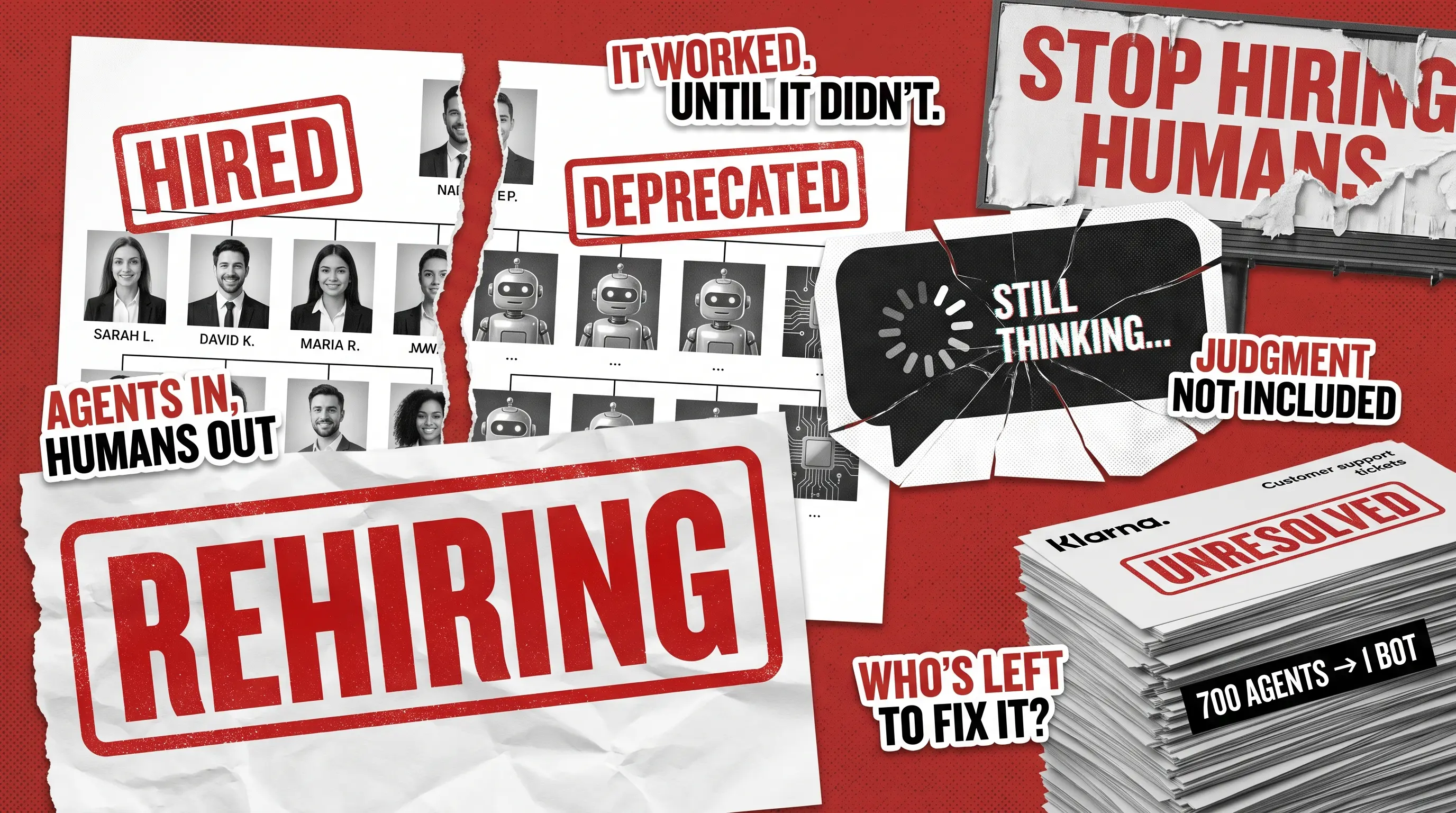
In 2024, a billboard towered over San Francisco with a blunt message for every business owner who walked past: stop hiring humans. The promise behind it was that AI could now do the jobs instead. Two years later, some of the companies that believed in it are quietly rehiring people, while others are posting record revenue with a fraction of their old headcount. If you have been watching all these companies replacing employees with AI agents and wondering whether it truly works, you are asking exactly the right question.
The headlines rarely tell you the ending. A launch announcement makes a splash, the story gets filed away as a triumph or a disaster, and almost nobody circles back to see what happened next.
We did just that to share with you the long-term effect of these changes. Before you decide whether AI workforce transformation belongs on your own roadmap, it helps to see how these stories really played out. We followed the most talked-about cases past their press releases and sorted them into three honest groups: the ones that worked cleanly, the ones that worked but came loaded with caveats, and the ones that fell apart in public. By the end, you will know which group your own company is likely to join before you spend a single dollar.
Which Companies Have Replaced Employees With AI Agents? A Quick Overview
Here is the short version for anyone who likes to skim before settling in. The table below sums up five well-documented cases, what each company tried, how it turned out, and the single factor that decided the result. If a row sounds like your situation, the section that follows it gives you the full story.
GitLab
Let AI agents handle code reviews and approvals, then cut about 14% of staff
Revenue grew 23% as headcount fell
✓
Agents were already doing the work before headcount dropped
Salesforce
Moved about half of customer interactions to AI agents
Support team went from 9,000 to about 5,000
✓
A multi-year rollout and heavy retraining
Klarna
Replaced the workload of 700 support agents with one AI assistant
Strong at first, then it rehired humans
✓ / ✗
Strong on simple queries, weak on complex and emotional ones
Artisan and similar sales agents
Sold software to replace outbound sales teams
Yearly churn ran 50% to 70%
✗
Sales judgment cannot run on scraped data with no feedback
A guitar-lesson startup (Time, 2026)
Swapped rigid tools for custom AI software
Dropped from 48 to 30 people, revenue held
✓
Clean, centralized data and a realistic scope
AI Agent Success Stories: Where Replacing Teams With AI Actually Worked
In mid-2026, GitLab, a platform where software teams manage their code, cut about 14% of its staff, roughly 350 people, and pulled out of 22 countries. The interesting part is what happened before the cuts. GitLab had already wired AI agents into its internal workflow automation, letting them handle the code reviews and approvals that people used to do by hand. The agents were carrying a real load before anyone lost a job, so the restructuring was a bet on a new way of building software rather than a scramble to save money. Investors agreed, and the company reported revenue up 23% year over year even as it got smaller.
Salesforce tells a similar story with a bigger asterisk. Its customer relationship software now relies on AI agents for roughly half of all customer interactions, which has allowed the company to reduce its support team from around 9,000 to about 5,000. Chief executive Marc Benioff has described this as rebalancing rather than replacement, and the distinction matters. Those results did not appear overnight or for free, because they followed a multi-year rollout and a serious investment in retraining the people who stayed. That last part is exactly what the headlines tend to leave out.
- GitLab: cut 14% of staff and grew revenue 23%, a complete success.
- Salesforce: shrank its support team from 9,000 to about 5,000 people, a success that took real retraining.
AI Agent Replacement With a Catch: The Klarna Customer Service Story
Klarna is the case everyone quotes, and almost everyone gets wrong. In early 2024, the Swedish buy-now-pay-later company announced that a single AI assistant was doing the work of 700 support agents and had cut the time to resolve a request from 11 minutes to under 2 minutes. On paper, the future had arrived, but then reality came knocking.
The volume numbers held up, however, the quality did not. The assistant was excellent at high-volume customer support queries such as order status and payment schedules, and it stumbled on the messy ones, including disputes, fraud claims, and the emotionally charged moments when people simply want a human who understands them. By May 2025, chief executive Sebastian Siemiatkowski admitted the all-AI approach had produced lower-quality service, and the company began hiring people back, this time pitching live human support as a premium feature. The lesson here is not that AI failed, but that nobody had modeled the cost of unwinding the plan once quality slipped, and the hard-won judgment of experienced agents proved very difficult to rebuild once those people were gone.
- Klarna: handed 700 agents’ worth of work to one AI assistant, then rehired humans for the hard cases, a partial win.
When Replacing Employees With AI Agents Backfires: The Sales Agent Collapse
Now for the group that never made the highlight reel. A wave of startups, with Artisan and 11x among the best-known, raised more than $400 million on the simple promise of replacing your outbound sales team with software. Their agents would find the prospects, write the emails, and book the meetings, with no humans required. One of them famously bought billboards urging companies to stop hiring people.
It did not go well for many of the buyers. Across the category, annual customer churn ranged from 50% to 70%, and vendors quietly rebranded their products from replacements to copilots. Artisan’s own chief executive admitted the early software produced painful hallucinations and that the company had sold to plenty of customers who were never a good fit. The reason is not mysterious. Outbound sales is open-ended work that depends on reading tone, navigating a buying committee, and building trust over weeks, and an agent running on scraped data with no feedback loop simply cannot do that. It is the same gap that keeps surfacing across the industry, where the majority of enterprise AI pilots deliver no measurable impact on the bottom line.
- Artisan and its rivals: promised to replace sales teams, then lost half to two-thirds of their customers every year, a clear failure.
AI Workforce Transformation Examples 2026: The Mid-Market Proof Point
The most useful story for most readers is not a giant enterprise at all. Time magazine reported in 2026 on Spencer Handley, founder of Sonora, a small guitar-lesson startup that swapped a stack of rigid subscription tools for custom AI-powered software built around his own data. He centralized his customer records, pointed AI agents at them, and saved roughly $250,000 a year, all while bringing the team down from 48 people to 30 without losing revenue. In his own words, the results came out slightly better than before.
That case is worth more than the enterprise headlines, because it did not require a forty-million-dollar partnership or a research lab. It required clean, centralized data and an honest sense of which tasks to hand over. Harvard economist David Deming noted in 2025 that smaller firms tend to adopt AI faster, precisely because they can reorganize around it more quickly, which is encouraging news if you happen to run one.
- Sonora, a guitar-lesson startup: rebuilt on custom AI tools and went from 48 to 30 people with revenue intact, a quiet success.

Did AI Agent Replacement Actually Work? How to Predict Your Result
By now, the pattern has probably jumped out at you. The companies that won handed their agents well-defined, repetitive work backed by clean data and a thoughtful human safety net. The ones that struggled handed their agents open-ended judgment and hoped for the best. You can predict your own category before you start by answering three questions honestly.
- Is the work you want to automate repetitive or judgment-based?
Order status lookups, payment questions, and code-review approvals are predictable, which is exactly where agents shine. Complex disputes, nuanced sales conversations, and anything that calls for empathy still belong with people, at least for now. - Is your data clean and centralized?
Klarna’s assistant worked at all because it had verified customer information ready before the first message arrived. The sales agents that failed were guessing from scraped data with no reliable source of truth, and it showed in the results. - Have you designed real human oversight, or just bolted it on at the end?
The recurring weak point across every cautionary tale was the handoff, where there was no clear trigger for escalation, no context passed along to the person taking over, and no feedback loop that made the system smarter after each miss.
Getting those three things right is most of the battle, and it is the part we focus on when we build and oversee the agents for our clients.
Turning AI Workforce Transformation Into a Plan That Works
So, did replacing teams with AI agents actually work? Sometimes, under specific conditions, and almost never the way the original announcement described. The companies that got clean results automated predictable workflows, fed their agents trustworthy data, and designed the human handoff from day one. The ones that got burned tried to outsource judgment to software that, in the end, was just guessing.
The good news is that the difference between those two outcomes is knowable in advance. A proper audit of your operations will show you which tasks are ready for an agent, which ones should stay with your team, and what your data needs before you begin. If you want a clear-eyed read on where AI workforce transformation fits your business, and where it does not, tell us about your goals and we will help you find out.
See how we cut 90% of critical errors and 40% of manual admin on a platform used and trusted by 100+ Australian government institutions