AI use now spreads like wildfire, which means it’s no longer enough to just offer some built-in AI/ML features through your products, now is the time of AI scaling. However, that comes with a host of challenges, including a drop in performance quality, business disruptions, excessive costs, system rollout failures, and irreparable reputational losses.
With 71% of organizations already using generative AI in their work, we must admit that you need it to remain competitive. The trick is to use AI models efficiently to reap maximum benefits. This means scaling and integrating your custom AI/ML features into a cohesive system that optimizes as it consumes more business data.
We have over 20 years of experience working with artificial intelligence development. Today, we’ll use this expertise to explain exactly what AI scaling means and why it’s not necessarily equal to making your system bigger. We will also list practical tips to help maintain the overall quality of AI models’ output during the process and provide real-life examples of how some business giants have achieved this and why.
Scaling AI Models: Which Direction Is Right for You?
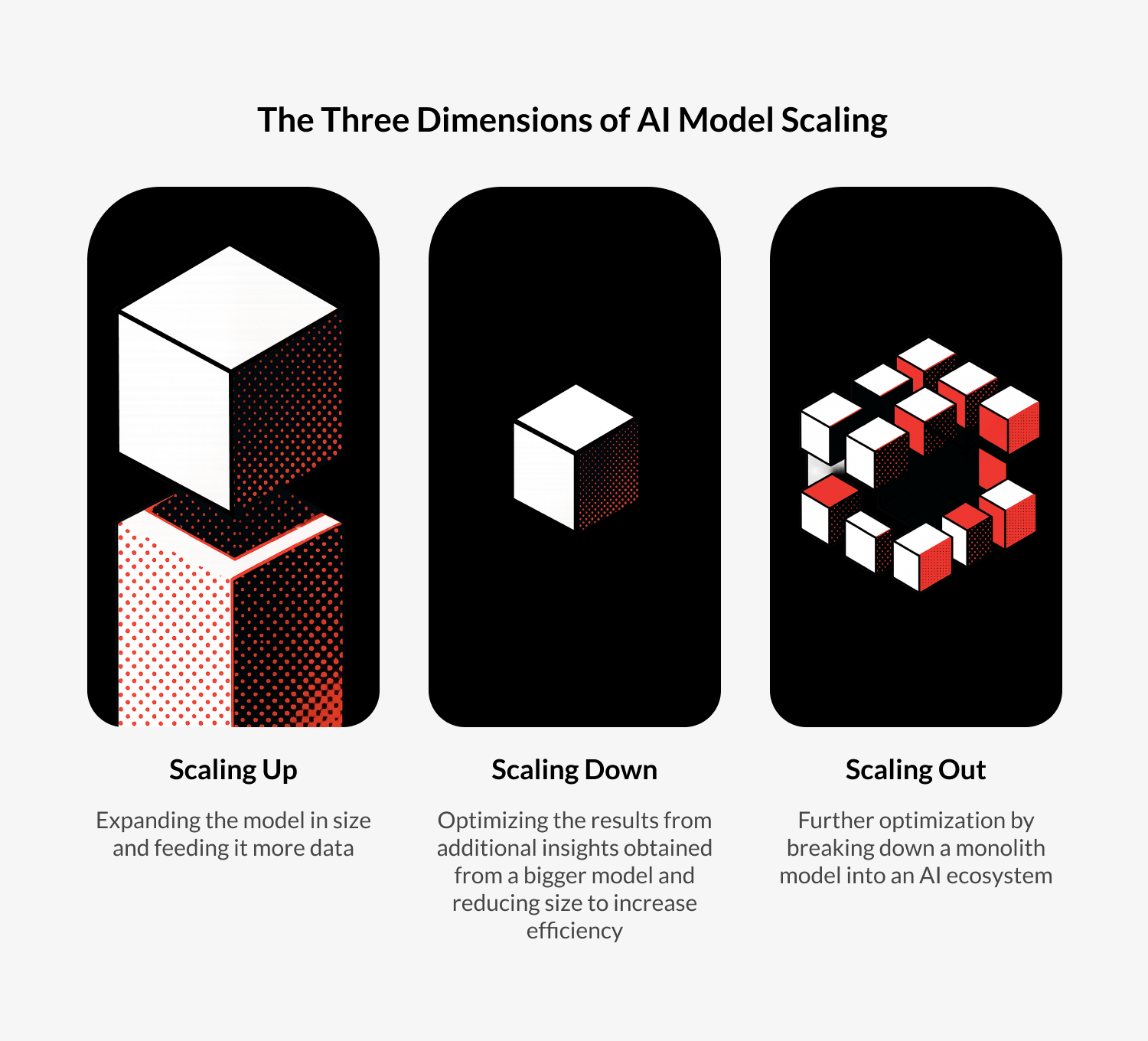
When discussing scaling AI models, we typically refer to scaling up. However, as AI models become more complex and their applications more widespread, the meaning of scale changes. Today, you need to understand that ‘bigger’ is not necessarily ‘better’ when it comes to AI model quality. Therefore, the first thing to decide on is what type of scaling will benefit your AI model applications most.
Scaling UpAs the name implies, scaling up AI models involves expanding their capabilities by increasing the number of parameters, training on larger datasets, and utilizing additional computational resources. Simply put, you make the model larger and push its limits to enhance the quality and accuracy of the results.
The downside of scaling up is the cost. This process will require a huge investment in data, infrastructure, and computational resources. It also increases the environmental impact of AI model deployment and use. Moreover, inevitable data saturation can lead to the deterioration of results over time.
Scaling DownSurprisingly, scaling down is the step that naturally follows scaling up. Gathering data from AI model drift monitoring and general performance provides you with insights that enable efficient downscaling. It’s a process of optimization that creates more efficient AI models. In simple terms, you remove everything non-essential from the previous AI scaling phase to preserve the quality of model performance for core tasks.
The main limitation of scaling down is that it typically focuses on a single optimized model, which can complicate AI model deployments across distributed or multi-model environments.
Scaling OutThe next step in refining AI model quality is scaling out. It builds upon the results achieved when scaling down. However, it goes further by breaking down a monolithic model into an AI ecosystem with the core intelligence and specialized models responsible for specific tasks.
This approach to AI scaling requires greater sophistication and collaboration with developers who have expertise in AI-driven solutions for growth.
How to Maintain Performance Quality in AI Models During Scaling
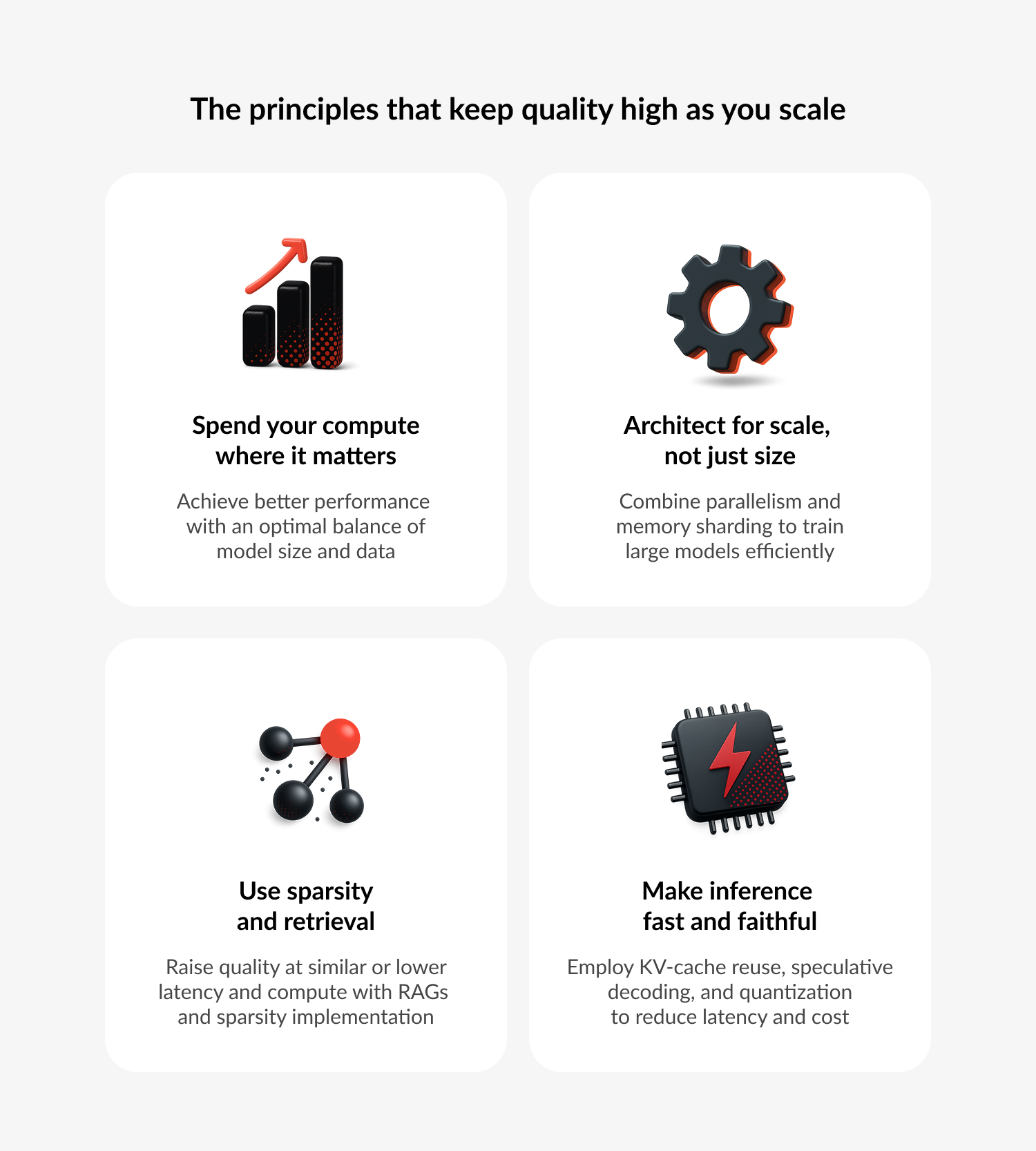
Regardless of the route you choose when scaling AI models, you need to minimize business disruptions caused by the changes. To achieve this, you must ensure highly targeted use of computing power and implement tools that will reduce latency and optimize the cost-to-value ratio.
Match Model Size to Data
Do not forget that bigger doesn’t equal better when it comes to AI. According to a massive study with the Chinchilla model, which outperforms both Gopher and GPT-3 yet uses much less computing, the key is balancing model size and training data volume.
To put it simply, AI model quality will be lower when a large model is trained on a small dataset as opposed to training a smaller one on robust and vast data sources. If your goal is automating AI scaling strategies, the core principle should be to train longer using more data instead of just increasing the number of parameters.
Architect for Scale
You can even run moderately big AI models on a single GPU. However, if you want to proceed with scaling up and future optimization, the architecture you build must support:
- Model parallelism to slice layers and tensors across multiple GPUs.
- Pipeline parallelism to layer groups across devices.
- Tensor parallelism to split matrix operations.
- State/optimizer sharding to avoid replicating all gradients and optimizer state across devices, thereby preventing memory overload.
Use Sparsity and Retrieval
One of the most efficient ways to preserve AI model quality when scaling is to rely on sparsity. Use sparsity techniques, such as Mixture-of-Experts (MoE), to activate only a fraction of model weights per input token, improving efficiency without sacrificing accuracy. This way, you activate only a fraction of model weights per input token. In simple words, this means that the model will use only a part of its capacity to get a precise result without unduly increasing compute or latency.
RAG, or Retrieval-Augmented methods, offer another way to optimize AI deployments and even improve the quality of results. RAG implementation is great for scaling because it allows the model to draw on data from external knowledge stores. It’s a method of improving factual accuracy without scaling the model’s knowledge or overloading its internal capacity. Also, it’s an effective solution for reducing AI model deployment costs.
Ensure the Inference Is Fast and Faithful
One of the main objectives when scaling AI models is to reduce latency in serving. Use techniques like KV-cache reuse in order to reuse computed keys/values for past tokens when serving a new message continuation.
Implement speculative decoding, where a smaller ‘draft’ model proposes tokens that are verified by a larger model, increasing inference throughput while maintaining output fidelity. This increases output speed and overall throughput. In addition, maintain fidelity (keep the results the model delivers unchanged during optimizations) through careful quantization or mixed precision.
Test Before Deployment
Offline evaluations might show great results. However, you still need to perform testing during AI deployments. Run shadow mode to mirror real-life traffic without directly showing your scaled model’s output to users.
The next step should be a canary release, when you roll out the new model to a fraction of traffic. Follow it with A/B testing to compare results and detect regressions or other issues that will show in the metrics (accuracy, latency, or toxicity). Such a staged approach allows for the implementation of effective AI model drift monitoring. You will also avoid massive failures during mass user adoption of the new model version.
AI Models Training Vs. Serving at Scale
Another thing to consider is that AI scalability varies between AI model training and serving. When going large-scale, such as in enterprise software development, you need to use highly specific approaches and techniques to prevent disruptions and maintain quality output for users.
How Large-Scale AI Training Works
When scaling up model training, follow the checklist below:
- When managing data, curate high-quality and diverse corpora, dedupe aggressively, and filter toxic/PII. Also, enforce license constraints relevant to your field.
- Train AI models in a compute-optimal regime, ensuring that the number of training tokens is proportional to the model’s parameter count for maximum efficiency.
- Implement model parallelism to distribute layers and tensors across multiple GPUs or TPUs, improving scalability and reducing single-device memory bottlenecks.
- Use ZeRO or Fully Sharded Data Parallel (FSDP) techniques to shard optimizer states, gradients, and parameters across nodes, allowing larger models to fit within available memory.
- Implement mixed-precision training and activation checkpointing to reduce memory consumption and maintain optimal computational throughput.
- Boost efficiency through sparsity to scale parameter count without proportional computing resources.
- Reweight or oversample high-value data during later stages of training to improve model specialization and reduce overfitting.
- Make stops and evaluations during training and examine multiple relevant metrics.
- Instrument everything for regressions to ensure you can restore optimal performance if necessary.
Production Patterns for AI Serving
Scaling AI models in serving comes with some challenges you can effectively resolve if you keep in mind the following:
- In serving architecture, deploy stateless model workers behind a low-latency inference gateway with autoscaling policies based on token throughput and request latency. When automating AI infrastructure scaling strategies, ensure auto-scaling on tokens and isolate noisy tenants.
- For caching, implement prompt/results cache and KV-cache reuse to enable session continuity and reduce latency.
- Use smaller draft models with verifier models to increase token generation speed (tokens/sec) while ensuring identical or equivalent output quality.
- Use 4/8-bit weights quantization and small distilled assistants for low SLA-paths.
- Rely on Retrieval-Augmented Generation (RAG) to ensure access to fresh, external knowledge sources without retraining the core model.
- Follow the Shadow-Canary-Gradual rollout pattern in scaled AI deployments.
- Implement continuous model drift monitoring with end-to-end tracing, real-time evaluations on live data slices, and automated alerts for drift, outliers, and safety metric violations.
Real-Life Examples of Large-Scale AI Deployments
To understand exactly how AI scaling can evolve and what challenges it presents, we should examine some companies that have succeeded with their models.
Meta’s release of Llama 3This was a large-scale project that involved Meta’s close collaboration with NVIDIA as its infrastructure partner. The rollout of Llama 3 versions at 8B and 70B parameters required Meta to gather over 15 trillion tokens of text corpus. All this data needed to be refined and filtered to remove low-quality segments.
They ran multiple experiments and balanced multiple data sources, such as web, code, dialogue, and scientific texts. Currently, Meta is using extensive tooling to manage and monitor the system and roll out updates. They implement orchestration layers (for example, Kubernetes or internal schedulers) and continuously monitor inference quality and latency metrics.
Uber’s Michelangelo ML scalingMichelangelo is one of the best public examples of a production-scale AI//ML stack you can find today. It started with Uber’s individual teams building custom pipelines, one-offs, and integrations. This approach resulted in the rise of operational debt and ML sprawl. Michelangelo was the solution that brought the necessary ML functions together on a single platform. It currently combines data ingestion, feature stores, model training and deployment, monitoring, and lifecycle management.
Uber’s successful example of AI scaling shows that even if you start with a complex enterprise-scale system of disconnected APIs and other solutions, you can cut your costs and boost performance through AI implementation. Businesses that have not yet reached the level of Uber can look at the Evolv AI case and see how to start AI implementations on a smaller scale first.
LinkedIn’s Pro-ML optimizationLinkedIn uses multiple ML systems to help its users find jobs, filter content, complete searches, advertise, and perform other actions. However, with so many separate ML features, they faced common challenges, such as duplicate efforts, complexity of new AI model deployment, and versioning complexity, among others. LinkedIn’s answer to these challenges was the launch of Pro-ML (Productive Machine Learning), which enables them to unify infrastructure, tools, and best practices across their ML lifecycle.
Netflix media ML scalingEveryone knows about the famed Netflix recommendation algorithms. However, it’s only one of the many ML features the streaming network uses, and it works with humongous amounts of data. The main challenges it faces include vast data volume and pipelines that must scale to process multiple modalities daily, extreme model complexity, data abstraction, streaming reliability, and resistance.
They resolve their issues through AI scaling and creating platforms like Data Gateway that help address each challenge. The complexity of the system requires a multi-layered approach that goes from multimodal AI model layering to close collaboration with Intel for infrastructure needs and hardware optimization.
Summing It Up
Scaling AI models is a challenge, especially if you want to avoid a drop in performance quality. However, it’s also a necessity as AI implementations grow, which often results in overtly complicated systems that break down and cost a fortune to maintain due to a lack of synchronization between components.
The solution is AI scaling that will incorporate everything you need, enhance possibilities, and optimize everything. Partnering with experienced AI agent developers can be the first step in this project. Together, we can work out the strategy that will prevent disruptions to your workflows while bringing the entire system up to par. As a result, businesses gain more productive and cost-efficient AI models that can effectively handle the challenges posed by growing user interest.
If you are ready to take this next step, exploring the boundaries of your AI scalability and going beyond, reach out, and we’ll see how to make this journey successful for your business.
See how we built
an AI-powered recruitment app
acquired by a US staffing giant