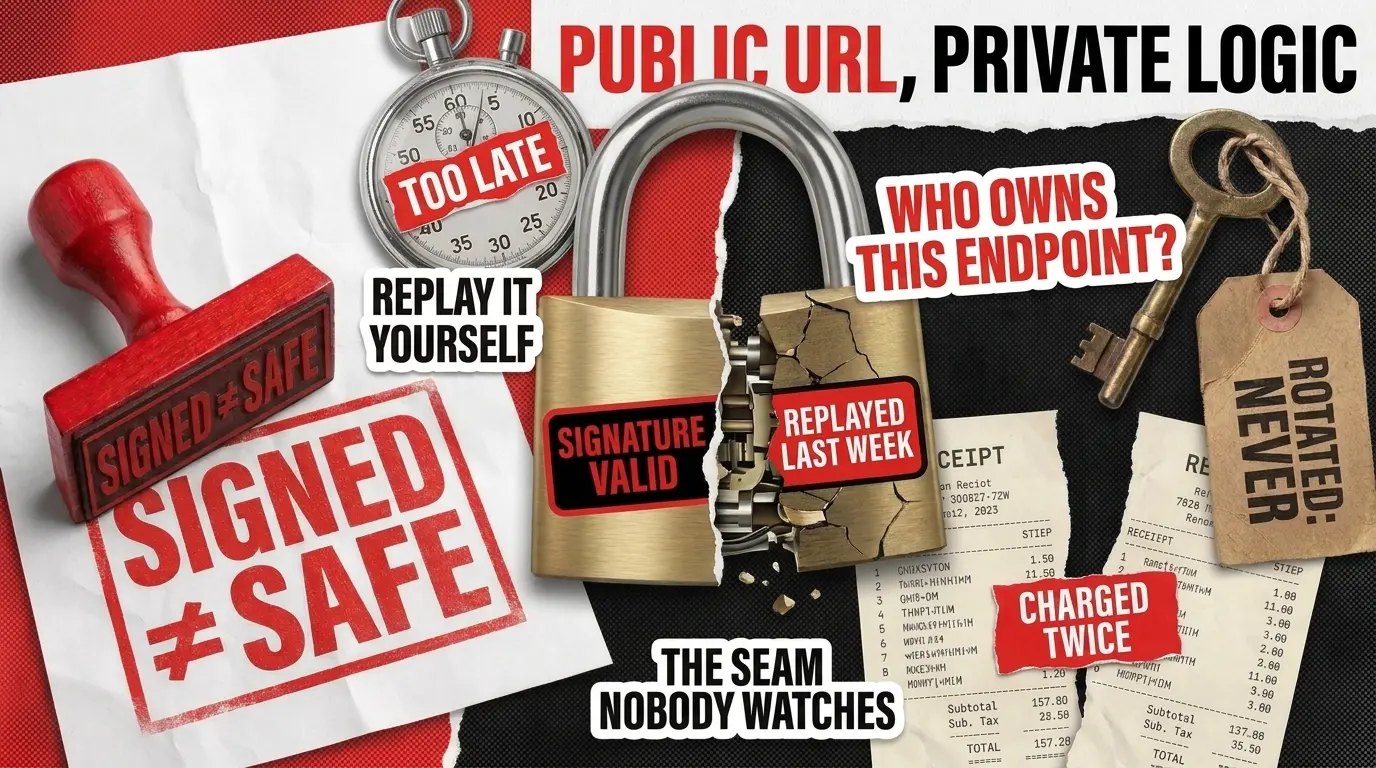
Most engineering teams delivering a SaaS product believe their webhook layer is safe the moment the signature check passes. That belief is the gap. Webhooks are the quiet plumbing behind payments, provisioning, notifications, and integrations, and they sit on a publicly reachable URL that an attacker can reach as easily as you can. According to Verizon‘s 2026 Data Breach Investigations Report, third-party involvement now drives 48% of all breaches, up 60% year over year. Webhooks live exactly in that third-party seam.
By the end, you will know the seven failure modes most teams overlook, what a secure webhook implementation requires beyond the signature check, and a ten-minute self-audit you can run today.
The Seam Nobody Owns
Webhooks invert the trust model your auth layer was built around. A normal API call is initiated by your code: you know what you sent, when, and to whom. A webhook arrives unannounced from a third party, hits a public endpoint, and triggers internal logic. Firewalls see encrypted HTTPS traffic to a legitimate domain. SIEMs lack context for normal webhook behavior. The protections you trust elsewhere are looking the other way.
The scale of the blind spot is bigger than most teams realize. Webhooks have become standard infrastructure for any SaaS that integrates with payments, identity, or third-party tooling, yet most teams cannot produce a complete inventory of the endpoints they expose. That gap is where attackers operate.
This is the structural reason webhook security keeps showing up as a 2026 priority for product security teams: the endpoints are public, the volume is high, and almost nobody owns them end to end.
Signed, but Still Broken
We have reviewed enough integration code to see the same patterns repeat. The signature gets verified, the test passes, the ticket closes. Then the bug shows up two quarters later, dressed as a duplicated charge or a phantom provisioning event. Below are the seven failure modes we see most often, grouped by what they actually break.
Crypto Done, Job Half Done
The first cluster looks like a cryptography problem but is really about how teams use the cryptographic check. Two failures dominate.
The first is verifying the wrong version of the message. Modern web frameworks quietly reformat incoming data before your code sees it, even something as small as reordering fields or changing spacing. The sender signed the original version; your code is now checking a slightly different one. The signature stops matching, and instead of fixing the root cause, teams often loosen the check until it passes again. The protection is still technically there, but it has been quietly defanged.
The second is treating a valid signature as proof that the message is current. A signature on its own never expires. Anyone who captures last week’s “subscription renewed” event can replay it next week, and your endpoint will accept it as new. The fix is to require a recent timestamp, signed alongside the message, and reject anything older than a few minutes. Webhook signature verification without that freshness check is a lock you never bother to re-key.
Real Events, Wrong Outcomes
The next cluster is sneakier because the events are genuine. The signature checks out, the timestamp is current, and your handler still produces the wrong result.
The first failure is missing idempotency. Providers like Stripe explicitly retry webhook deliveries when they do not receive a 2xx within their timeout window. If your handler debits an account or provisions a seat without first checking whether the event ID has already been processed, the same legitimate event will fire its side effects twice. Founders only notice when a customer complains about a duplicate charge. We have seen the consequences of skipped idempotency surface across payment gateway integration mistakes more times than any other category.
The second failure is trusting what the webhook says without checking the source. If the message claims a customer paid $100, your code grants $100 worth of access. But anyone who finds a way to send fake-looking messages to that endpoint, even through an unrelated weakness elsewhere in your app, now controls what your business logic does. The fix is simple but requires discipline: for anything that involves money, permissions, or sensitive data, ask the provider directly before acting on it. The webhook tells you something happened. The provider’s records tell you what is actually true.
The Debt That Compounds Quietly
The last cluster is where most teams accumulate years of risk without noticing.
Signing secrets that never rotate are the most common. The key copied into the environment file at launch is still there three years later, replicated across staging, production, two engineer laptops, and one ex-employee’s GitHub gist. A rotation cadence written down somewhere is the difference between a contained incident and a forensic nightmare.
Rejected requests that log to nowhere are the next layer. A 401 returned silently is invisible. A spike of forged requests is a probe, and probes precede attacks. Structured logging on both accepted and rejected events, with an alert on rejection rate anomalies, turns the noise floor into a signal you can act on.
Finally, there is the endpoint nobody remembers shipping. Most teams cannot produce a complete list of every webhook URL their app exposes, who owns each one, what secret signs it, and when that secret was last rotated. The forgotten endpoints are the dangerous ones. This is the same operational hygiene problem you find in a thorough security code review checklist: you cannot defend what you have not catalogued.
Signed Is Not Authenticated
A persistent confusion is the conflation of signature verification and webhook authentication. The two terms describe different layers, and treating them as synonyms is part of why the gap stays open.
A signature proves that the request was created by a party holding the shared secret. That is it. It says nothing about whether the request is current, whether you are the intended recipient, whether the event has already been processed, or whether the payload contents reflect the real state on the provider’s side. Authentication is the larger question: is this request legitimate, fresh, intended for me, and safe to act on? Signature verification is one component of that answer, not the whole answer.
Sender holds the shared secret
Yes
Yes
Payload was not tampered with in transit
Yes
Yes
Request is current, not a replay
No
Yes
Event has not already been processed
No
Yes
Payload values match the provider’s source of truth
No
Yes
The right framing is to treat signature verification as a necessary entry condition and authentication as the full pipeline that has to pass before your handler does anything with side effects.
What “Secure” Actually Looks Like
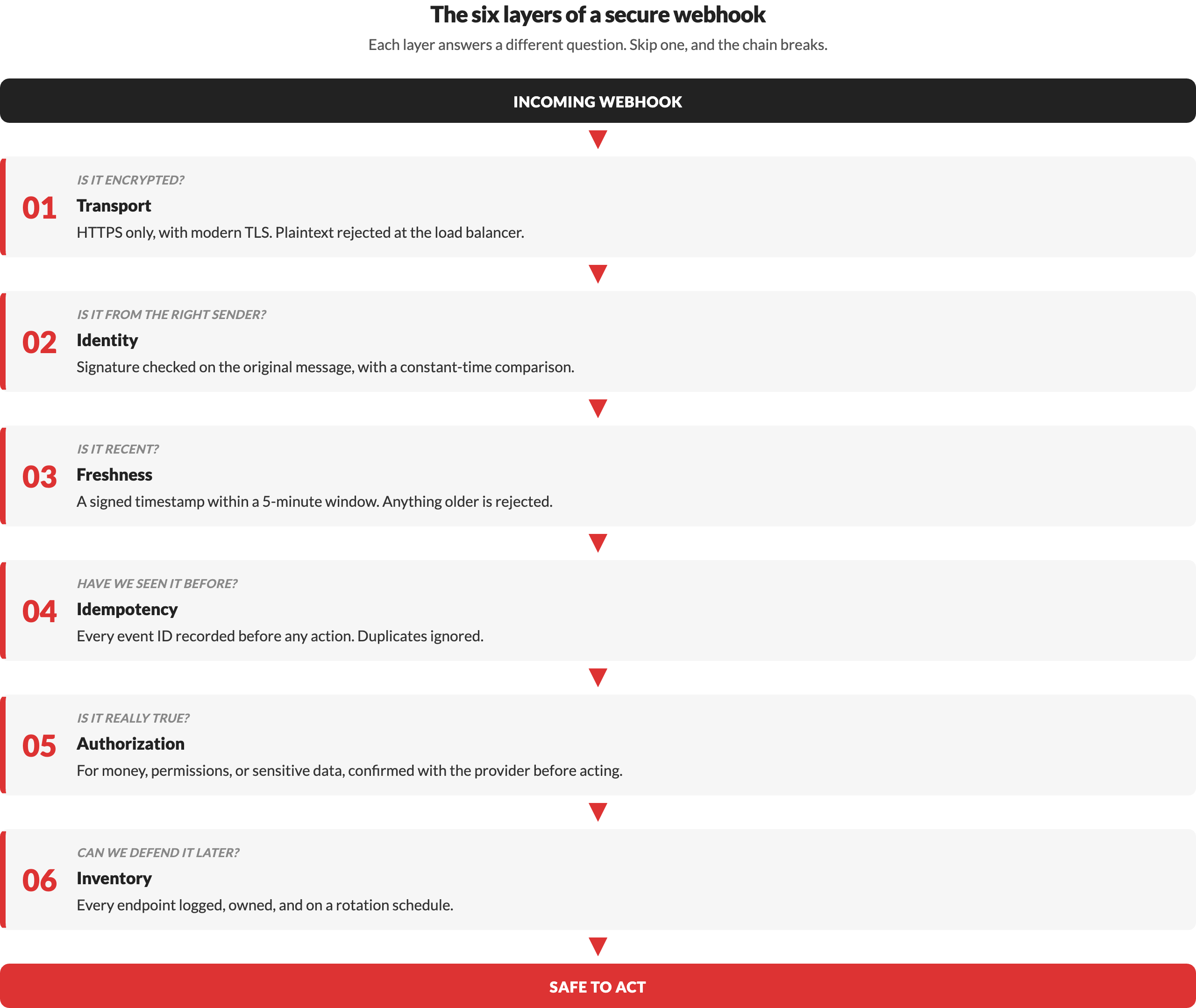
A secure webhook implementation is layered. No single control carries the load; each one closes a class of attack the others leave open. The architecture below is what we set up for SaaS products and event-driven backends as part of SaaS development and cloud application development engagements.
Transport, Identity, Freshness
The first three layers run before your business logic gets a vote.
Transport is HTTPS only, with HTTP rejected at the load balancer rather than the application. Modern TLS, valid certificates, and automatic renewal are table stakes. Every major provider already requires HTTPS-only endpoints, and accepting plaintext webhooks in 2026 is a configuration mistake, not a tradeoff.
Identity is HMAC computed over the raw request body, with a constant-time comparison against the signature header. Use the provider’s official library where one exists. Reach for the raw bytes that arrived on the socket, not the parsed body your framework hands you.
Freshness is a timestamp signed alongside the payload, with a tolerance window of around five minutes. Reject anything older. This single change eliminates replay attacks against captured payloads and costs roughly fifteen lines of code.
Idempotency, Authorization, Inventory
Passing the first three layers means the message is real, current, and from the right sender. It does not mean your system should act on it yet. Three more layers stand between a verified message and the moment your business logic actually does something.
Idempotency is making sure the same event is never processed twice. Every webhook carries an ID, and your code should record that ID before doing anything else. If the same ID arrives again, ignore it. This sounds trivial until you remember that providers like Stripe deliberately resend events when they do not get a fast reply, which means duplicates are not an edge case but the default behavior.
Authorization is refusing to take the message at face value when the stakes are high. The webhook tells you that something happened. For anything involving money, permissions, or sensitive data, your code should ask the provider directly to confirm what actually happened before acting. This is the layer that saves you when an attacker finds an unrelated weakness in your app and starts sending convincing but fake messages.
Inventory is knowing what you have. One single list should answer four questions about every webhook endpoint in your product: who sends it, what secret signs it, when that secret was last changed, and which engineer owns it. Pair that list with logging on both accepted and rejected messages, an alert when rejections spike, and a written schedule for rotating secrets. That combination is what turns webhooks from a forgotten surface into a defensible one.
The 10-minute Self-Audit
Run this against your codebase right now. Each “no” tells you which failure mode your team is exposed to.
1
Does your code verify the original message exactly as it was sent, not a reformatted version?
Signature mismatches that get patched by loosening the check.
2
Does every webhook include a timestamp, and do you reject anything older than a few minutes?
Replay attacks using captured messages.
3
Does each webhook get processed only once, even if it arrives twice?
Duplicate charges, double provisioning, broken state.
4
For anything involving money, permissions, or sensitive data, do you confirm with the provider before acting?
Fake but convincing messages from an attacker.
5
Is every signing secret on a written rotation schedule, with the last rotation date logged?
Stolen keys that stay valid for years.
6
Are rejected webhooks logged, with an alert when rejections spike?
Probes and attacks that arrive invisibly.
7
Can someone on the team list every webhook endpoint, its owner, and its rotation date in under ten minutes?
Forgotten endpoints that no one is defending.
Three or more “no” answers is the threshold where most teams we audit need structural work, not patches. Teams shipping AI-generated code typically score lower on this list, which is why vibe code cleanup has become a standing service for us, and why a thorough vibe code audit often surfaces the same webhook gaps this article walks through.
The Work That Starts After Launch
A webhook layer is not a feature you deliver once. It is a posture you maintain, the same way you maintain your authentication layer. The teams that get this right assign a clear owner, write down the threat model, and review the inventory quarterly. The ones that do not, learn the same lesson the Verizon DBIR has been documenting for two years running: third-party seams are where modern breaches enter, and the seam you do not own is the seam that breaks.
If you ran the self-audit above and the “no” answers piled up faster than you would like, that is exactly the kind of work we do. Contact us and we will help you close the gap before it closes you.
See how Redwerk audited and future-proofed a backend API to lift maintainability by 80% and harden every integration touchpoint before scale.