Your team pushes code from Lisbon at 6 PM and it sits untouched until Austin logs on the next morning. For a distributed engineering team, the review queue is where velocity quietly dies, and no amount of typing speed fixes an eight-hour wait for a second pair of eyes.
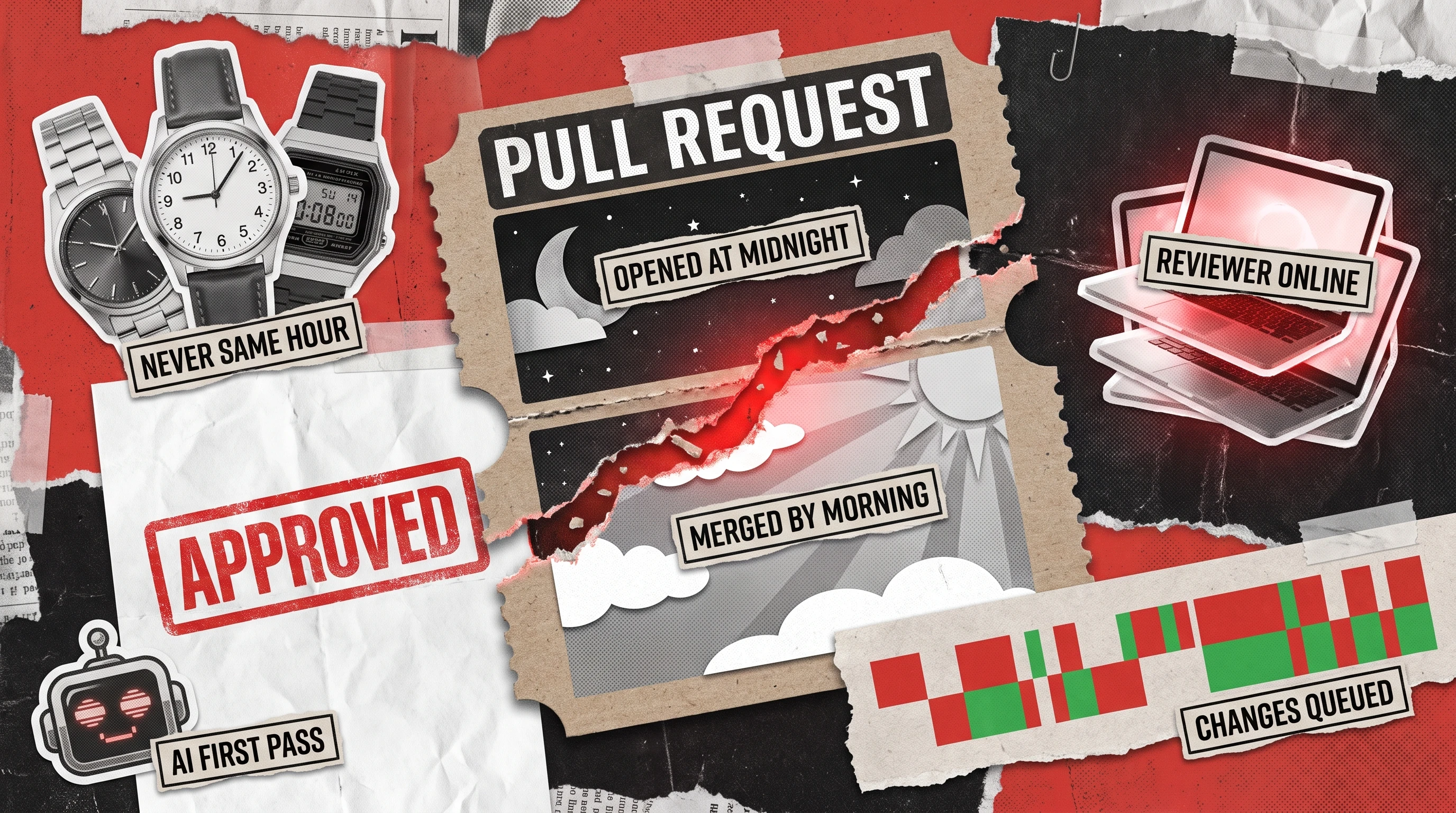
The best code review tools for distributed teams shorten that overnight gap by automating the first pass, routing each pull request (PR) to whoever is awake, and keeping full context inside it so nobody waits for a meeting to approve a change.
This guide filters six tools against five criteria that matter when your reviewers never share a working hour, then covers the point where tooling runs out and senior engineers who already know your stack take over the depth of review automation cannot reach.
The Five-Point Filter: Choosing the Best Code Review Tools for Distributed Teams
Before comparing products, agree on what "good" actually means for an asynchronous team. A distributed setup quietly breaks any tool that assumes the author and reviewer share a time zone, a chat window, or the same mental model of the codebase. We score every candidate against five criteria, and the strongest code review software earns a pass on all five instead of winning on raw feature count.
The best code review tools treat these five as defaults instead of add-ons, so a reviewer waking up three time zones away can act on a pull request without pinging the author and waiting a full day for the reply. Each of the six tools below is measured against these same five criteria, not against how many features it lists.

Six Code Review Tools Built for Distributed Teams
No single product covers all five criteria, so most distributed teams combine two or three. The six code review tools below each solve a specific part of the around-the-clock review problem, from AI triage the moment a PR opens to safe merges while the author sleeps. They are grouped by the job they do best, not ranked top to bottom, because the right mix depends on your stack and where your engineers actually sit.
CodeRabbit: AI First-Pass so Reviewers Wake up to a Warm PR
CodeRabbit runs an automated review the moment a pull request opens, so the human reviewer in the next time zone starts from a plain-language summary and a list of likely issues instead of a cold wall of raw code changes. Among AI code review tools it stands out for line-by-line comments, a readable change summary, and the way it learns from how your team resolves past feedback. Its limit is the one every automated reviewer shares: it recognizes patterns without grasping intent, so treat its output as a warm-up for the human, not a final verdict, a trade-off we unpack in our guide to AI-powered code reviews. Pick CodeRabbit first when a team needs an immediate quality lift without restructuring how pull requests get built, since it drops into an existing GitHub or GitLab workflow within minutes.
Graphite: Stacked PRs and Reviewer Routing Across Regions
Graphite is built around stacked pull requests, small dependent changes reviewed in sequence instead of one giant pull request nobody wants to open at 2 AM. For distributed teams it adds two things that matter most when reviewers are scattered:
- Smaller PRs a reviewer can clear in a single sitting, which keeps the overnight queue short.
- Automated reviewer assignment based on code ownership and availability, so a review lands with someone who is genuinely online.
The trade-off is a workflow shift. Stacking takes discipline, and teams used to one branch per feature usually need a few weeks to adjust before the payoff shows. Reach for Graphite over an AI-only first pass when the real bottleneck is pull request size itself, since shrinking each pull request cuts review time in a way automated commentary on one giant change never can.
LinearB: Codified Review SLAs and Workflow-as-Code
LinearB turns the review process into policy a team configures once and enforces automatically. It assigns reviewers by codeowner and availability, flags any pull request that sits past an agreed SLA, and escalates the stale ones to a backup reviewer or a Slack channel before they stall a release, so the process runs identically whether the author is in London or Sydney. That codified SLA is the whole point for distributed teams, since nothing depends on a reviewer remembering the convention or a manager chasing status by hand. LinearB earns its place over the other tools here when the actual failure mode is a pull request going stale with no one accountable, and its delivery-metrics dashboard gives a manager visibility into exactly where that stalling happens across every region.
Gerrit: Async by Design, Still the Reference for Change-Based Review
Gerrit predates the current wave and remains the benchmark for change-based, asynchronous review. It reviews individual commits, not entire branches, tracks every revision of a change, and enforces scoring before a merge, a model that assumes reviewers act entirely on their own schedule. Among open source code review tools it is the most battle-tested for large distributed engineering organizations, with Android and Chromium built on it for years. The cost is setup and interface, since Gerrit is powerful and unapologetically utilitarian, so budget a steeper onboarding curve than any hosted option here. Gerrit makes the most sense once an organization is large enough to run its own platform team and wants strict commit-level history, a fit better suited to scale than to a small team trying to move fast on day one.
Aviator: Merge Queues That Keep the Pipeline Moving Overnight
Aviator solves a different problem: merging safely once approval is done and nobody is left watching. Its merge queue batches approved PRs, re-tests each against the latest main, and merges only what passes, so a green review at midnight becomes a merged change by morning with no human babysitting the pipeline. For distributed teams this closes the gap between "approved" and "shipped" that otherwise stalls until the author’s next working day. It does assume a mature CI setup, since a merge queue without reliable tests simply automates the delivery of broken code. Aviator is worth pairing with any tool above the moment merge volume makes a human babysitting the queue impractical, since it solves a later stage of the pipeline than review itself.
Sourcegraph Cody: Cross-Repo Context for Reviewers With No Meeting Time
Sourcegraph Cody attacks the context problem head-on. A reviewer three time zones away cannot lean over and ask why a function exists, so Cody answers from the code itself, searching across every repository, explaining unfamiliar modules, and tracing how a change ripples through dependencies. That cross-repo awareness is what lets a reviewer approve with confidence and skip the synchronous handoff entirely. It works as an assistant, not a gate, so it complements a review tool instead of replacing one. Reach for Cody specifically when a team spans many repositories and reviewers keep blocking on questions only the original author could answer, a gap none of the other five tools close.
Where Tooling Runs Out: The Review Capacity Problem
Every tool above speeds up the mechanics of review. None of them add reviewers, and that distinction is where distributed teams get stuck. Google’s 2025 DORA research frames it well, finding that AI mostly acts as an amplifier, "magnifying an organization’s existing strengths and weaknesses" instead of fixing a weak process by itself.
When automation helps engineers produce more code, the constraint moves downstream to the people who review it, and a distributed team feels this first because its reviewer pool is already thin and spread across time zones. The 2025 Stack Overflow Developer Survey shows why teams cannot simply automate the gap away, with 46% of developers distrusting AI output and 58.7% saying they do not plan to use AI for committing and reviewing code. A continuous integration code review pipeline enforces that human checkpoint automatically, and a shared code review checklist keeps standards identical whether the reviewer sits in Berlin or Boston. Tooling routes and triages the work, and it never manufactures senior judgment where there is none. Sizing that judgment layer is a staffing question rather than a purchasing one, and our guide to AI-native engineering team structure works through the roles and reviewer ratios in detail.
The Human Layer Behind Around-the-Clock Reviews
Teams that genuinely ship around the clock treat tooling as scaffolding around a staffed review function, not a replacement for one. Real 24-hour coverage means reviewers whose working hours overlap every part of your commit cycle, who know your codebase well enough to catch intent-level problems an AI misses, and who respond fast enough that a pull request never sleeps a full night. Most mid-market teams cannot staff that depth from a single office.
This is where an outside team earns its place. We match engineers to your exact stack, so a reviewer picks up context in days instead of weeks, and coverage spanning our time zones and yours means a pull request opened at the end of your day meets a fresh reviewer at the start of theirs. Pairing that senior human layer with the automation above, for example an AI first pass from CodeRabbit handed to a stack-matched engineer, is how distributed teams win both speed and depth. For teams wiring an AI agent directly into the review loop, our guide to using Claude Code for code review lays out the specific pull request types it handles well and the boundaries worth setting around it.
Distributed teams do not win by buying the longest feature list. They win by deciding what asynchronous review must guarantee, choosing two or three tools that deliver those guarantees, and backing them with reviewers whose hours and expertise actually cover the clock. Get the human layer right and the tooling compounds it. Get it wrong and faster merges only ship defects sooner. If you want a senior review team matched to your stack and your time zones, get in touch with us.
FAQ
How do remote teams do code reviews across time zones?
Remote teams make review asynchronous by default. That means small pull requests a reviewer can clear alone, full context written into the PR description so no live call is needed, automated routing to whoever is online, and a merge queue that safely ships approved changes while the author sleeps. Teams that overlap at least one working hour per region handle urgent reviews live and leave everything else to the async flow.
Which code review tool works best for async reviews?
There is no single winner, because async review has several distinct needs. Gerrit is the strongest choice for pure change-based review at scale, CodeRabbit is best for an automated first pass so reviewers start warm, and Graphite wins on keeping pull requests small enough to review alone. Most distributed teams combine an AI first pass, a routing or stacking layer, and a merge queue instead of relying on a single product.
What's the biggest mistake distributed teams make with code review tools?
Assuming a tool adds review capacity. Automation triages, routes, and summarizes, and it never creates senior reviewers or the judgment to catch intent-level bugs. Teams that buy tooling to cover an understaffed or poorly matched review function end up merging faster and shipping the same defects later. Fix the human layer first, then add tooling to make it faster.
See how Redwerk audited Complete Network's Project Science software and boosted code maintainability by 80% before scaling nationwide