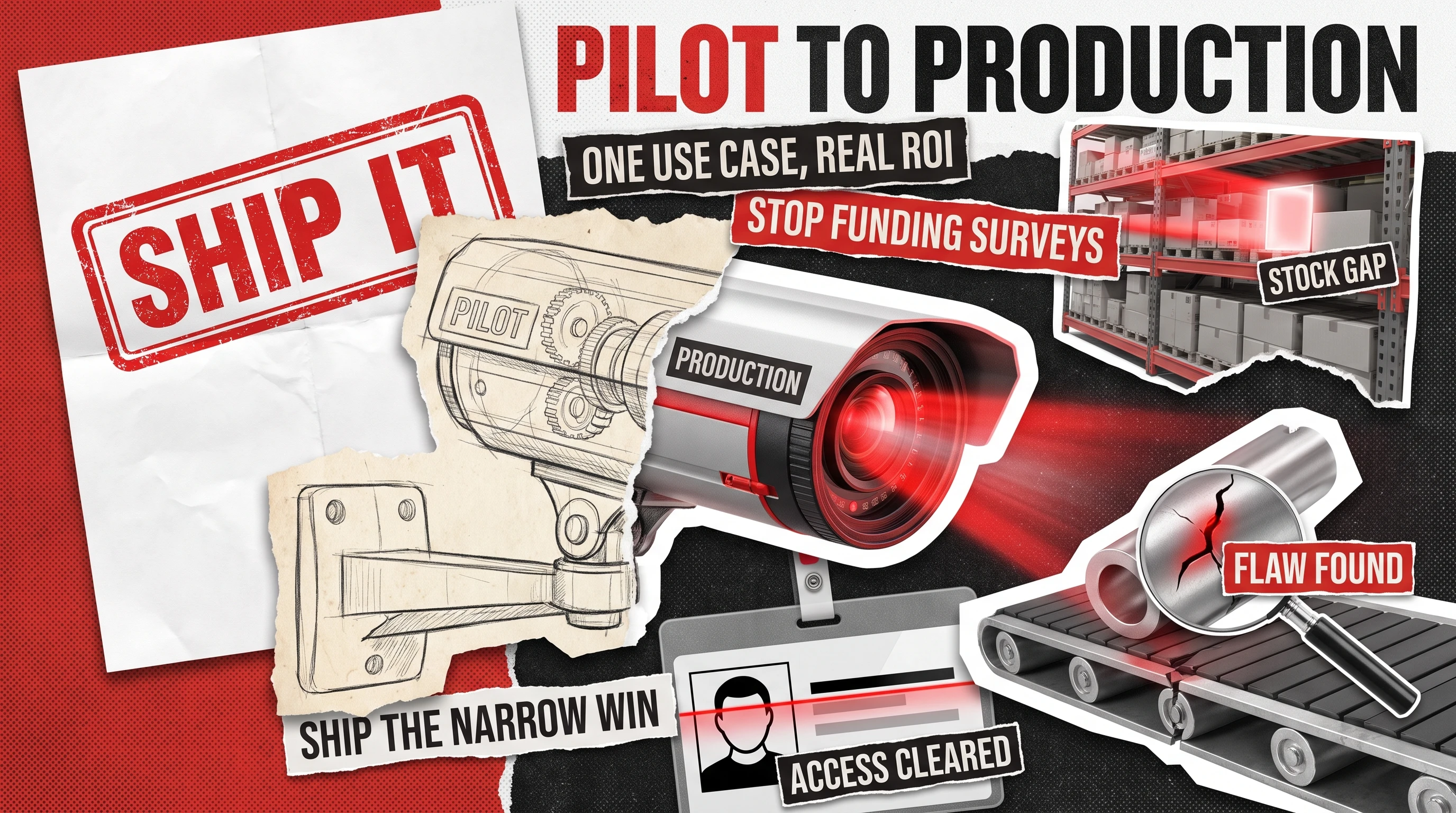
Computer vision left the research lab years ago. The four computer vision applications with the clearest return today are automated visual quality control in manufacturing, shelf and warehouse inventory recognition in retail, diagnostic imaging support in healthcare, and facial recognition for access control in security. The technology is mature enough to buy. Choosing which one to fund first is the hard part.
Most buyers arrive with the same two questions. Which application pays for itself first, and what does it take to move a working model out of a notebook and onto the line. This article answers both, and names the decision that separates production systems from pilots that die after the proof of concept.
Redwerk builds image recognition, object detection, facial recognition, and video analytics as part of our Artificial intelligence development services, with confirmed delivery in manufacturing, retail, and healthcare. What follows reflects where those projects reach production and where they stop.
Why Most Computer Vision Pilots Stall Before Production
The gap between a working demo and a working system is where most vision budgets disappear. A 2026 review of machine learning vision for robotic inspection found that 77% of implementations remain at prototype or pilot scale, even though accuracy in those pilots frequently exceeds 95%. The model performs. The system around it never gets built.
Three causes explain most of that 77%, and all three are visible before a contract is signed. This is the shortlist for buyers who want to fund the first project once.
No Labeled Data at Production Quality
Pilots run on curated, clean images. Production runs on a line where lighting shifts, parts arrive at odd angles, and the defect you care about appears once in ten thousand units. That same review names limited training data as a primary deployment constraint. Raw footage usually exists already, while labeled footage covering the rare cases does not.
A Use Case That Never Had ROI in the First Place
Some projects are technically successful and financially pointless. Automating a check a human does in two seconds, on a line running 400 units a shift, saves less than the labeling bill costs. Surviving use cases share a shape: high unit value, high inspection volume, or a failure that costs real money once it escapes.
No Plan for the Last-Mile Integration into the Line or the Storefront
A model returning predictions in a notebook has solved the easy part. The 2026 deployment analysis places most effort and failure risk in what comes after, which is connecting the model to enterprise systems and redesigning the work around it. On a factory floor that means a programmable logic controller, a reject actuator, and an operator screen. In retail it means the warehouse management system.

Computer Vision in Manufacturing: The Highest-ROI Starting Point
Sorting computer vision use cases by industry puts manufacturing at the top, and it is not close. Automated visual quality control returns the most here, because the cameras are often already on the line and the cost of a missed defect already belongs to someone. A defect caught at the station is scrap or rework. The same defect found by a customer becomes a warranty claim.
Accuracy has stopped being the blocker. The 2026 review reports defect detection accuracy frequently exceeding 95%, with some systems reaching 98% to 100% under controlled conditions. Manufacturing is where our AI work goes deepest, and our Manufacturing software development practice is where these economics are easiest to model before anyone writes code.
Automated Visual Quality Control on Production Lines
This is the entry point for most manufacturers. A camera at the inspection station classifies each unit as pass or flag, and flagged units divert to a human reviewer instead of being scrapped. Existing line cameras often have enough resolution to start. Payback is fastest where unit value is high and inspection is manual today, which is why automotive, aerospace, and medical devices move first.
Predictive Maintenance via Thermal and Visual Inspection
Thermal and visual cameras watch the equipment instead of the product. The pattern is consistent across plants:
- A thermal camera trends bearing and motor temperatures, flagging drift before failure.
- A visual model catches belt wear, seal leaks, and misalignment on a fixed route.
- The output becomes a maintenance ticket with a timestamped photo attached.
The cost signal is unplanned downtime on the constrained machine, measured per hour. Insurers increasingly ask what monitoring covers high-value equipment.
Safety Compliance Monitoring
PPE detection and restricted zone alerts are the two workhorses. A model checks whether people entering a zone wear the required helmet, vest, or eye protection, and whether anyone crossed into an area that should stay empty. The second benefit is the audit trail, since timestamped detection logs turn an argument into a record.
Automated visual quality control
Scrap, rework, and warranty cost per escaped defect
Thousands of labeled images per defect class, including rare defects
Predictive maintenance inspection
Cost per hour of unplanned downtime on the constrained machine
Thermal and visual image history tied to recorded failures
Safety compliance monitoring
Incident rate, insurance premium, and audit exposure
Labeled footage of compliant and non-compliant behaviour per zone
Computer Vision in Retail and E-commerce
Retail runs two different vision problems at once. In the store and the warehouse, the question is what sits on the shelf right now. On the website, it is what a shopper wants when they cannot put it into words. Both earn their budget, though the data economics differ sharply.
Shelf and Warehouse Inventory Recognition
Fixed cameras or a handheld pass detect empty facings, misplaced products, and planogram violations without anyone walking the aisle. Real-time stockout detection is the headline benefit, because an empty facing on a fast-moving item leaks margin every hour. The quieter benefit is audit labour, since a weekly manual count becomes floor service time. Redwerk builds this as part of our E-Commerce development services.
Visual Search and Product Recommendation
A shopper uploads a photo or taps a product image, and the model returns visually similar catalogue items. The measurable effects sit on discovery pages: conversion lift where text search was failing, average order value uplift from better cross-sell matches, and faster product research.
Retail is also where the data cost gets underestimated most often. Catalogues change weekly, seasonal ranges rotate, and packaging gets redesigned, and each change degrades a model trained on last quarter’s images. A working system needs a retraining loop budgeted as an operating cost. Teams that fund one training run are the ones whose retail pilots stall around month four.
Computer Vision in Healthcare
Healthcare holds the most impressive vision research and the slowest path to production, and both facts share a cause. Clinical applications touch patient outcomes, which brings a regulatory pathway with them. Operational applications sit outside that pathway, so they usually ship first.
Diagnostic Imaging Support
Radiology triage, dermatology screening, and ophthalmology carry the deepest published work. The framing that survives clinical review is clinician assist: the model prioritises a worklist or flags a study for a second read, and a clinician makes the call. Redwerk’s image recognition and object detection capability is confirmed for this work, and we describe it at capability level because we have no named diagnostic deployment to point at.
Operational Use Cases with Lower Regulatory Load
Several healthcare applications avoid the clinical pathway entirely:
- Patient flow analytics, using anonymised counts to find waiting room bottlenecks.
- Hand hygiene and PPE monitoring, reported as aggregate compliance.
- Medication scan verification, matching a package against the order before administration.
These ship faster because the model informs a process while a human stays accountable for the clinical decision. They also build the imaging pipeline a later diagnostic feature will need anyway.
The caveat on the clinical side is substantial. A diagnostic feature needs an FDA or CE Mark pathway, data handling that satisfies HIPAA and GDPR, and documented provenance for every training image. Projects usually stall at provenance, because the archive was never assembled with training consent in mind. Our write-up on the Challenges of AI in healthcare covers those constraints, and our Healthcare IT software development work covers how we build inside them.
Computer Vision for Security and Access Control
Security is where the technology performs best and the regulation bites hardest. Accuracy under controlled conditions is genuinely high, and the same model degrades quickly once conditions stop being controlled. Both facts belong in the design conversation from the first week.
Facial Recognition for Access Control
Offices, secure facilities, and high-risk zones are the standard deployments, and conditions there favour the technology. A person stops, faces a camera at a known distance under fixed lighting, and the system compares against a few hundred enrolled faces. Accuracy there sits in the 95% to 99% range, and it falls with pose, lighting, and occlusion. A worker in a hard hat and safety glasses at an angle is a much harder problem than the same worker at a turnstile.
Video Analytics for Perimeter Monitoring
Loitering detection, tailgating detection, and incident alerting shift the guard’s job from watching 40 screens to answering a handful of flags a shift. Tailgating, where a second person follows an authorised badge holder through a door, is usually the highest-value behaviour to model, because it defeats the access control system everything else depends on.
Biometric regulation belongs in the architecture, at the start. Illinois’ Biometric Information Privacy Act requires written consent before a faceprint is collected and carries a private right of action, and the GDPR treats biometric identification data as a special category. Both shape enrolment flows, retention windows, and whether facial recognition is viable at a given site.
What It Takes to Build Computer Vision Applications That Ship
Four questions decide whether a vision project reaches production, and all four can be answered before a statement of work is signed. Any credible computer vision development services partner should raise them in the first two conversations, because the answers move the estimate more than the model architecture does. Where an answer comes back no, narrow the scope until it becomes yes.
Do You Have Enough Labeled Data?
Production models generally need thousands to tens of thousands of labeled examples per class, and the rare classes carry the value. Manufacturers and retailers usually have years of raw footage already. The cost sits in labeling it to a consistent standard, and it is the most commonly underestimated line in a vision budget.
Is the Use Case One You Can Afford to Be Right 95% of the Time?
Some applications absorb a 5% error rate easily. An inventory audit at 95% accuracy still beats a weekly manual count, and a quality flag with a human reviewer turns a false positive into a few seconds of inspection. Other applications cannot. A safety interlock or a medical diagnosis at 95% accuracy implies a defined number of failures per year, and that number has to be acceptable to a regulator first.
Do You Have the Training Infrastructure?
Serious training runs need managed machine learning infrastructure, with versioned datasets, reproducible experiments, and enough compute to retrain on a schedule. Redwerk used Azure ML Studio to train a model on more than 1.5 million records for a recruiting platform, the same class of pipeline work a production vision system depends on. What transfers is the discipline: data versioning, experiment tracking, and a retraining path that survives one engineer changing jobs.
How Will the Model Reach the Last Mile?
This is where projects die quietly. Edge deployment on a production line, integration with a warehouse management system, or a mobile SDK in a retail app are each engineering programmes with their own release cycles, their own hardware constraints, and their own regression risk. According to Discover Artificial Intelligence, a 2026 paper on machine vision integration in manufacturing identifies the recurring blockers as limited resources, missing in-house technical expertise, and integration standards that do not address the needs of smaller manufacturers. Budget this phase as its own project, with its own timeline and its own owner, and the model stops being the risky part.
The rule of thumb is short: start with the narrowest use case where all four answers are yes, ship it to production, and let that pipeline become the foundation for the second one. Our AI custom software development work is built around that sequence.

Pick the Use Case That Pays for Itself
The framework fits in a sentence. Fund the narrowest application where you have the labeled data, a genuine tolerance for the error rate, the infrastructure to retrain on a schedule, and a concrete plan for reaching the line or the storefront.
The companies getting real returns today largely did the same thing. They picked one high-value application, ran it all the way to production, and let the pipeline they built there pay for the second and third. The larger group funded a survey of possibilities and shipped none of it.
Redwerk delivers image recognition, object detection, facial recognition, and video analytics, with real machine learning training at scale behind it and our deepest industry work in manufacturing. If you want help working out which application clears all four questions, find your first computer vision use case with us and we will scope it together.
FAQ
What is the most common computer vision application in business today?
Automated visual quality control in manufacturing is the most widely deployed, because the cost of a missed defect is already measured and the cameras are often already installed. Retail inventory recognition and security video analytics follow behind it.
How much does a computer vision project cost?
Three things drive cost rather than a list price: the labeling cost of the training data, the model complexity, and the size of the integration surface. A narrow pilot sits at the lower end of custom development, while a line-integrated system sits well above it. Send us the use case for a scoped estimate.
How long does it take to build a computer vision system?
A pilot that proves accuracy on your own images takes weeks. A production system takes months, and most of that time goes to the last mile: edge hardware, integration with the systems already running the operation, and the operator workflow.
Do we need our own training data?
Usually yes. Public datasets rarely match your parts, packaging, lighting, or camera angles, so a working model needs examples from your own environment. Labeling it to a consistent standard is the real cost.
Can computer vision be used in regulated industries like healthcare or finance?
Yes, provided the regulatory pathway is planned from the start. A clinical diagnostic feature needs an FDA or CE Mark route and documented data provenance, and biometric applications must satisfy regional privacy law. Operational applications carry a lighter load, which is usually where a first project lands.
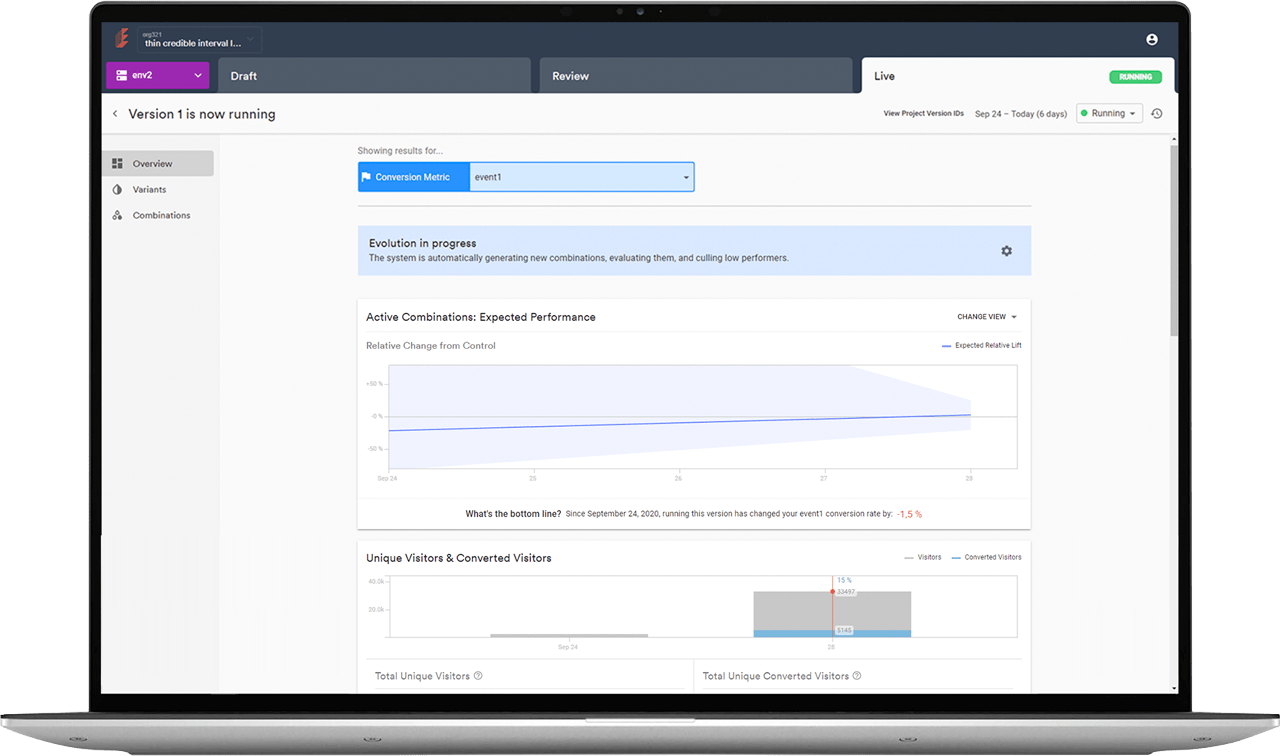
See how Redwerk rebuilt the front end of an AI optimization platform running evolutionary algorithms