Have you ever thought of the automotive industry’s supply chain management as a high-performance engine in the vehicle of the auto business? Meaning, it’s a core component that drives you to success at breakneck speeds. But should it fail, it won’t matter how good your other processes are, you won’t be able to move forward at all.
Today, we will talk about automotive supply chain challenges and solutions, and offer some ideas for how to make it when you are only one tiny element in the exceedingly complex global supply infrastructure. Most importantly, we will explain how automotive software development can help you stay on top of this ever-changing industry using real-life solutions built by Redwerk experts.
What Is a Strategic Approach to Automotive Supply Chain Optimization?
Before building anything, you need a blueprint, meaning you need a strategic supply chain framework for the automotive industry. In simpler words, it’s a master plan that shows how materials, information, and decisions flow across your entire business.
A good framework doesn’t just describe how things move from point A to point B. It aligns three layers of your organization:
- Your business strategy: where you’re headed.
- Your operations: how work actually gets done.
- Your technology: the tools that make it all possible.
When these three are in sync, every decision from the boardroom to the warehouse floor pulls in the same direction. Therefore, your priority must be to always think strategically, which will allow you to prevent the majority of automotive supply chain issues that are sure to pop up down the line.
Core Components of an Automotive Supply Chain Management Framework
Most modern supply chain frameworks are organized around five core processes. These aren’t unique to any single company — they reflect a widely accepted model for how supply chains work. But how you execute them is where automotive logistics software development can make all the difference.
- Planning
Demand forecasting and production strategy determine what you’ll build, how much, and when. Get this wrong, and you’re either sitting on unsold inventory or scrambling to fill orders you can’t meet. - Sourcing
Managing your supplier network is about more than finding the cheapest parts. It’s about building relationships, monitoring performance, and having backup options when your primary supplier can’t deliver. - Production
The manufacturing floor is where raw materials become real products. Quality control, assembly efficiency, and the ability to scale up or down quickly all live here. - Delivery
Logistics and distribution deliver the finished product where it needs to go — on time and in one piece. This includes everything from warehouse management to last-mile delivery. - Returns and lifecycle
The supply chain doesn’t end at the point of sale. Aftermarket parts, warranty returns, recycling, and end-of-life management are all part of the picture, and increasingly important as automotive supply chain sustainability becomes a competitive differentiator.
Now that you understand the framework’s outline, see how custom automotive supply chain solutions can fit into it and boost overall performance and productivity.
- Unified Visibility Across Tiers
See your entire supplier network — not just the first layer — in one place. - Real-Time Planning and Scenario Modeling
Run ‘what if’ simulations before making big decisions, based on live data rather than last month’s report. - Seamless Integration
Connect your ERP, logistics platforms, and supplier systems so information flows automatically instead of being copied between tools.
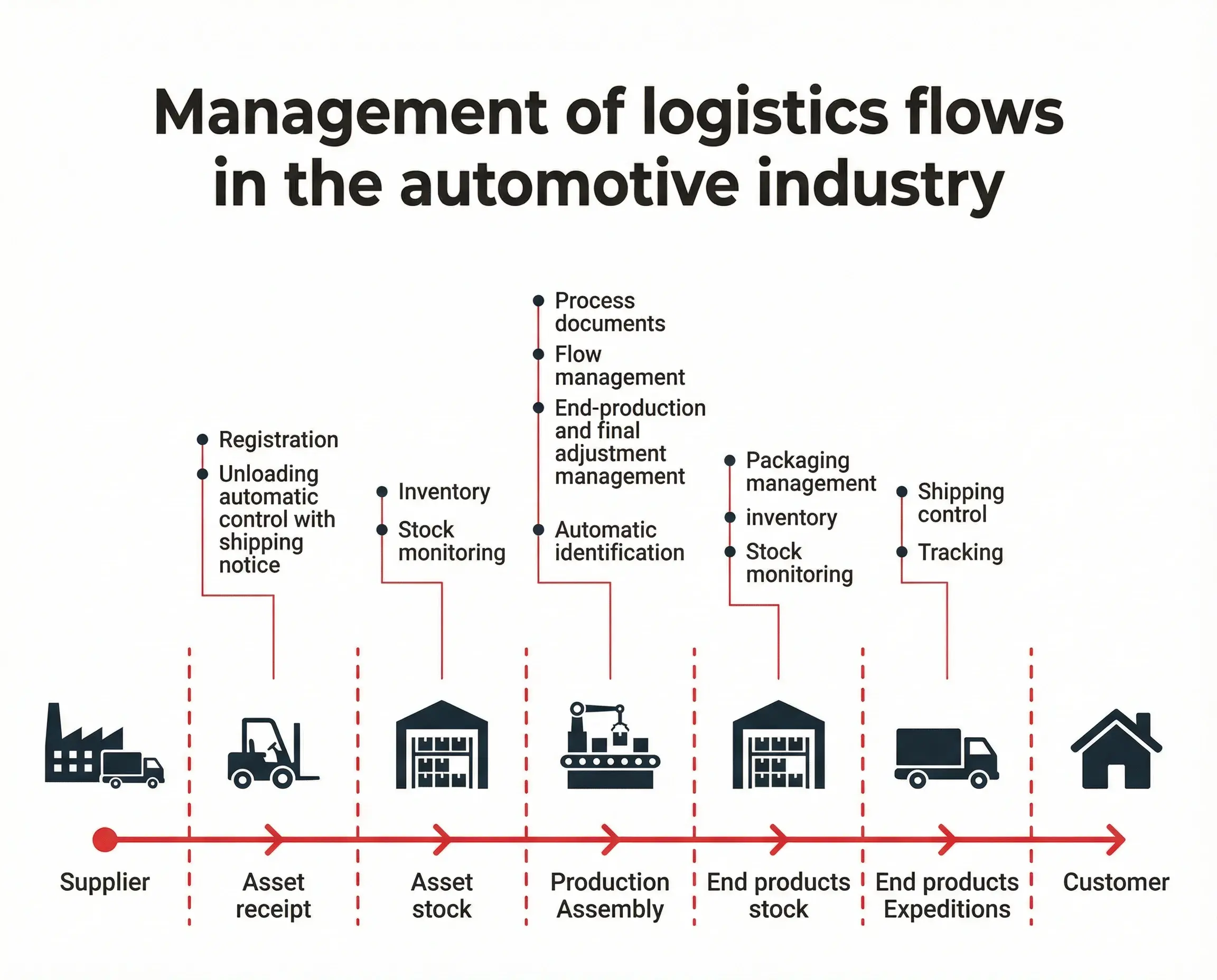
For more ideas on where to implement an automotive supply chain solution tailored to your business, check out the flow below.
Your How-To Guide for Automotive Supply Chain Risk Management
The main challenge of supply chain risk management in the automotive industry is that everything is connected. A single-source supplier shutting down in one country can halt production lines on a different continent within days. Just look at what happened to global supply chains during the COVID-19 pandemic.
The most common risks relevant to the auto industry supply chain include:
- Supplier Dependency
Relying too heavily on a single supplier — or a single region — means that a single disruption can knock out a critical part of your production. - Demand Volatility
Consumer preferences shift, new competitors emerge, and economic conditions change. If your forecasting can’t keep pace, you’re always a step behind. - Geopolitical and Logistics Disruptions
Trade restrictions, natural disasters, and transportation bottlenecks are unpredictable and increasingly frequent. - Quality and Compliance Risks
A defective component that slips through can trigger recalls, legal liability, and lasting brand damage.
A practical approach to risks in the automobile industry supply chain management should include:
- Supplier Risk Segmentation
A smart approach is to categorize your suppliers based on two factors: the risk they pose and their criticality to your business. This kind of segmentation stops you from spreading your risk management efforts too thin. You focus your energy where it matters most. - End-to-End Visibility
End-to-end visibility is like having a live traffic map for your entire automotive manufacturing supply chain. You see where materials are, which suppliers are on track, where bottlenecks are forming, and where things are moving smoothly. Therefore, you can take immediate action if an issue arises. - Collaborative Planning
When you and your key partners share demand forecasts, inventory levels, and production schedules, everyone can adjust together rather than react alone. Collaborative planning creates a more cost-efficient supply chain.
How Automotive Supply Chain Software Minimizes Your Risks
The difference between reacting to a crisis and preventing one often comes down to information. It means that you need to ensure the right data gets to the right hands at the right time. In this context, a custom automotive supply chain solution offers capabilities that generic tools simply can’t match:
- Forecasting and Scenario Testing
Did you know that one area of AI software development is creating machine learning (ML) models that can run a variety of simulations and generateforecasts? Simply put, we can create a virtual copy of your supply chain (a digital twin) and simulate a wide range of disruption scenarios, such as port closures, extreme weather, and price hikes. These models can not only help you prepare for every imaginable scenario but also forecast the probabilities of different issues based on real-time and historical data analysis. Predictive Maintenance
Manufacturing software development delivers products of exceptional value in process automation that can be implemented across multiple areas of the automotive industry. However, one of its greatest strengths in a car manufacturing supply chain is that custom solutions can be programmed to evaluate the condition of machinery or your vehicle fleet and alert you before a problem occurs. It means that when a risk threshold is crossed, the right people are notified immediately. No waiting for someone to spot the problem in a spreadsheet or for the equipment to break down and stop your manufacturing or delivery line. Predictive maintenance solutions powered by your data will minimize incidents.
Automotive Supply Chain Challenges and Solutions
If your business has any stake in the automotive supply chain and logistics management today, these challenges probably sound familiar:
- Multi-Tier Supplier Network Complexity
Your direct suppliers have their own suppliers, who have their own suppliers. The challenge is gaining visibility across all tiers to forecast and manage your own risks. - Demand Volatility and Shorter Product Cycles
Market competition pushes companies to refresh models and introduce new features at a pace that makes long-term production planning a moving target. The challenge is to have enough foresight and capability to predict and fit within rapidly changing automotive supply chain trends. - Rapid Tech Innovation
The shift to electric vehicles is reshaping the entire supply base, which in turn is affecting the automotive industry supply chain. The main challenge is that you are constantly forced to rebuild entire sourcing strategies from scratch.
Automotive Supply Chain Solutions Enabled by Custom Software Development
These challenges are real, but they’re not unsolvable. Custom software platforms can address each of them head-on. Here are some concepts of solutions that can make the biggest difference in supply chain management for the automobile industry:
- Supply Chain Control Towers
A control tower is a central dashboard that pulls data from across your supply chain into a single view. Instead of switching between five different systems to understand what’s happening, your team sees everything — inventory levels, shipment status, supplier performance, demand signals — in one place. - Advanced Planning and Forecasting Platforms
AI-driven planning platforms analyze patterns across massive datasets — sales history, market trends, weather, economic indicators — to produce forecasts that are more accurate and more responsive to change. When the market shifts, the system adjusts in near real time, making it integral to the future of automotive supply chain management. - Supplier Collaboration Portals
With a unified collaboration portal, your suppliers can update their delivery timelines, share quality reports, and flag potential issues directly. You get real-time performance tracking, and your suppliers get a clearer picture of your expectations and needs. Developing and implementing such a product must be an essential part of any digital transformation strategy. - Traceability and Compliance Systems
In an industry where a single defective component can trigger a million-dollar recall, traceability isn’t optional. Custom-built systems track every part through every stage of production — where it came from, who handled it, and whether it met quality standards. When regulators come calling, you have the answers ready. This traceability is another integral feature that must be included in digital transformation models for automotive businesses. - Automation and Workflow Orchestration
Workflow automation handles repetitive tasks, such as sending status updates, chasing approvals, and reconciling data between systems. Orders flow automatically, exceptions are flagged instantly, and nothing falls through the cracks. Custom software automation can completely revolutionize supply chain management in the automotive industry, enabling you to eliminate redundant roles, reduce costs, and optimize workflows for maximum efficiency.
Automotive Supply Chain Process Optimization: Redwerk Expertise
When we talk about automotive supply chain management software, we draw on experience from developing multiple successful products for clients across various fields. As we mentioned before, the challenge of modern supply chains is their complexity. Therefore, supply chain analytics in the automotive industry are affected by supply chains for raw materials mining, transformation, and manufacturing that turn those materials into parts. That’s not even mentioning the effect that the global fuel supply chain has on every business on the planet.
So, the supply chain infrastructure is exceedingly complex. And this is how Redwerk helped some of our clients to overcome the challenges they face in it:
- Web + Mobile Apps for Inventory Management & Logistics
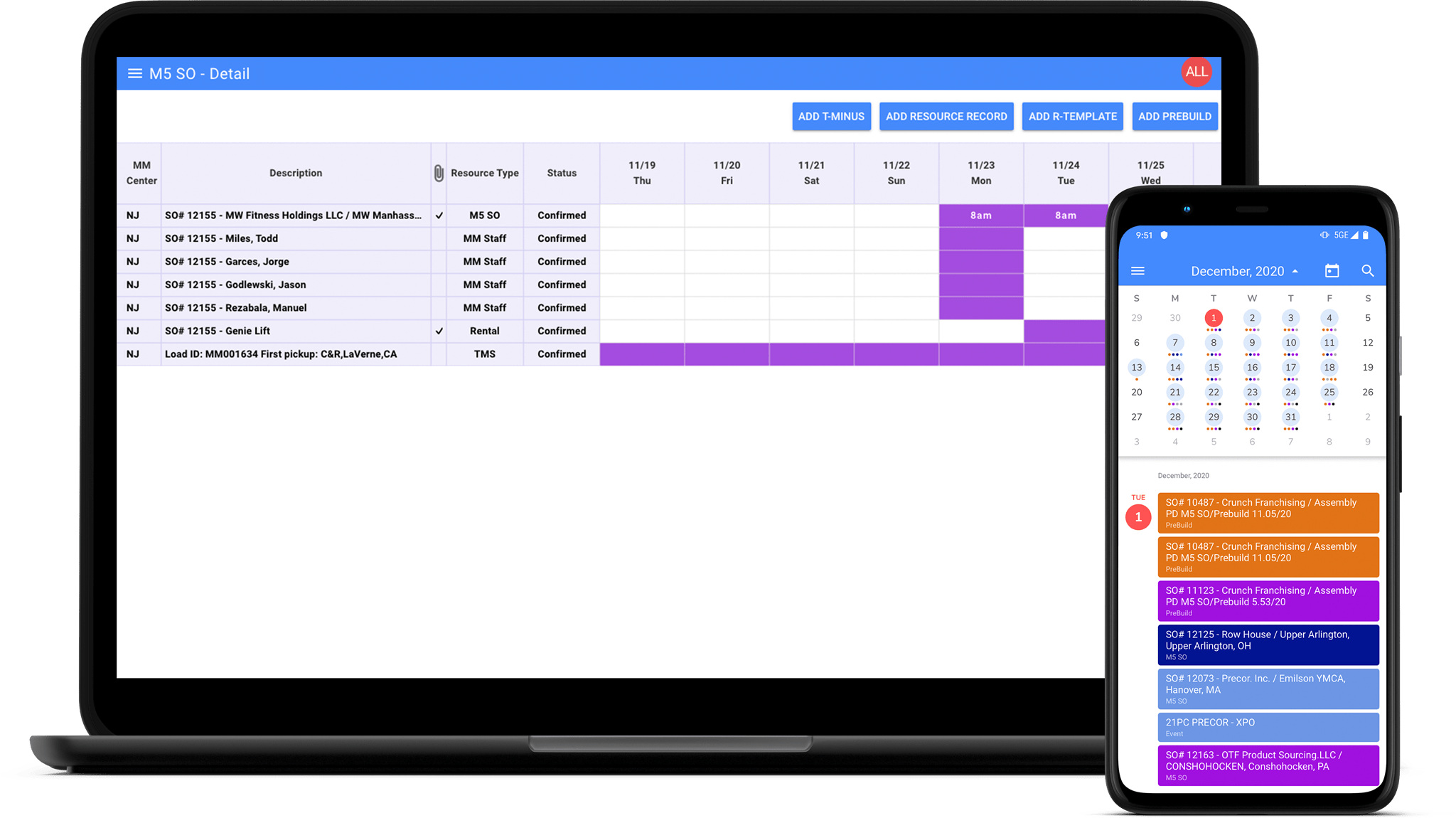
Our client, Mass Movement, needed a comprehensive, multi-platform inventory management system that must include features such as inbound and outbound truck tracking, packing list, warehouse item tracking, and reporting, among others. We created a platform that allowed the client to manage their entire equipment base, its transportation and distribution among clients, and warehouse management. Moreover, the platform can be easily accessed from any device. In terms of supply chain solutions for the automotive industry, a similar product can help you manage your entire business, regardless of where you stand in the chain, or monitor it in its entirety. - Automated Smart Pricing Solution
We developed a 100% unique product for KillerBee that can effectively work with legacy systems while offering all the benefits of modern SaaS. It’s a fully automated smart pricing platform that accounts for pricing tiers, real-time competitor data, and heat maps. This would be an invaluable tool for automotive supply chain analytics and management in real-time. - Custom Web App and API for a Sustainability Startup
We developed a complex, tailored solution for a sustainability-focused business. Essentially, this was a custom ‘supply chain’ but for cups. The idea is simple: the user gets a drink in a Kooky cup, then drops it off at a designated spot so the cup can be processed and reused while the user gets their initial deposit back. Kooky needed a product to manage the entire cup’s journey in their initiative, including a portal for partner businesses, such as shops and restaurants. We created such a solution that also includes features such as an interactive map, Kooky Box sync, and cup batching for deliveries, to name a few. You can find and use dozens of Kooky Boxes all over Zurich and Basel today. - Market Assessment Software
For our client Market Bee, we developed a web-based visualization tool that integrated with Power BI. Combining custom software development with existing tools enabled us to stay within the client’s budget while delivering the tailored tool they needed to perform real-time calculations and provide immediate data output and visualization for decision-making. If you are building a supply chain strategy in the automotive industry, a similar tool can help you make smart decisions and adjust them dynamically to maximize your chances of staying on top.
Do any of these examples sound like something you need? Contact us and let’s start talking!
If you aren’t sure where to start, we will gladly provide a consultation and help you define your plans and goals.
See how we helped Mass Movement boost their revenue to $2.74 billion after joining assets with J.B Hunt