What does a great TypeScript code review actually check? It answers one practical question: Does this update strengthen the system or introduce risk as it grows? A strong review examines how data shapes are modeled, how modules communicate, and how safely new logic moves through the architecture. Gartner’s Top Strategic Trends in Software Engineering 2025 notes that AI-native development is reshaping review workflows, with nearly 90% of developers expected to use AI coding assistants by 2028. It makes structural clarity and type accuracy even more critical in pull-request reviews.
Think of the review like inspecting a structural beam before adding another floor. The goal is to confirm that the new logic fits the load and maintains the structure’s stability. This article breaks that beam inspection into five clear pillars, giving you a practical framework for evaluating the shape of your system and keeping it clean as it grows.
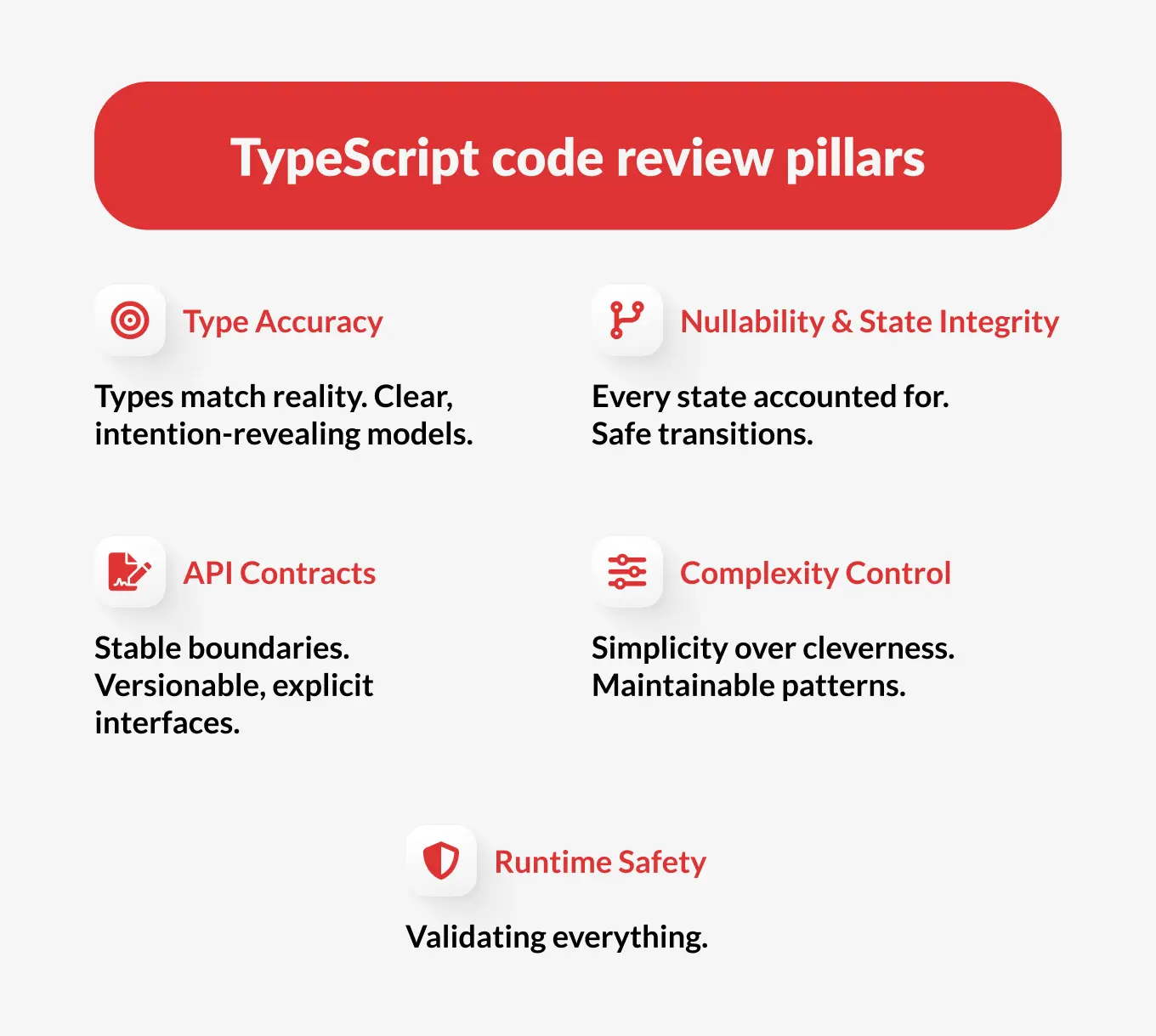
The 5-Pillar TypeScript Code Review Checklist
A solid TypeScript code review checklist focuses on the structural decisions that determine whether your system scales smoothly or slows down under its own weight. Each pillar acts as a checkpoint, keeping the project stable, predictable, and easy to evolve. This guide walks through the five areas that matter most when reviewing code with long-term maintainability in mind.
Type Accuracy
Type accuracy is the foundation of TypeScript code quality. When types reflect the real data your system works with, runtime behavior becomes predictable across features, APIs, and even UI layers like React. Clean modeling starts with narrow, intention-revealing types that stay consistent everywhere they’re used.
A few quick checks help keep type accuracy in line:
- Ensure every type reflects real domain data
- Avoid vague shapes and duplicated interfaces that dilute meaning
- Replace casual or unclear usage with precise, intention-revealing types
- Use consistent models so reviewers can instantly understand expectations
Accurate types speed up development by reducing guesswork and preventing the codebase from drifting into confusion. Besides, type safety in TypeScript is achieved by accurately modeling the domain, validating untrusted data, and letting the compiler enforce correctness instead of bypassing it.
Nullability and State Integrity
A large portion of issues caught during TypeScript code review best practices stems from unhandled null or undefined values. Even a well-modeled system becomes fragile when states slip through unchecked. A thorough process examines how data flows through a feature and whether each step anticipates missing, partial, or delayed information.
A few quick checks help keep nullability under control:
- Use strictNullChecks. If it’s not used, null and undefined are effectively ignored by the language. This can lead to unexpected errors at runtime
- Prefer exhaustive switch statements and safe narrowing
//  ❌ The "Silent Failure" Switch

type UserRole = 'ADMIN' | 'EDITOR' | 'GUEST';

function getPermissions(role: UserRole) {
  switch (role) {
    case 'ADMIN':
      return ['all'];
    case 'EDITOR':
      return ['edit'];
    case 'GUEST':
      return ['view'];
    // What happens if we add 'MODERATOR' to the type?
    // This function returns undefined, and the app might crash.
  }
}


// ✅ The never Check (Exhaustiveness)
// By assigning the default case to a variable of type never, TypeScript will throw a compile-time error if any case is missed.

type UserRole = 'ADMIN' | 'EDITOR' | 'GUEST' | 'MODERATOR';

function getPermissions(role: UserRole): string[] {
  switch (role) {
    case 'ADMIN':
      return ['all'];
    case 'EDITOR':
      return ['edit'];
    case 'GUEST':
      return ['view'];
    case 'MODERATOR':
      return ['moderate'];
    default:
      // If 'MODERATOR' wasn't handled above, TypeScript would flag an error here:
      // Argument of type 'string' is not assignable to parameter of type 'never'.
      const _exhaustiveCheck: never = role;
      return _exhaustiveCheck;
  }
}
- Treat external data as unsafe until validated within the code review checklist
- Identify places where missing values could break UI, API, or business logic
- Apply thoughtful refactoring to ensure state handling stays predictable as data evolves
- Verify that every state transition accounts for null and undefined explicitly:
//❌ Trust received data and avoid type checking
function getUsername(user: User | null) {
  // If user is null, this crashes.
  return user!.profile.name;
}

try {
  saveUser(user);
} catch (e) {
  console.log(e.message); // 'e' is 'unknown' or 'any'. This might crash if e isn't an Error object.
}


// ✅ Use discriminated Unions and Type Guards
type Result =
  | { success: true; data: T }
  | { success: false; error: string };

function safeGetUsername(user: User | null): Result {
  // Explicit null check
  if (!user) {
    return { success: false, error: "User not found" };
  }
  return { success: true, data: user.profile.name };
}

// Exhaustive checking
const result = safeGetUsername(currentUser);
if (result.success) {
  console.log(result.data); // TypeScript knows data exists here
} else {
  console.log(result.error); // TypeScript knows error exists here
}

// For catch blocks:
try {
  // ...
} catch (err) {
  if (err instanceof Error) {
    console.error(err.message);
  }
}
This pillar keeps reviews grounded in runtime reality, ensuring code remains stable even as inputs change over time.
API Contracts Built to Last
Stable API contracts sit at the core of TypeScript code standards. When return types are explicit and interfaces stay consistent, each layer of the system — backend, services, or even UI teams following a React code review checklist — can rely on predictable shapes and behavior. This prevents boundary drift, where subtle mismatches start creating confusion across teams.
Trouble begins when internal details leak across layers or when endpoints return slightly different structures depending on execution paths. These small cracks eventually surface as slow and costly debugging sessions.
A few quick checks keep API contracts stable:
- Ensure return types are explicit and consistent across all execution paths
- Keep domain models internal, expose only mapped, public-facing shapes
- Version interfaces when changes are unavoidable instead of mutating existing ones
- Validate request and response boundaries so discrepancies don’t spread across the system
Clear contracts scale cleanly, reduce rework, and keep integrations frictionless as the platform grows.
A simple demo of how dangerous the lack of structured typing of API requests:
// ❌  Implicit Exports and "Any": Exposing internal implementation details or using any which hides the contract.
// internal-service.ts
export async function fetchConfig() {
  const res = await fetch('/api/config');
  return res.json(); // Returns 'any' - the consumer has no idea what's inside
}

// consumer.ts
import { fetchConfig } from './internal-service';
const config = await fetchConfig();
console.log(config.apiUrl); // No error here, but fails at runtime


// ✅ Define a strict contract and use Readonly to prevent consumers from mutating your internal state.
// contract.ts
export interface AppConfig {
  readonly apiUrl: string;
  readonly timeout: number;
  readonly features: {
    readonly enableBeta: boolean;
  };
}

// service.ts
export async function fetchConfig(): Promise {
  const res = await fetch('/api/config');
  const data = await res.json();
  return data as AppConfig;
}

// consumer.ts
const config = await fetchConfig();
// config.apiUrl = "http://malicious.com"; // Error: Cannot assign to 'apiUrl' because it is a read-only property.
Complexity Control
Readable code outperforms clever code every time. When logic is wrapped in unnecessary generics or abstracted into type patterns that no one can decode, future work slows, and onboarding becomes expensive. Good structure improves TypeScript performance by providing clarity that lets developers move without hesitation.
A few quick checks help keep complexity in line:
- Favor clear naming, small functions, consistent patterns, and minimal cognitive load
- Complex generics or conditional types should be well-documented
- Run type-checking performance using generateTrace to identify bottlenecks
- For large monorepos, use TypeScript project references to break the codebase into smaller, independent chunks that can be type-checked in parallel and cached
Clear code ages well and supports every contributor, and not just the person who wrote it.
Runtime Safety
TypeScript checks compile-time assumptions, but real data doesn’t always follow the rules. That gap is where most hidden failures come from. A solid review looks at how the code handles unpredictable inputs, such as API responses that shift or third-party services that lag.
Key points to verify:
- External inputs are validated before being trusted
- API responses use safe parsing instead of assumptions
- Union types are handled exhaustively
- Edge cases, like empty arrays and missing fields, partial payloads, are covered
When runtime behavior is treated with the same care as type modeling, the system stays stable under pressure. It can more easily adapt to real-world data variations and avoid the subtle bugs that surface only after deployment.
Red Flags in a TypeScript Code Review
Some patterns in a TypeScript code review aren’t random; they signal deeper maintenance issues that tend to grow over time. Code quality and structure directly affect how easy it is to maintain and evolve a system. One of the recent studies found that type-rich codebases like those using TypeScript exhibit better understandability and maintainability than their dynamic counterparts when type discipline is respected.
Red flags/Type accuracy:
- Avoid using any to “fix” compiler errors
- Avoid complex “type-level programming” that leads to massive, deeply nested inferred types
- Avoid overly broad types should be avoided – types like string, object, or {} when a narrower type is possible reduce safety
An example demonstrating the danger of using the “any” operator and not type checking:
// ❌ any disables type checking
function getUserAge(user: any) {
  // Trusts API response blindly and assumes profile and age exist.
  // Crashes if null / undefined or wrong shape is returned.
  return user.profile.age.toFixed(0);
}

const user = await fetch('/api/user').then(r => r.json());
getUserAge(user);


// ✅ No any
// ✅ Invalid states are modeled explicitly
// ✅ null is handled intentionally
// ✅ External data is treated as unknown before use
enum UserStatus {
  Active,
  Inactive,
}

type User =
  | { status: UserStatus.Active; age: number }
  | { status: UserStatus.Inactive };

function getUserAge(user: User): number | null {
  return user.status === UserStatus.Active ? user.age : null;
}

const raw: unknown = await fetch('/api/user').then(r => r.json());

if (raw && typeof raw === 'object' && 'status' in raw) {
  getUserAge(raw as User);
}
Identifying these patterns early keeps the system flexible and reduces the risk of costly rewrites later.
How Strong TypeScript Reviews Protect Delivery
A disciplined TypeScript code review process keeps delivery cycles predictable and reduces costly last-minute fixes. When types clearly express data structures and boundaries, new team members understand the codebase faster, and regression bugs drop significantly. The NIST Software Assurance Reference Dataset (SARD) highlights how explicit data contracts and rigorous validation correlate with lower defect incidence and fewer unpredictable runtime failures — the same principles TypeScript enforces at compile time.
A practical example of this dynamic played out at Pinterest, when the engineering team migrated 3.7 million lines of code from Flow to TypeScript. Their developers reported cleaner interfaces, fewer shape-related issues, and greater confidence when merging large changes. Clear contracts made it easier to reason about the system, leading to faster feature rollouts and fewer integration surprises.
That’s an example of how strong reviews safeguard momentum and help teams build new capabilities without introducing uncertainty into the codebase.
TypeScript Code Review Best Practices
A good review process feels more like air traffic control than bureaucracy. You keep things moving smoothly, prevent collisions, and make sure every change lands safely. The goal is clarity, whether you handle reviews internally or rely on external code review services to keep quality consistent.
Authors set the tone by preparing pull requests with intent. A clear explanation of why the change exists gives reviewers the context they need to assess structure instead of guessing at motivations.
Reviewers start at the architectural level: data contracts, boundaries, and long-term impact. Formatting and micro-details come later, if at all. To keep feedback sharp and predictable, use simple categories:
- Blocker: breaks safety or architectural guarantees
- Concern: intent unclear or introduces future fragility
- Suggestion: an opportunity for simplification or better alignment
Time-box reviews to maintain momentum. When everyone understands the purpose of the change and the shared language for discussing it, code moves forward quickly.
Predictability Starts With the Review
TypeScript delivers real leverage when types are reviewed with the same discipline applied to architecture. When teams evaluate data shapes, boundaries, and state transitions with intent, they eliminate the category of bugs that usually surface only under scale. The five pillars outlined here create a predictable development environment, where onboarding is faster and delivery stays on track.
Strong reviews shape the long-term health of the codebase. They reduce future maintenance costs and give every contributor a clear mental model to build on. This is how TypeScript becomes an accelerant instead of overhead: through structure, clarity, and deliberate review.
If you want your TypeScript foundation to scale cleanly and support your product’s next stage of growth, reach out — we’ll see how to make that journey smoother and faster.
See how we helped an IT quoting platform strengthen its architecture and unlock long-term scalability