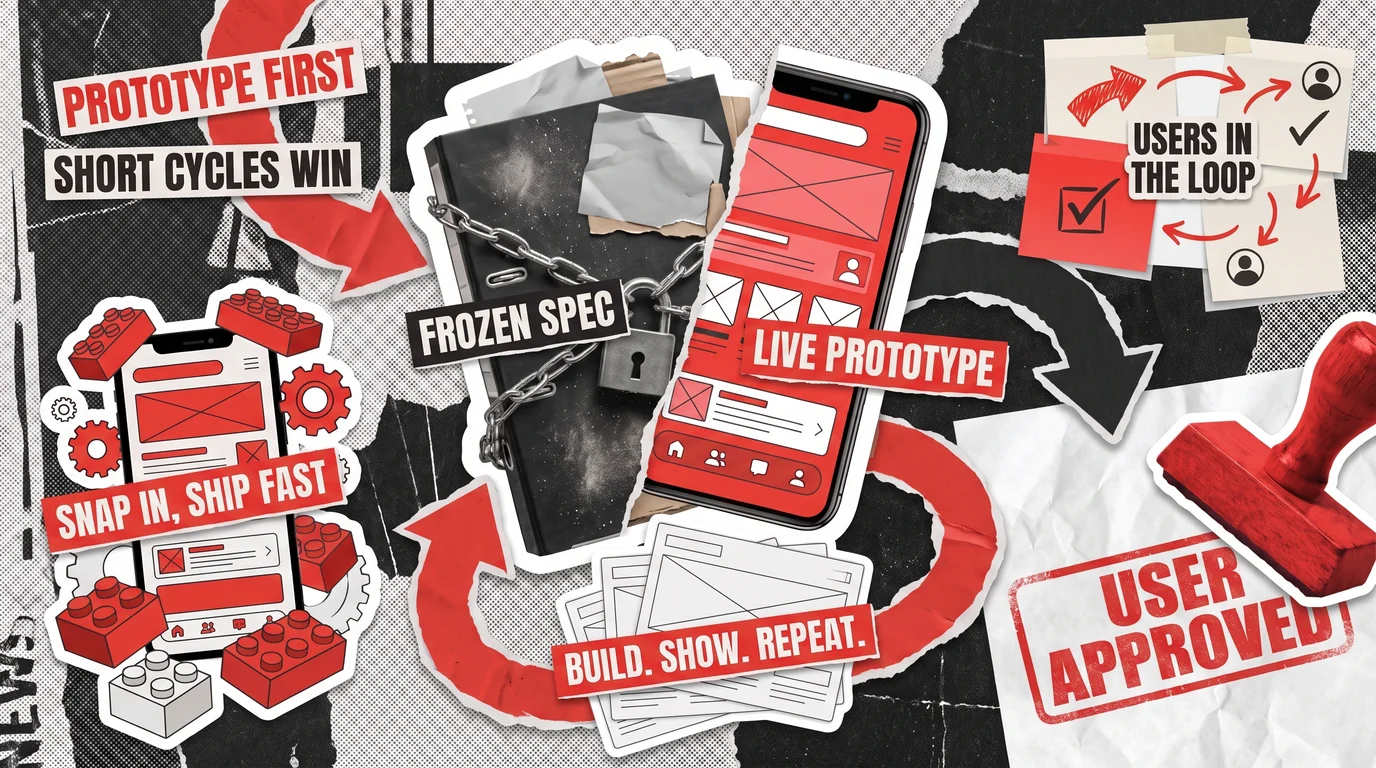
Rapid application development is a software delivery approach that replaces long upfront specifications with working prototypes, frequent user feedback, and short build cycles, so a usable product reaches people in weeks. The idea predates Agile by a decade. Today it is usually marketed alongside low-code platforms, which blurs a simple fact: RAD is a methodology, and a tool delivers it only when the process around it follows the method. For a founder or product manager, the practical question is whether the project, the team, and the stakeholders can support that pace. Below we cover the four phases, a side-by-side comparison with Agile and Waterfall, the projects where RAD pays off, the ones where it backfires, and how we apply it to custom-coded builds.
What Rapid Application Development Means
RAD is an iterative model in which users and developers shape the product together through a series of working prototypes. Each prototype answers a specific question about screens, data, or workflow, and the answers feed the next build. Documentation stays light because the prototype itself carries most of the requirements.
The term comes from British IT consultant James Martin, who formalized the approach in a 1991 book of the same name, building on iterative methods trialed through the 1980s. He was reacting to Waterfall projects where requirements froze early and users saw the result months or years later, often after their needs had moved on. Ideas such as timeboxed delivery and joint user workshops later resurfaced in the Agile Manifesto of 2001.
The central promise is simple: put working software in front of real users early and let their reactions steer the build. The pressure behind it has only grown. The PMI Pulse of the Profession 2026 found that 31% of complex projects fail to deliver their full intended benefits, more than double the 12% PMI reported in 2024, and it ties much of the change to scope shifting faster than the original plan.
The Four RAD Phases
The RAD methodology phases run as a loop, with the middle two repeating until users sign off on what they see. Planning happens once, and cutover happens once per release, while design and construction cycle as many times as the timebox allows.

Requirements Planning
Business owners, key users, and the delivery lead agree on the problem, the scope boundary, and the fixed constraints, such as budget, compliance, or a launch date. The output is a short scope statement and a prioritized list of capabilities, often a few pages in place of a full specification. In our experience, the most useful artifact from this phase is a named list of users who commit to reviewing prototypes, because every later phase depends on their availability.
User Design and Prototyping
Designers and developers turn the capability list into clickable or partially working prototypes, then walk users through them in short review sessions. Early rounds often use a design tool such as Figma to validate flows within hours. Later rounds run on real code with real data, so users can test edge cases, permissions, and performance. Each session produces a list of changes that goes straight into the next iteration.
Rapid Construction
Developers build the production version in short timeboxes, reusing components, templates, and services wherever they exist. Users keep testing each increment, so construction and design overlap: a review may send a screen back for redesign while backend work continues. Testing runs alongside development, which is why automated tests and a continuous integration pipeline matter more in RAD than in a sequential project. The practical risk here is technical debt. Speed pressure tempts teams to skip refactoring, so a healthy RAD team budgets cleanup time inside each cycle.
Cutover and Handover
Cutover covers everything between an approved build and people using it daily: data migration, final testing, user training, deployment, and support setup. This phase is compressed in RAD because users already know the system from prototype reviews, so training is shorter and adoption starts sooner. For custom builds we also treat handover as documentation of the architecture and the decisions behind it, so the next team, internal or external, can extend the product without reverse engineering it.
Core Principles Behind RAD
Five principles hold the method together, and dropping any one of them slows the whole loop. The first is iteration over specification: teams accept that requirements will shift and use working prototypes to discover them, trading documentation effort for review effort. The second is active user involvement, meaning the people who will use the system join reviews every cycle, while a product manager supplements their input as a proxy.
Small cross-functional teams are the third principle. Martin’s original teams were compact groups where designers, developers, and business representatives worked side by side, and decisions happened in the review session instead of through a change request. Reusable components come fourth, since speed depends on assembling proven parts over writing everything from scratch. Timeboxing closes the list: each cycle has a fixed end date, and scope flexes to fit it. A feature that outgrows the box moves to the next cycle, which keeps delivery dates credible for stakeholders who plan budgets around them.
RAD vs Agile vs Waterfall
The three models answer the same question differently: how much should a team know before it starts building? Comparing RAD vs Agile vs Waterfall on the criteria below helps a project manager choose based on the project itself.
Cadence
Timeboxed prototype cycles of days to a few weeks, aimed at a release
Fixed sprints of 1 to 4 weeks, each ending in a usable increment
Sequential phases, one release at the end
Planning depth
Light upfront plan, requirements emerge from prototypes
Backlog refined continuously
Full specification signed off before design
User involvement
Intensive, users review every prototype
Regular, through a product owner and sprint reviews
Heavy at the start and at acceptance testing
Team size
Small, tightly connected group
Small teams, scaled through multi-team frameworks
Any size, often large and specialized
Best-fit project
MVPs, internal tools, UI-heavy apps with clear owners
Evolving products with long roadmaps
Fixed-scope, regulated, or hardware-bound systems
Main risk
Scope creep and technical debt under time pressure
Drift without a clear product vision
Late discovery that requirements were wrong
Labels alone guarantee little. A September 2026 GAO assessment found that 10 of 18 US Department of Defense IT business programs reported using Agile and iterative approaches, yet 8 of those 10 did not report or demonstrate the required metrics for tracking customer satisfaction and development progress. An iterative plan works only when the feedback loop is measured.
RAD sits between the two other models. It keeps some of Waterfall’s structure, with a defined planning phase and a distinct cutover, and borrows the feedback loop that later defined Agile. The main difference from Agile is rhythm: RAD compresses design and construction into intensive prototype rounds aimed at a release, while Agile keeps a steady sprint flow for as long as the product lives. Many teams blend the two, running RAD-style prototype rounds at the start and moving to a sprint cadence once the product is live and the backlog becomes the main planning tool, which is where agile software development practices take over.
Best-Fit Projects for RAD
RAD pays off when the scope is clear enough to timebox and the people who judge the result can meet the team often. Four project types match that profile consistently.
- Well-scoped MVPs. A startup or a new product line needs to test one core promise with real users, and prototype rounds show quickly which features matter. Well-run MVP development services follow the same logic, with the first release limited to the smallest feature set that proves the idea.
- Internal tools. Operations dashboards, admin panels, and workflow apps have users within reach who can review a prototype this week.
- Portals with committed stakeholders. Customer, partner, or employee portals work well when a business owner has the authority to approve screens and settle conflicting requests.
- Prototypes for investor demos. A working demo built in a few cycles shows investors real user flows, and the same code can seed the production build when the architecture is planned for it from day one.
Practical Limits of RAD
The traits that make RAD fast also create four scoping conditions worth checking before a project starts. Large multi-team enterprise rollouts strain the model, because prototype feedback has to be coordinated across many teams and integration points, and the review loop slows to the pace of the slowest dependency. Splitting such programs into smaller, independently deliverable modules often restores the rhythm.
Safety-critical and regulated systems, such as medical devices or payment clearing, need traceable requirements and formal verification, so RAD suits their user-facing layers better than their core. Projects whose users cannot join regular reviews lose the method’s main input, and a proxy stakeholder rarely fills that gap for long. Fixed-scope, fixed-price contracts clash with scope that flexes each cycle, so a time-and-materials model or a fixed budget with flexible scope aligns incentives better.
RAD in Custom Development, Not Only Low-Code
Low-code platforms speed up RAD with visual builders and prebuilt connectors, and for simple internal apps they can be the right call. The trade-offs appear as the product grows: licensing tied to one vendor, limits when business logic outgrows the builder, and a migration project if the app needs to leave the platform.
Custom code reaches similar speed through engineering practices. A componentized codebase with a shared design system, documented in a tool like Storybook, lets a team assemble new screens from tested parts. Feature flags, managed with a tool such as Unleash, let unfinished features ship to production hidden and open only to a pilot group for review. A CI/CD pipeline in GitHub Actions or Azure DevOps turns every approved change into a deployable build, and frameworks such as Django or ASP.NET Core get a working prototype running on real data within days.
AI coding assistants add another boost. In a March 2026 survey of 65 developers, over 70% reported at least halving the time spent on boilerplate and documentation, while planning and requirements analysis showed markedly lower gains. That gap is exactly where RAD’s user reviews do their work. The payoff of the custom path is ownership, since the prototype evolves into the production system without a platform migration. Deciding which parts suit a builder and which need code is a scoping call worth making early, and software development consulting at the start of a project can map it.
How Redwerk Delivers RAD-Style Projects
Our delivery model shares RAD’s core loop and runs it through custom code. Projects start with MVP-first scoping, where we and the client’s stakeholders agree on the smallest release that proves the product’s value, then move into 2-week sprints. Each sprint ends with a review in which stakeholders click through working software, and their feedback sets the next sprint’s priorities. Releases go out iteratively, so users see progress every few weeks and the budget follows visible results.
The same rhythm works when specifications are incomplete. OpenTeams came to us with a vision for an open source contribution platform and no finished specification, so we started with refactoring and CI/CD setup, then built features in increments on Vue.js and Nuxt.js. For 1Amped’s web-based circuit simulator, a discovery phase with requirements engineering, sketches, and wireframes came before any code, giving the team a validated design before construction began.
Getting Started with a Fast-Turnaround Build
Fast delivery rests on three pillars. A clear scope gives each timebox a target, engaged users turn every prototype into a decision, and short cycles keep mistakes small and cheap to fix. With all three in place, a team moves from idea to a working release while stakeholders stay confident about where the budget goes. If one pillar is missing, fix it before writing code by narrowing the scope, securing reviewer time, or agreeing on a sprint rhythm. If you are planning an MVP, an internal tool, or a portal and want a senior team that works in short, visible cycles, contact us to discuss your project.
Frequently Asked Questions
Is RAD the same as Agile?
They are related but distinct. RAD came first, formalized by James Martin in 1991, and influenced the Agile Manifesto of 2001. Both rely on iteration and user feedback. RAD concentrates that feedback into intensive prototype rounds aimed at a release, while Agile runs fixed-length sprints for the life of the product, guided by a backlog and a product owner.
What are the four RAD phases?
The four phases are requirements planning, user design and prototyping, rapid construction, and cutover. Planning sets scope and constraints. Design and construction repeat in short cycles with users reviewing each prototype, and cutover handles data migration, testing, training, and deployment. The middle two phases loop until users approve the result, which is where the speed comes from.
When is RAD a poor fit?
RAD struggles on large programs spanning many teams, on safety-critical or heavily regulated systems that need formal, traceable requirements, and on projects where users cannot attend regular reviews. Fixed-scope, fixed-price contracts are another mismatch, because RAD expects scope to flex within each timebox. In these cases, a hybrid or more sequential approach usually carries less risk.
Does RAD require a low-code platform?
RAD is a methodology, so any delivery path that supports fast prototyping and frequent feedback can apply it. Low-code platforms are one option. Custom-coded projects reach comparable speed with reusable components, design systems, feature flags, and CI/CD pipelines, and they keep full ownership of the code as the product grows.
See how an iterative, user-tested build turned an anonymous web3 messenger into a product acquired within months