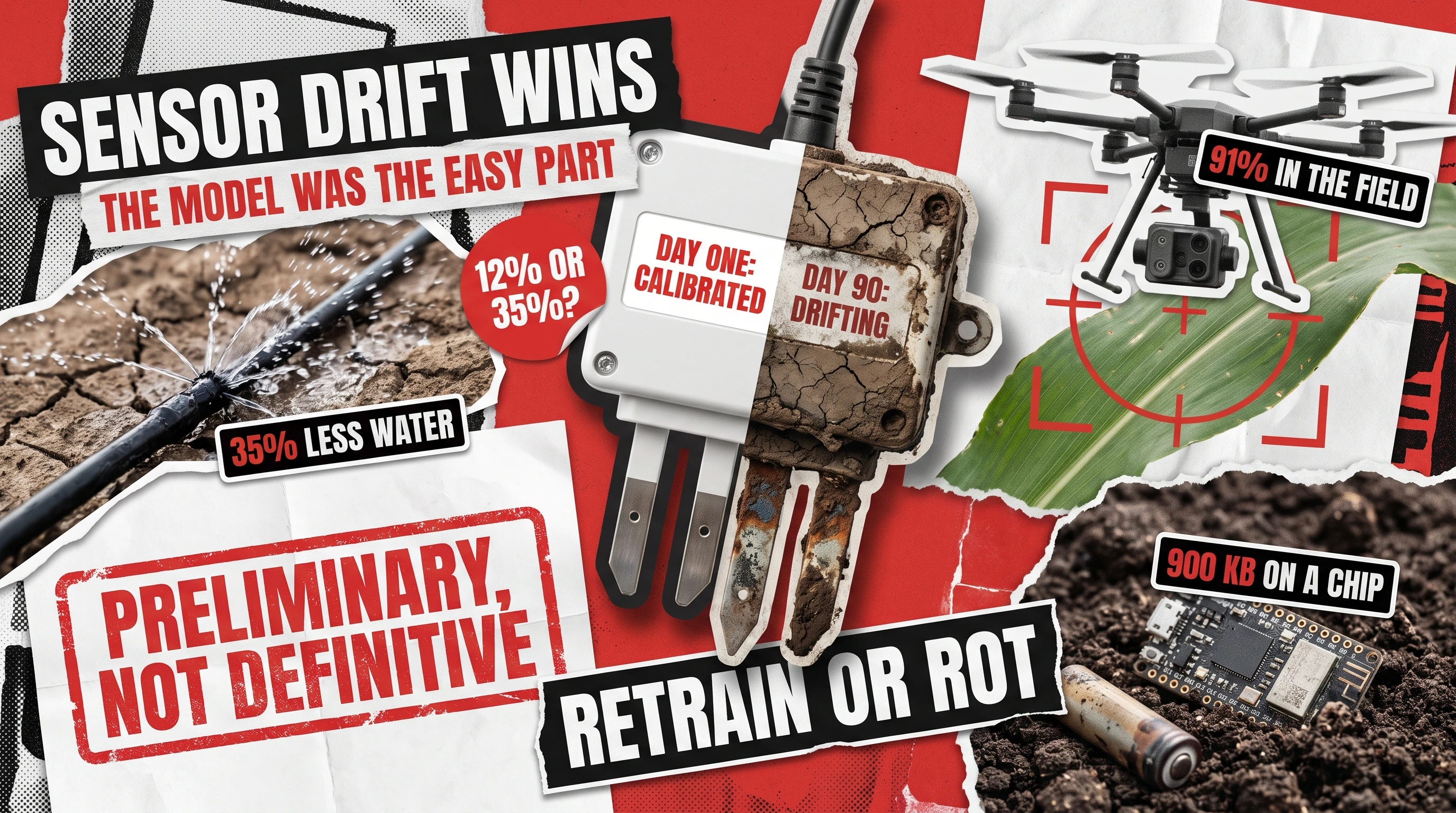
An agri-tech product owner evaluating an AI feature has three numbers to defend: what the model saves, how long the hardware survives in a field, and what happens when connectivity drops during harvest. AI in agriculture is the use of machine learning models trained on sensor, satellite, and imagery data to make per-zone decisions about water, chemicals, and harvest timing, replacing calendar schedules and whole-field averages with predictions tied to the specific block of land in front of you.
Peer-reviewed 2026 field trials, run on irrigation systems in the US Midwest and in Tamil Nadu, India, put the measurable range at roughly 12 to 35 percent less irrigation water and 3 to 4 percent higher yield, depending almost entirely on the baseline. Those are engineering outcomes, earned in the data plumbing far more than in the model. This guide covers where the returns are documented, how these systems fail, and what an artificial intelligence development services engagement has to build.
Precision Irrigation and Resource Management
Irrigation is where precision agriculture AI has the most defensible payback, because the optimized input already has a meter on it. Water moves through a valve for a measurable number of minutes, so a recommendation can be audited against a utility bill instead of a dashboard. That makes it the easiest agri-tech AI case to fund.
How AI Decides When and How Much to Water
The model is a scheduler, not an oracle. It reads soil moisture at several depths, local weather, and a vegetation index, then predicts whether the root zone falls below a crop-specific threshold before the next usable rain.
A 2026 study in Frontiers in Sustainable Food Systems built this as a two-stage XGBoost classifier over three capacitive soil probes, a temperature and humidity sensor, and a rain gauge sampling every 15 minutes. SHAP analysis showed soil moisture and its six-hour rolling mean dominated the decision, matching standard FAO-56 principles. A scheduler an agronomist cannot defend rarely survives a season.
Documented Outcomes: What 2026 Field Trials Report
Two 2026 trials measured the same intervention against very different baselines. The gap between their results is more instructive than either number alone.
AI-STGNN irrigation model
Corn and soybean, US Midwest (Nebraska, Iowa, Kansas)
12.3% to 15.7%
+3.5% to 4.2%
IoT and explainable AI irrigation
Paddy and vegetables, Tamil Nadu, India
35.1%
+4.2%
A 30 percent reduction is real, and it sits at the top of that range against the weakest available baseline. On an already-instrumented Midwest operation the same class of model returned roughly 13 percent, and those authors call their gains “preliminary rather than definitive.” A business case built on one headline percentage hides its baseline.
The ML Stack Behind Precision Irrigation
Nothing here is exotic, which is good news for anyone budgeting it. The Midwest trial used a dynamic spatiotemporal graph neural network across soil moisture at three depths, weather station data, and MODIS vegetation indices captured every 16 days, interpolated to daily values and resampled from 250 metres to 50 metres.
The interesting engineering sits in that resampling, not the model family. Its authors flag that upsampling introduces mixed-pixel effects, and that interpolated daily values approximate crop development rather than observe it. Those caveats land in the confidence interval a customer sees.
Crop Monitoring with Computer Vision
Imagery-based monitoring is the most visible group of AI agriculture use cases, and where lab accuracy diverges hardest from field accuracy. A model scoring 99 percent on a curated leaf dataset often collapses on canopy imagery shot at midday, and understanding why is most of the work.
Disease and Pest Detection from Drone Imagery
A 2026 Scientific Reports trial flew a five-band multispectral camera at 30 metres over a 0.8 hectare maize farm in Limpopo, South Africa, yielding 2 centimetre ground resolution and 725 labelled samples. Three classifiers on NDVI, GNDVI, and NDRE inputs clustered tightly rather than separating cleanly:
- Healthy versus diseased versus background: SVM 91.73% (kappa 0.89), XGBoost 91.53%, Random Forest 91.28%
- Identifying the specific disease: SVM 89.41% (kappa 0.87), Random Forest 88.96%, XGBoost 88.06%
Two findings matter more than the accuracy figures. Phosphorus deficiency was hardest to separate, so some stressors are invisible in multispectral bands. The trial’s own authors also stress this was one field on one date, and the same generalization gap appears across computer vision applications in manufacturing and retail.
Weed Identification and Spot-Spraying
Spot-spraying runs a similar pipeline under a far tighter latency budget. Inference has to finish between the camera seeing a plant and the nozzle passing over it, tens of milliseconds at working speed, so the model runs on the implement.
The economics also invert. A missed weed costs one weed, while a crop plant sprayed as a weed costs chemical plus a damaged plant, so cost asymmetry sets the threshold rather than whatever maximizes F1. Tune this like a benchmark and the result is statistically excellent and agronomically unusable.
Fruit Ripeness and Harvest-Timing Models
Ripeness is a regression problem, and the constraint is ground truth rather than architecture. Every label needs a human to pick the fruit, measure sugar content or firmness, and record it against the matching image.
That arithmetic decides feasibility. A model spanning a whole harvest window needs repeat flights across weeks with destructive sampling at each one, so budget field labour before GPU time.
Yield Forecasting and Livestock Monitoring
These look like unrelated products, and they usually sell to different buyers inside the same customer. Underneath they are the same system with different sensors attached, and recognizing that early changes how a roadmap gets sequenced.
Yield Forecasting for Insurance, Trading, and Logistics
The buyer here is frequently not the farm. Crop insurers, commodity traders, grain elevators, and processors booking capacity all need a defensible tonnage estimate weeks before harvest, and they pay for a narrower confidence interval over a better point estimate.
The inputs are the same satellite series, weather history, and soil data that drive irrigation models, aggregated to a region instead of down to a valve. The interpolation uncertainty noted above belongs in the forecast rather than smoothed away by it, because a forecast without an interval sells false precision to a customer whose business is pricing risk.
Livestock Health Signals from Wearables and Cameras
Wearables produce a continuous stream of activity, rumination, and location data, while fixed cameras produce gait and posture frames. Both feed anomaly detection rather than classification, because illness is a departure from one animal’s own baseline rather than a herd average.
That definition has hard engineering consequences. Per-animal baselining becomes a data-modelling requirement, the first weeks of a deployment produce no usable alerts by design, and every new animal restarts its own clock. Skip the baselining layer and operators mute the alert stream within a fortnight.
Where the signal is strong, the accuracy backs it up. A 2025 Animal Frontiers review of the field cites lameness classifiers reaching 96.61 percent accuracy from back curvature data, vision based digital dermatitis screening running in real time on a Jetson Xavier NX at 40 frames per second, and ketosis detection pipelines that combine wearable and cloud data hitting 93.2 percent for individual animal identification. Those numbers assume the baselining layer above is already in place for each animal.
Why Both Use Cases Share the Same Core AI Stack
Strip the domain language away and both are irregular multivariate time series with missing values, per-entity baselines, and a metric based on early detection rather than accuracy at the event. They also fail identically: a sensor goes quiet, nobody notices, and the model keeps predicting confidently from stale input.
Build the ingestion, gap-handling, feature-store, and monitoring layers once and most of the second product already exists. That is the argument for one platform with several heads, and it decides whether a second use case takes one quarter or three.
What Building an Agri-Tech AI System Actually Involves
Most of the cost in AI technology in agriculture is not the model. In the 2026 trials the modelling step is almost trivial: the smallholder classifier trained in 2.40 seconds on a standard CPU and inferred in 0.004 milliseconds per sample. Keeping those numbers usable in a field for three seasons is where an AI custom software development budget goes.

Sensor Networks in Low-Connectivity Environments
The hardware itself turns out to be the cheap part of a low-connectivity deployment, since the Tamil Nadu installation ran on an Arduino-class microcontroller costing roughly USD 45 at plot scale and USD 40 to 50 per gateway at field scale, with a 1,000 mAh cell projected to run beyond 60 days on a deep-sleep protocol.
The number to design around is packet delivery. That deployment hit 99.3 percent, 25,743 readings out of 25,920, at 4 to 6 seconds end-to-end latency. The missing 177 are the real specification, because the pipeline needs defined behaviour for gaps, out-of-order arrivals, and duplicates.
Sensor Drift and Model Retraining Cadence
Soil probes drift slowly enough to stay invisible until they have corrupted a season of decisions. Over 90 days the Tamil Nadu probes showed a maximum offset of 2.8 percent volumetric water content, just inside the manufacturer’s 3 percent specification, and higher conductivity soils can exceed 5 percent drift in under 60 days.
Retraining follows the same logic. That model came from one 90-day dry-season deployment at a single site, and its authors state that geographic or seasonal generalization requires retraining on new labelled data. Write both the recalibration interval and the retraining trigger into the contract, because an unmaintained model degrades quietly into a liability.
Edge vs. Cloud: Where Inference Should Run
Latency and connectivity settle this, not cost. The Tamil Nadu model deployed at the edge as a roughly 900 KB quantized ONNX Runtime artifact, while district-scale inference across 10,000 hectares ran in the cloud. A workable split:
- Edge inference when the action is local and time-bound, such as opening a valve, or when connectivity is unreliable
- Cloud inference when the decision aggregates across fields or seasons, or the model is too large to quantize
- Both in most real deployments, with a small edge model handling the action and a cloud model recomputing overnight and pushing new thresholds down
The cloud half suits bursty, event-driven workloads, which is why a serverless architecture guide is worth reading before buying always-on infrastructure for a system that computes hard two hours a day. The edge half carries its own tax in over-the-air updates and fleet management.
Integrating with Farm-Management Systems and Market Feeds
A recommendation that does not appear inside the software an operator already uses gets ignored, however accurate it is. That means integrating farm-management platforms, equipment telematics, weather providers, and commodity price feeds, each with its own auth model, rate limits, and units. Schedules slip here, because unit mismatches and undocumented API behaviour surface only under real data, which is why many teams hire a dedicated development team for the integration layer.
Does AI Fit Your Agri-Tech Product?
Four conditions predict whether an agri-tech AI feature pays for itself. All four concern the data you already hold rather than the ambition of the idea:
- A season of labelled history. Sensor readings alone are not training data. You need outcomes joined to timestamps, which takes a season you cannot compress
- A measurable baseline. Returns swung from 12 to 35 percent purely on what the model replaced, so unquantified current practice leaves nothing to prove
- An action the software can trigger. Value appears when a prediction moves a valve, routes a sprayer, or files a claim, not when it lands in a PDF
- An owner for retraining. Recalibration and seasonal retraining are operating costs, not one-off tasks
What we build repeatedly for agri-tech products is the layer underneath every use case above: image recognition, object detection, and predictive analytics, with the .NET and Azure plumbing that keeps them fed. On one HR platform that meant training a neural network on more than 1.5 million records in Azure Machine Learning Studio, the same pipeline shape as a field-data ingestion-to-inference loop, and if you are weighing building that capability in-house, our hire AI developers guide covers what to screen for. If your product needs that same computer vision and predictive analytics layer built around your own sensor and field data, talk to us about your agri-tech project and we will scope it against the data you already collect.
Where AI in Agriculture Actually Earns Its ROI
The pattern across the 2026 evidence is consistent. Returns are largest where the replaced practice was weakest, most defensible where the optimized input is metered, and most fragile where nobody owns recalibration. Irrigation clears all three bars, which is why it keeps producing publishable numbers while flashier cases produce demos.
The build itself is mostly data engineering wearing a machine learning label: ingestion that tolerates gaps, per-entity baselines, a retraining cadence with an owner, and an integration that lands the recommendation where the operator already works. Get those right and a modest model beats an excellent one on stale input.
Talk to us about your AI project and we will start from the data you already collect rather than from a model choice, and we will tell you honestly what your current data can and cannot support before you commit any budget.
FAQ
How much does it cost to build an AI system for agriculture?
Hardware costs rarely set the budget for an agri-tech AI system, since the 2026 Tamil Nadu deployment priced sensor nodes at roughly USD 45 at plot scale and USD 40 to 50 per gateway at field scale. What actually drives the software budget is the number of field sites, the third-party integrations required, and the retraining cadence, rather than model complexity.
What data do you need before starting an AI agriculture project?
At minimum one full season of observations with outcomes joined to timestamps. Raw volume is easy to reach and rarely the problem: the 2026 irrigation study collected 25,920 sensor readings and kept about 5,000 of them as model-ready rows. Labelled, time-aligned, trustworthy rows are the bottleneck.
Can AI work on farms with poor internet connectivity?
Yes, by running inference on the device instead of in the cloud. The 2026 irrigation model compressed to roughly 900 KB in quantized ONNX form and runs on microcontroller-class hardware, with 60 days or more of projected battery life. The trade is that you now operate a device fleet.
How long does it take to see ROI from an AI agriculture deployment?
Plan on one growing season to validate and a second to trust the result. The 2026 studies measured over 90 days and across two seasons, and both sets of authors caution that single-site results do not generalize without retraining. Recalibration and seasonal retraining are permanent operating costs.
See how Redwerk trained a neural network on 1.5M+ records to power an AI matching platform, later acquired by a US staffing giant