You’ve read the strategy decks. McKinsey, Accenture, BCG. The board has signed off on “doing something with AI.” And now you’re staring at an org chart with twelve functions, trying to figure out which one becomes the proof point that justifies the next twelve months of budget.
The problem with most guidance on this is that it operates one altitude too high. Frameworks tell you to “identify high-impact use cases.” Readiness audits tell you to fix your data governance. Neither tells you, on Monday morning, whether to put agents on tier-1 support or accounts payable first.
This is a working AI transformation checklist. Score each function against five questions, total the result, and you have a defensible answer for your next leadership meeting. The second half of the article turns those scores into a 12-month sequencing plan.
Why Function-Level Scoring Beats Org-Wide Readiness Audits
Most published guidance picks the wrong unit of analysis. McKinsey‘s brief found that while 88% of companies use AI in at least one function, fewer than 25% have scaled agentic AI to production. The bottleneck is rarely strategy. It’s that nobody has decided which function ships first.
What Process-Level Prioritization Misses. A function owns five or six workflows that succeed or fail together. Scoring one workflow in isolation, like “invoice matching” inside accounts payable, gives you a green light to build something the rest of the AP function cannot absorb. The agent ships, the team around it stays unchanged, and the workflow flips back to manual within a quarter.
What Org-Wide Readiness Audits Miss. Audits tell you that your data governance needs work, your talent pipeline is thin, and your change management capability is weak. All true. None of it tells the COO which budget line to defend next quarter. An audit produces a report. A function scorecard produces a decision.
Why the Function Is the Right Unit for a CTO’s Roadmap. Functions have owners, budgets, headcount, and measurable outputs. They map cleanly to a P&L. When Salesforce reduced its customer support headcount by roughly 4,000 in 2025, it did so by function. Workday now ships agents named Payroll Agent and Talent Mobility Agent for the same reason. The unit of replacement is the function, so the unit of scoring should match.

The 5-Question Function Readiness Assessment
Pick a candidate function. Score it yes or no on the five questions below. One point per yes. The scoring rubric at the end converts the total into a build decision.
These five criteria are deliberately strict. In May 2026, Gartner warned that 40% of enterprises will demote or decommission autonomous AI agents by 2027 due to governance gaps discovered only after production incidents. Strict criteria up front prevent the rework that kills Phase 1 budgets.
Is the Output Verifiable?
Can a human or a system confirm whether the agent’s output was correct, within minutes of the work being done?
If the verification loop runs quarterly, in a QA review, or “when something breaks,” the function fails this question. Verifiable output is the difference between catching an agent’s mistake at the point of action and discovering it three months later in a customer complaint.
Is the Data Accessible?
The inputs the agent needs must live in systems with APIs and reasonably clean schemas. If the answer the agent needs is scattered across five tabs, three Slack channels, and one analyst’s head, the answer is no. Exporting to a dashboard does not count. The agent needs the source, not the report.
This is also where most middle-market companies hit a wall. Practical Claude API patterns for business automation show that the build itself is rarely the hard part. The hard part is plumbing the data so the agent has something to act on.
Are the Decisions Rule-Bound?
Day-to-day calls in this function must be expressible as policy, never as judgment. Refund under $50 without approval is rule-bound. Promotion decisions are judgment-bound. Lead qualification by firmographics is rule-bound. Lead qualification by “gut feel for fit” is judgment-bound.
Functions full of judgment calls can still benefit from AI assistance. They are not yet candidates for agent replacement.
Is the Volume High Enough to Justify a Build?
A rough threshold: 500 or more instances per month, or enough collective volume across similar functions that one shared agent platform pays back inside twelve months. Below that, the engineering, governance, and monitoring overhead outweighs the savings.
This is the question executives most often skip. Painful does not mean voluminous. The function that frustrates the CEO every Friday might handle thirty cases a month, in which case there is no business case for replacement.
Is the Escalation Path Clear?
When the agent is not confident, who picks up the work, and how fast? If the answer is “we’ll figure that out later,” the answer is no.
Production agents need a named human owner, a defined confidence threshold, and a service-level commitment for handoffs. Without those three, the agent silently degrades the function it was meant to improve. This is the readiness factor that becomes the foundation of any serious AI transformation strategy, because every other gain depends on it.
How to Score: 5/5, 3–4/5, Below 3
Total the function’s score. The result tells you what to do next.
5 / 5
Build now
Phase 1 candidate, fast-tracked
3 or 4 / 5
Build with caveats
Phase 2 candidate, document the gap
0–2 / 5
Not yet
Revisit in 6 to 12 months
Score every candidate function in your org. The list you end up with becomes the input to Part 2.
Sequencing Your Scored Functions Across 12 Months
A scored list is not yet a plan. The plan comes from sequencing. Think of this as the operating layer of your broader AI transformation strategy, the place where strategy turns into a Gantt chart.
The structure below lays out three AI transformation roadmap phases, each tied to the scores from Part 1. The goal is never to ship everything in twelve months. The goal is to ship one thing in three, then compound.
Phase 1 (0–3 Months): One Function, Shipped to Production
Pick one 5/5 function and resist the temptation to load the cart. A single function shipped to production, with a real escalation lane and a measurable cost or cycle-time improvement, becomes the internal proof point that funds Phase 2. Three half-finished pilots become the case study for why the board should pause the program.
The companies that win Phase 1 share two habits. They publish a baseline metric before the agent ships, and they keep human escalation generous in the first sixty days, then tighten it.
Phase 2 (3–9 Months): Scale and Build the Shared Platform
With one function in production, two things become possible. The remaining 5/5 functions ship faster because the platform exists. And the 3–4/5 functions where the gap is solvable, usually data accessibility, become viable.
This is the phase where a structured agentic AI workforce transformation widens into the broader digital transformation agenda: identity, observability, security, and the operating model around human-agent teams.
Phase 2 is also where reuse starts paying back. The second agent should cost meaningfully less to build than the first. If it does not, the platform exists only on a slide.
Phase 3 (9–12 Months): Re-Score the Deferred Functions
Take the 0–2/5 list from twelve months ago and score it again. Most functions will have moved. The reason has little to do with the functions themselves. Phase 1 and Phase 2 cleaned data, built escalation infrastructure, and established governance as side effects.
A function that scored 1/5 in January often scores 4/5 in December without anyone working on that function directly. Re-scoring on a fixed cadence prevents the deferred list from becoming a graveyard.
What not to Pick for Phase 1
Three patterns to avoid:
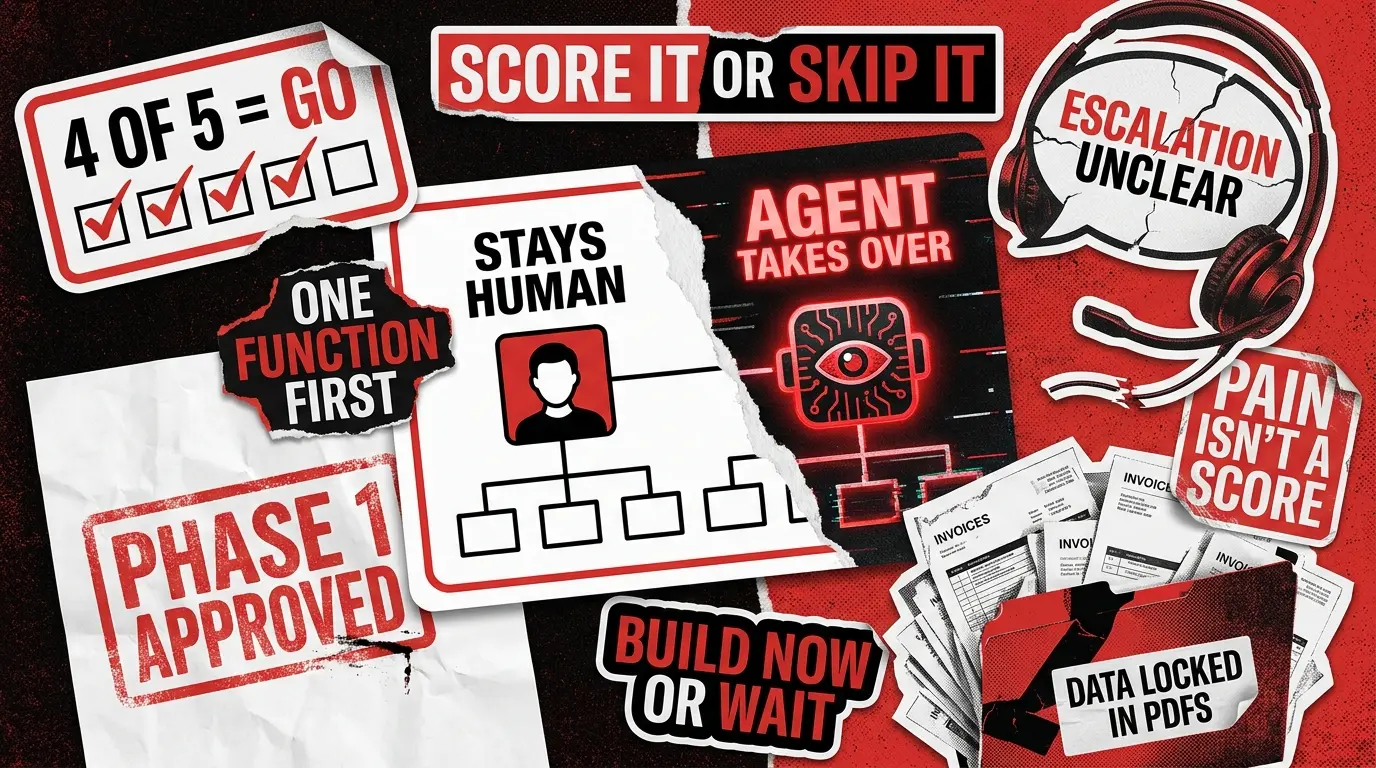
- The function the CEO complains about most. Pain is a feeling, never a score.
- The function the loudest vendor demoed last week. Demos run on staging data.
- The function with the most political weight. Political weight turns Phase 1 into a campaign instead of a build.
Pick the highest score. If two functions tie, pick the one with the higher monthly volume. The math wins.
Common Scoring Mistakes That Burn Phase 1 Budget
The most expensive errors come from generous scoring. Four worth flagging:
Calling outputs verifiable when the QA review is quarterly. Counting data as accessible because it appears in a BI report. Treating tribal knowledge as a rule because one person wrote a Notion doc nobody reads. Skipping the volume question because the function “feels” big.
A useful discipline is to have a second reviewer score the same function independently. Where the two scores differ by more than one point, the function needs more discovery before it enters Phase 1. The same principle that makes custom AI builds work for mid-market companies applies here: rigor up front saves rework later.
From Score to Business Case
A 5/5 function with 500-plus monthly instances is already a board-ready proposal. The score gives you the function, the phase, the success metric, and the named escalation owner. Three of the four hardest questions in any agentic AI budget conversation are answered before you walk into the room.
Run the five questions across your org in a single afternoon. Score five functions in your next leadership meeting and you will leave with a Phase 1 candidate that survives scrutiny. If three or more of your functions clear the 4/5 threshold, the score is the business case. Contact us if you are ready to put it to work.
FAQ
How do I know which team functions to automate with AI?
Score each function against five questions: is the output verifiable, is the data accessible, are decisions rule-bound, is volume high enough to justify a build, and is the escalation path clear. A score of 5/5 means the function is ready for agent replacement now. A score of 3 or 4 means build with caveats. Below 3, revisit in six to twelve months.
What's the difference between an AI transformation strategy and a checklist?
A strategy sets direction and defines outcomes over a multi-year horizon. A checklist is the working instrument that decides what ships next quarter. Strategy answers why. The checklist answers which one, and when.
Which function should we replace first?
The function with the highest readiness score, then the highest monthly volume as a tiebreaker. Replacing the highest-scoring function first builds the platform and the internal proof point that funds everything after it.
See how we helped BengalFox
automate warehousing routines and reduce order processing from 15 to 3 seconds